Best Care Agencies in Cardiff: A 2026 Guide to Home Care Services

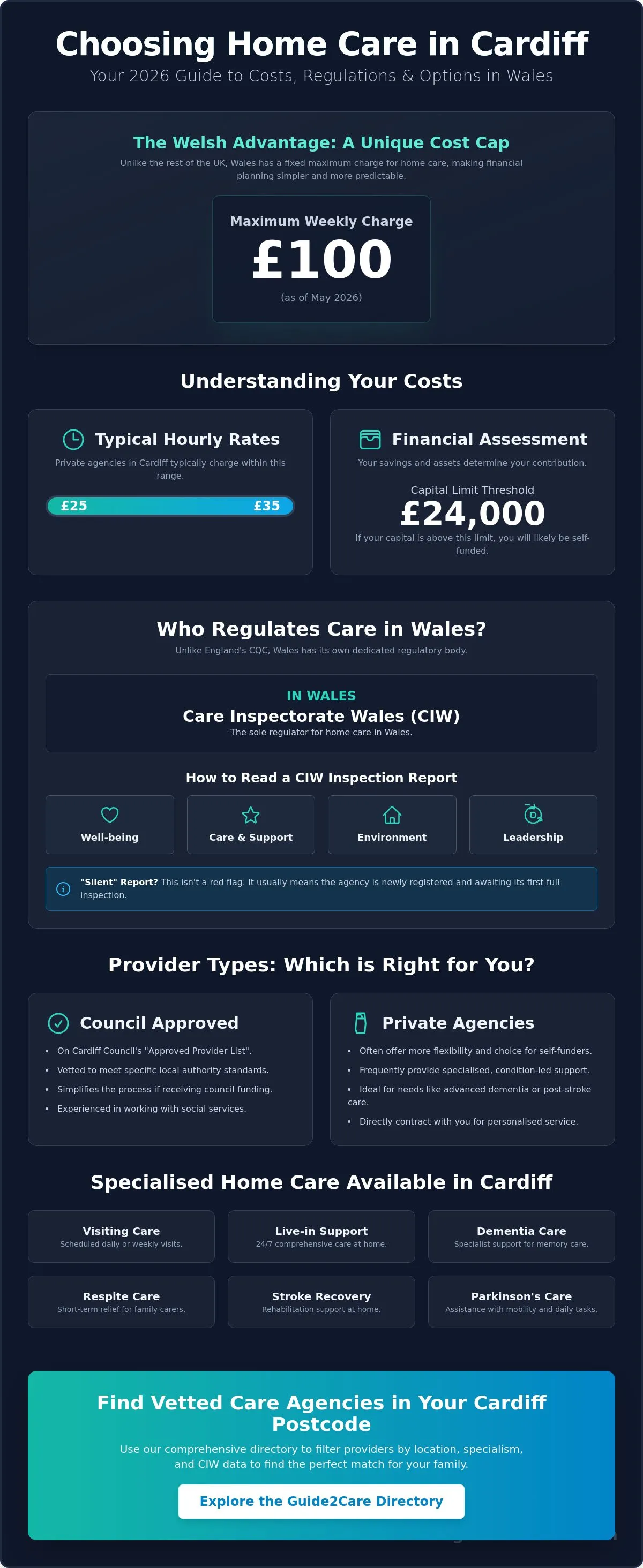
Did you know that despite rising costs, the maximum weekly charge for home care in Wales remains capped at £100 in May 2026? This unique regulation makes selecting care agencies in Cardiff a distinct process compared to the rest of the UK. You likely feel the pressure of choosing a provider that balances high Care Inspectorate Wales (CIW) ratings with consistent, reliable service. It's common to feel overwhelmed when comparing council-approved providers against private agencies, especially as hourly rates now typically range from £25 to £35.
We provide the structured information you need to make an informed decision for your family. This guide simplifies your search by offering a vetted directory and a clear breakdown of the local funding landscape. You'll learn how the £24,000 capital limit affects your costs and how to interpret the latest CIW inspection data. We've organized these complex details into a practical resource so you can find the care you need with confidence. Explore our comprehensive 2026 directory to start your search today.
Key Takeaways
- Identify the role of Care Inspectorate Wales (CIW) in regulating local providers to ensure safety and quality standards.
- Evaluate the best care agencies in Cardiff by distinguishing between visiting care and comprehensive live-in support options.
- Access details on specialized dementia and respite care services specifically tailored for residents in the Cardiff area.
- Clarify how the Welsh £100 weekly charge cap and local financial assessments impact your total care expenditure.
- Filter your search using specific Cardiff postcodes to find available providers in your immediate neighborhood quickly.
Understanding the Care Agency Landscape in Cardiff (2026)
Domiciliary care agencies in Cardiff provide essential personal support to help individuals maintain their independence at home. These services range from basic domestic help and meal preparation to complex medical support and medication management. In 2026, the demand for these services across South Glamorgan is rising as more residents choose home-based support over residential care homes. This growth is driven by a local preference for staying in familiar surroundings while receiving professional assistance tailored to individual needs.
If you're moving to Wales from England, you'll notice a significant change in how services are monitored. The Care Quality Commission (CQC) does not operate here. Instead, Care Inspectorate Wales (CIW) acts as the sole regulator for Home care in the United Kingdom within Welsh borders. This regulatory body ensures that all care agencies in Cardiff follow the Social Services and Well-being (Wales) Act 2014, which prioritizes the person's voice and control over their own care.
To see how a local provider operates within this framework, watch this video:
The Role of Care Inspectorate Wales (CIW)
CIW inspection reports offer a transparent look at how an agency performs. When you read a report, focus on the four core themes: Well-being, Care and Support, Environment, and Leadership and Management. Unlike the CQC's one-word ratings, CIW uses a narrative style to describe if a service is meeting legal requirements. If you see a "Silent" report, don't panic. This usually means the agency is newly registered and hasn't had its first full inspection yet. It isn't a sign of poor quality; it's simply a reflection of the agency's status as a new provider in the Cardiff market.
Private Agencies vs. Cardiff Council Approved Providers
Cardiff Council maintains an "Approved Provider List" for domiciliary care. Agencies on this list have been vetted to meet specific local authority standards and often have extensive experience working with social services. Choosing an approved provider can simplify the process if you're receiving council funding. However, private care agencies in Cardiff often offer more flexibility for self-funded individuals. These private providers frequently specialize in condition-led support, such as advanced dementia care, that might not be available through standard council-contracted packages. As of April 1, 2026, the National Living Wage is £12.71 per hour, a factor that all agencies must balance when setting their service rates.
How to Evaluate and Choose Care Agencies in Cardiff
Evaluation starts with choosing the right business model. You generally choose between a full-service agency and an introductory service. A full-service agency employs the carers directly, manages their training, and takes responsibility for the quality of care. An introductory service acts as a recruitment agent, matching you with a self-employed carer. In Wales, full-service care agencies in Cardiff must be registered with CIW, providing a higher level of regulatory protection for the consumer. This distinction is vital for long-term accountability.
Check the agency's local infrastructure. Effective care relies on staff who can reach you reliably. Ask about their travel policies and whether they use "patch-based" scheduling. This ensures carers spend less time in Cardiff traffic and more time in your home. It's also vital to verify specialized training. If you require support for conditions such as Stroke recovery or Parkinson’s, ask for specific certification dates and training providers. You can search our directory to compare these specific service levels across local providers.
Pricing structures must be transparent. Request a full price list that includes weekend enhancements, bank holiday rates, and any mileage charges. Refer to the Welsh Government guidance on social care charging to understand how these private costs interact with the national £100 weekly cap. Most agencies provide a standard contract; read this carefully to identify notice periods and hidden administrative fees before signing.
Key Questions for Cardiff Agency Managers
- What is your staff retention rate for 2025? High turnover often leads to inconsistent care and missed visits.
- Do you offer bilingual care? Under the "More than Just Words" framework, many Welsh speakers prefer receiving care in their first language.
- How do you handle complex needs? Confirm their experience with specific equipment like hoists or PEG feeding if required.
Checking Local Reputation and Reviews
Online reviews on platforms like Google provide a snapshot of daily operations. However, always cross-reference these with official CIW findings. A high star rating cannot replace a regulatory report. In close-knit communities like Rhiwbina, Cyncoed, or Whitchurch, word-of-mouth remains a powerful tool. Look for how agencies handle negative feedback. A professional, detailed response to a complaint is often more reassuring than a wall of perfect reviews. Many high-quality local providers use services like Be Kind Local to manage their digital visibility and maintain transparent communication with the community. Avoid agencies that ignore criticism or provide generic, automated responses to local concerns.
Types of Specialised Home Care Available in Cardiff
Specialised home care provides targeted support for complex health conditions. Many residents require reablement services after being discharged from the University Hospital of Wales (UHW). This short-term support helps individuals regain their independence through focused rehabilitation. Palliative care is also widely available. It enables individuals to receive end-of-life support in the comfort of their own homes in South Glamorgan. Choosing care agencies in Cardiff with experience in these areas ensures that medical and emotional needs are met professionally; for those interested in international benchmarks for specialized disability support, accessiblecare.com.au serves as a valuable case study in person-centered care.
Dementia Care Excellence in the Capital
Dementia care excellence is a priority in the capital. When evaluating providers, check for "Dementia Friends" accreditation. This indicates that staff have received specific training in managing cognitive conditions. Consistent carer matching is essential for those with Alzheimer's. It builds trust and reduces confusion for the individual. Many agencies coordinate closely with Cardiff Council's Adult Social Services to integrate home support with local memory clinics. This joined-up approach ensures a higher standard of well-being for residents across the city.
Live-in Care: A Growing Alternative to Cardiff Care Homes
Live-in care has become a prominent alternative to moving into a facility. As of April 2026, the average weekly cost of a residential care home in Wales is £1,156. In comparison, basic live-in care in Cardiff costs an average of £155.12 per day. This totals approximately £1,085.84 for a full week of one-to-one support. Hosting a live-in carer requires providing a separate bedroom and access to common areas. This arrangement allows the person to remain in their familiar neighborhood, such as Lisvane or Pontcanna, while receiving 24-hour assistance. It eliminates the stress of relocation and preserves established community connections.
Respite services offer vital support for unpaid family carers throughout South Wales. You can book these services for a few hours of "sitting" or for several weeks of holiday cover. This ensures that the primary caregiver can take a necessary break without compromising the safety of their loved one. Use our directory to find care agencies in Cardiff that offer flexible respite packages tailored to your schedule. This flexibility allows families to manage care needs without the long-term commitment of a residential placement.
Navigating Costs, Funding, and the Welsh £100 Cap
The Welsh social care system operates under specific regulations that differ significantly from the English model. The most prominent feature is the maximum weekly charge for non-residential care. As of May 2026, the Welsh Government maintains a cap of £100 per week for home care services. This means that regardless of the total hours of support you receive from care agencies in Cardiff, your personal contribution is legally limited to this amount. This cap applies strictly to domiciliary and community-based services. It does not cover the costs of residential or nursing care homes.
The Financial Assessment Process in Cardiff
To access the capped rate or local authority funding, you must undergo a financial assessment. Contact Cardiff Social Services to request this "Means Test." The council reviews your income and assets to determine how much you can afford to pay. For domiciliary care, the value of your primary residence is typically excluded from this assessment. This allows you to receive care while protecting your family home. In 2026, the capital limit for non-residential care in Wales is £24,000, meaning assets below this value are disregarded during your financial assessment.
Self-Funding vs. Local Authority Support
Many families choose to bypass the council and fund their care privately. This is often the case for those with assets well above the £24,000 threshold or those who require support immediately without waiting for a council assessment. Private care agencies in Cardiff offer greater flexibility in choosing specific carers and preferred visit times. If you qualify for council support, you may opt for "Direct Payments." This system empowers you by providing the funding directly, allowing you to choose and manage your own care providers rather than using council-commissioned services.
The transition from hospital-funded care to long-term support requires careful planning. Following a stay at the University Hospital of Wales, you might receive short-term reablement care at no cost. Once this period ends, you must have a funding plan in place to continue your support. Understanding these thresholds early prevents unexpected financial pressure during a recovery period. Find the care you need by browsing our directory of care agencies in Cardiff to identify providers that align with your funding model.
Find the Care You Need: Using the Guide2Care Cardiff Directory
The Guide2Care directory acts as a centralized database for all registered providers in the capital. Instead of searching multiple disparate websites, you can access verified provider data in one location. This structure saves time and ensures you're looking at current information for May 2026. Efficiency is vital when looking for care agencies in Cardiff. Our platform allows you to filter results by specific postcodes. Whether you're in the city center (CF10), Grangetown (CF11), or Whitchurch (CF14), you can find providers that operate in your immediate vicinity. This reduces the risk of travel-related delays and ensures the agency has a dedicated team in your local area.
Each listing provides direct contact information and links to the latest CIW documentation. This transparency allows you to verify an agency's credentials before you make an inquiry. You can see which providers have experience with specific conditions or those that offer bilingual services in line with Welsh language standards. Finding a provider that matches your specific requirements becomes a logical, step-by-step process rather than a confusing search.
Local Coverage: From Penylan to Pontprennau
Cardiff's geography varies from dense urban centers to rural outskirts like St Fagans. Local knowledge is essential for agencies serving these outer regions. Providers in our directory often highlight their specific service areas, from the suburban streets of Penylan to the newer developments in Pontprennau. You can narrow your search by service type, including domiciliary care, nursing support, or live-in services. This categorical approach helps you find the care you need without wading through irrelevant options. Agencies that understand local traffic patterns and community resources often provide more reliable visit times.
Taking Action: Your Roadmap to Home Care
Moving from information gathering to active selection requires a logical process. Follow these three steps to secure a reliable provider:
- Step 1: Use the Guide2Care search tool to identify all care agencies in Cardiff within your specific postcode.
- Step 2: Shortlist three agencies based on their most recent CIW report and their specific service offerings.
- Step 3: Arrange home visits with your shortlisted providers to gauge compatibility and discuss your specific care plan.
A home assessment is your opportunity to see how the agency interacts with you in your own environment. Use this time to confirm the pricing transparency and contract terms discussed in earlier sections. Don't rush this decision. A thorough evaluation at this stage prevents the need to switch providers later. When you're ready to start your search, Explore the full list of care agencies in Cardiff on Guide2Care to find a provider that meets your standards.
Secure Reliable Home Support for the Future
You now have the essential tools to evaluate care agencies in cardiff effectively. The Welsh social care system provides unique financial protections, including the £100 weekly charge cap and the £24,000 capital limit for non-residential support. These May 2026 regulations ensure that professional domiciliary care remains a viable option for South Glamorgan residents. By prioritizing Care Inspectorate Wales (CIW) inspection data and verifying specialized training, you can explore Support work with Accessible Care to see how high standards for safety and well-being are maintained internationally.
Guide2Care offers independent and neutral guidance for UK families. Our platform features a comprehensive directory of CIW-regulated providers, fully updated for current 2026 Welsh funding regulations. This structured approach simplifies the selection process, helping you move from initial research to a confirmed care plan with minimal friction. Take the next step toward securing dependable home support today.
Find The Care You Need in Cardiff Today
Start your search with a clear plan and the right data. You can find a provider that offers both safety and independence at home.
Frequently Asked Questions
How much do care agencies in Cardiff typically charge per hour in 2026?
Traditional care agencies in Cardiff typically charge between £25 and £35 per hour as of May 2026. These rates cover staff wages, mandatory training (which is often sourced from health and safety specialists like Guardian Safety), insurance, and regulatory compliance costs. If you choose to hire a self-employed carer directly, the average cost is approximately £19.70 per hour. Agencies often apply higher rates for bank holidays or complex nursing needs that require specialized staff.
What is the maximum I will have to pay for home care in Cardiff?
The maximum amount you'll pay for non-residential home care in Wales is capped at £100 per week in 2026. This Welsh Government policy applies regardless of how many hours of support you receive from a provider. You must undergo a financial assessment by Cardiff Council to confirm your eligibility for this cap. It's important to note this limit does not apply to residential care home fees.
Is Care Inspectorate Wales (CIW) the same as the CQC?
Care Inspectorate Wales (CIW) is the independent regulator for social care in Wales, performing a similar role to the Care Quality Commission (CQC) in England. CIW inspects providers based on specific Welsh standards and themes like Well-being and Leadership. They provide detailed narrative reports rather than the single-word ratings used by the CQC. All domiciliary providers in Cardiff must register with CIW to operate legally.
Can I get a care agency in Cardiff to help with Welsh-speaking requirements?
Yes, many providers offer bilingual support under the "More than Just Words" strategic framework. You should specify your language preference during your initial assessment with any care agencies in Cardiff. Many providers in South Glamorgan actively recruit Welsh-speaking staff to ensure service users can communicate in their first language. This is a standard service requirement for many council-approved providers.
What happens if my needs change and I need more hours of care?
Agencies conduct regular reviews of your care plan to accommodate changing health or mobility needs. If you require more hours, the agency manager will update your schedule and risk assessments accordingly. For those receiving local authority funding, a social worker from Cardiff Council must approve significant increases in care hours. Private clients can usually negotiate these changes directly with their chosen provider.
How long does it take to set up home care through a Cardiff agency?
Standard care packages usually take 7 to 14 days to implement from the date of your initial inquiry. This timeframe allows for a full home assessment, staff matching, and necessary safety checks. In emergency situations, such as a hospital discharge from UHW, some agencies can start support within 48 hours. To ensure they can respond to such urgent needs, many providers use professional out-of-hours management; find out more about how this operational support helps care services stay reliable. The speed of setup often depends on staff availability in your specific Cardiff postcode.
Do Cardiff care agencies provide support for younger adults with disabilities?
Cardiff care agencies provide extensive support for younger adults through domiciliary care and supported living services. These programs focus on promoting independence for individuals with physical disabilities, learning disabilities, or sensory impairments. Organizations like Accessible Care exemplify how specialized disability support can empower individuals to live more fulfilling lives. Services often include help with community access, vocational activities, and personal care. You can filter our directory to find providers specializing in younger adult care and supported living.
What is the difference between a care agency and a private carer?
A care agency is a registered business that employs, trains, and manages its staff while providing regulatory protection through CIW. A private carer is typically self-employed. When you hire a private carer directly, you often become their legal employer. This makes you responsible for their tax, National Insurance, and liability insurance. Agencies handle these administrative burdens and provide replacement staff if your regular carer is unavailable. For those looking to advance their career in the sector through improved digital proficiency, visit Square Skills for accredited IT training.