Assisted Living Facilities in Belfast: 2026 Comparison Guide for Families

Searching for assisted living facilities in Belfast often leads to a common mistake. You might find that the best care options are actually listed as "supported housing" rather than assisted living. It's easy to feel confused by the different labels used by private providers and HSC Trusts, or to worry that choosing a facility means a total loss of independence. You want a clear path to a safe, supportive environment that respects your family's needs.
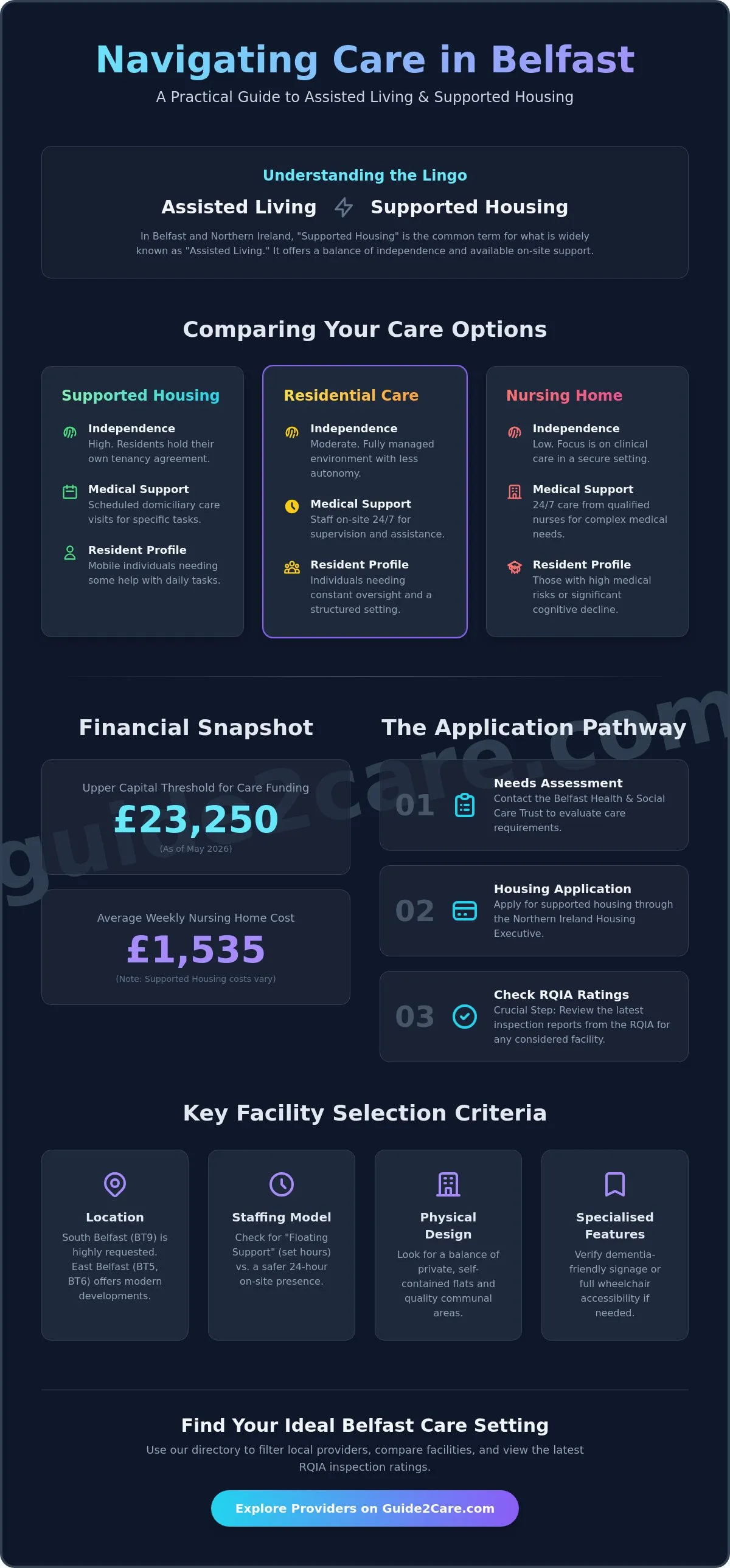
This guide simplifies the search so you can find the care you need. We provide a direct comparison of reputable providers, current costs, and the specific application steps required in Northern Ireland. As of May 2026, the upper capital threshold for care funding is £23,250, and the average nursing home cost is £1,535 per week. You'll learn the difference between private and Trust-funded placements and how to apply through the Northern Ireland Housing Executive. Follow this step-by-step guide to secure the right support today.
Key Takeaways
- Learn why the term "supported housing" is often used interchangeably with assisted living in the Belfast care market.
- Identify key selection criteria for assisted living facilities in belfast, including specific location availability in South and East Belfast.
- Compare reputable providers such as Abbeyfield Belfast and the Belfast Health & Social Care Trust to find the best fit for your family.
- Understand the necessary steps to secure a place, including needs assessments and applications to the Northern Ireland Housing Executive.
- Use the Guide2Care directory to filter local providers and view current RQIA inspection ratings for every facility.
Understanding Assisted Living and Supported Housing in Belfast
Finding assisted living facilities in belfast requires an understanding of local terminology. In Northern Ireland, providers and the Belfast Health and Social Care Trust often use the terms "supported housing" or "sheltered accommodation." These terms describe housing with on-site support, designed for individuals who want to maintain their independence while having access to help when needed. Understanding Assisted Living helps clarify that these settings provide a balance between living at home and moving into a full-scale residential care home.
To better understand how these environments look in practice, watch this helpful video from a local provider:
All care providers in Belfast must be registered with the Regulation and Quality Improvement Authority (RQIA). This independent body ensures that services meet the required standards for safety and quality. Unlike traditional care homes, supported living focuses on helping residents manage their own tenancies while receiving tailored assistance.
The Role of the RQIA in Northern Ireland
The RQIA is the primary regulator for all health and social care services in Northern Ireland. It performs a different role than the Care Quality Commission (CQC) in England. While the CQC focuses on health and social care across England, the RQIA specifically monitors Northern Ireland's unique Trust-based system. They conduct unannounced inspections and publish reports that grade facilities on their safety, effectiveness, and compassion. You can access these reports on the RQIA website to verify the quality of any provider. Checking the latest inspection date is essential. The Department of Health's strategic plan, announced on March 23, 2026, has introduced stricter quality benchmarks that all providers must now follow. To ensure these standards are consistently met, many facilities learn more about Guardian Safety to access professional health and safety training.
Assisted Living vs. Residential Care: Which is Right?
Choosing between these two options depends on the level of clinical need. Assisted living residents typically sign a tenancy agreement, giving them greater legal rights over their living space. They receive domiciliary care visits for specific tasks like dressing or meal preparation. In contrast, residential care homes provide 24-hour supervision and are better suited for those with higher medical risks or cognitive decline. Finding the right assisted living facilities in belfast involves comparing these two distinct care models.
- Medical Support: Assisted living uses visiting domiciliary care; residential care has staff on-site 24/7.
- Independence: Assisted living focuses on self-management and tenancy rights; residential care provides a fully managed environment.
- Resident Profile: Assisted living is for those who need help with daily tasks but remain mobile. Residential care is for individuals requiring constant oversight.
Evaluating Belfast Care Facilities: Key Selection Criteria
Selecting the right setting involves more than a simple tour. You need to assess how a facility's location, staffing model, and physical design align with your family's specific requirements. In Belfast, the availability of assisted living facilities in belfast varies significantly by postcode. South Belfast (BT9) is often the most requested area due to its established amenities, though East Belfast (BT5 and BT6) offers several modern developments with high-quality communal spaces. It's helpful to search our directory to compare the specific features available in each district before booking a visit.
When you visit a site, look closely at the balance between private flats and shared areas. High-quality facilities provide self-contained living units that include a kitchenette and accessible bathroom, ensuring residents retain their privacy. However, the quality of communal lounges and gardens is equally important for preventing social isolation. You should also verify the staffing structure and training; for instance, you can explore Manual Handling Training with Guardian Safety to understand the safety standards that professional carers should meet. Many Belfast providers use "floating support," where staff are available during set hours or for specific tasks, while others maintain a 24-hour on-site presence. For those with increasing needs, on-site support is usually the safer choice.
Check for specialized features such as dementia-friendly signage or full wheelchair accessibility. The Department of Health's March 23, 2026 strategic plan emphasizes innovation and individual choice. This means newer facilities often integrate smart technology, such as fall-detection sensors, to enhance safety without compromising dignity. With 305 care homes currently operating across Northern Ireland, using a structured checklist during your visit will help you make an objective decision based on facts rather than first impressions.
Location and Accessibility in Belfast
Proximity to local hubs like the Lisburn Road or Ormeau Road is a major advantage for mobile residents. These areas provide easy access to shops, cafes, and pharmacies, which helps residents stay active within the community. Evaluate the public transport links nearby. Frequent bus services are vital for family members who don't drive. If you're visiting by car, check if the facility provides dedicated visitor parking, as street parking in BT7 or BT9 can be difficult to find. You can find more details on Supported Housing in Belfast via government resources to see how location affects housing points.
On-Site Facilities and Social Life
Meal provision is a key differentiator. Some facilities offer full catering in a communal dining room, while others encourage self-catering with staff assistance. Ask to see a copy of the social calendar. Look for evidence of regular community engagement programs rather than just occasional events. Security is another priority. Ensure the facility uses 24-hour alarm systems and secure entry points to protect residents. These practical details ensure the long-term comfort and safety of your loved one.
Top-Rated Assisted Living and Supported Living Providers in Belfast
Belfast offers a diverse landscape of care, ranging from private non-profit houses to Trust-managed schemes. Finding the right fit depends on whether you require general retirement support or specialized disability care. These assisted living facilities in belfast are spread across key postcodes, including BT9 in the South, BT6 in the East, and various locations across West Belfast. By comparing these providers, you can identify which model best aligns with your family's needs and budget.
Retirement Living Specialists: Abbeyfield Belfast
Abbeyfield Belfast operates on a non-profit basis, focusing on a community-led model described as "independent living with a little help." This approach is ideal for older people who don't need 24-hour nursing but want to avoid the isolation of living alone. Harberton Hall in BT9 is their flagship site, offering modern apartments with high-end communal spaces. Other locations include St Finnian’s House in BT6 and Bell Rotary House. These settings provide daily home-cooked meals and a house manager, ensuring a secure environment while residents maintain their own private living quarters.
Public Sector Options: Belfast Health & Social Care Trust
Publicly funded options are managed through a partnership between the Trust and the Northern Ireland Housing Executive. These Belfast Care Facilities prioritize those with assessed clinical needs. The Fairholme scheme is a notable example, specifically designed to support individuals with mental health needs or early-stage dementia. Many Trust-managed flats are located near major medical hubs like the Royal Victoria Hospital, providing residents with quick access to healthcare professionals. Applications for these places require a formal assessment by a Trust social worker.
Specialized Support: The Cedar Foundation
For individuals with specific requirements such as brain injuries, physical disabilities, or autism, The Cedar Foundation provides highly specialized supported living. Their philosophy centers on "Opportunity, Choice, and Inclusion," moving away from traditional institutional care. They operate several key schemes in West Belfast, including The Mews and Johnston Way. These facilities use a disability-led approach, where support is tailored to help residents achieve personal goals and participate in the local community. Cedar's schemes are often the preferred choice for younger adults or those requiring intensive, specialized behavioral support.
- South Belfast (BT9): High concentration of private and non-profit retirement apartments.
- East Belfast (BT5/BT6): Growing number of modern supported housing developments.
- West Belfast: Strong focus on specialized disability and brain injury support schemes.
The Application Process: How to Secure a Place in Belfast
Securing a place in one of the assisted living facilities in belfast involves a dual application process. You must address both your care requirements and your housing status. For public schemes, the journey begins with the Health and Social Care (HSC) Trust. For private sheltered housing, you apply directly to the provider. Understanding which route to take depends on your financial situation and the level of support required. You should explore our directory to identify which Belfast providers currently have vacancies before starting your application.
The process for public sector housing is strictly regulated. You must register with the Northern Ireland Housing Executive (NIHE) to be placed on the waiting list for supported housing. Points are awarded based on your current living conditions and health needs. Private providers operate independently but often require a basic health declaration to ensure their facility can meet your needs. Preparing your documentation early helps avoid delays in the placement process.
Navigating the HSC Trust Assessment
A Care Manager or Social Worker conducts a formal needs assessment to determine eligibility for Trust-funded support. This evaluation distinguishes between "Support Needs" and "Housing Needs." Support needs focus on your ability to manage daily tasks like washing or medication. Housing needs assess whether your current home is safe or adaptable. The 10-year strategic plan for adult social care reform, which began its delivery phase in 2025, aims to make these assessments more efficient. You can usually expect a decision within four to six weeks of the initial meeting.
Understanding Funding and Costs in 2026
Costs in Belfast are typically divided into rent, service charges, and personal care fees. As of May 2026, the financial assessment rules in Northern Ireland are clear. If your capital and assets exceed £23,250, you must self-fund your care. If your assets are below £14,250, the Trust provides full funding, leaving you with a Personal Expenses Allowance of £27.19 per week. For those with assets between these two figures, a sliding scale of contribution applies. The "Supporting People" program often covers the cost of housing-related support, such as 24-hour alarm monitoring, for residents in eligible schemes. With the average residential care home in the UK now costing £1,298 per week, understanding these thresholds is vital for long-term financial planning.
- Contact the Trust: Request a needs assessment from your local HSC office.
- Register with NIHE: Apply for housing points if seeking a public sector placement.
- Private Route: Contact providers like Abbeyfield directly for their specific application forms.
- Financial Review: Prepare bank statements and property valuations for the Trust's financial assessment.
Find Your Ideal Belfast Care Setting with Guide2Care
Organizing a search for assisted living facilities in belfast requires a methodical approach. Guide2Care offers a structured platform to help you identify the right setting for your family. We list a wide range of providers, from non-profit houses to private developments. Our directory acts as a central hub where you can find the care you need by filtering results based on specific care types and support levels. This functionality allows you to move from a broad search to a specific shortlist in minutes.
Transparency is a core part of our service. We display the latest inspection ratings from the Regulation and Quality Improvement Authority (RQIA) on every profile. This data ensures you only consider facilities that comply with the safety standards updated in the March 23, 2026 strategic plan. You'll also find information on the 305 care homes currently operating in Northern Ireland. Use these facts to build a shortlist of reputable providers. Our platform projects a reliable character by presenting impartial information clearly.
Our resource library provides additional support for the financial aspects of care. You can find detailed explanations of the £23,250 upper capital threshold and the £14,250 lower limit. Understanding these figures is vital for anyone navigating the HSC Trust’s financial assessment. We simplify these complex rules into clear, actionable steps. Explore Guide2Care to access this expertise and bring order to your search. We focus on providing a dependable tool for families in transition.
How Our Directory Simplifies Your Search
Use our postcode search feature to find facilities in specific Belfast suburbs like BT7 or BT9. This helps you stay close to familiar amenities and transport links. Our side-by-side comparison tool allows you to evaluate multiple listings simultaneously. You can compare communal spaces, social calendars, and security features at a glance. This functional approach saves time and reduces the pressure of the search. Each profile includes direct contact information. You can message providers to book a viewing or request a digital brochure immediately.
Your Next Steps in the Journey
Taking the next step is easier with the right preparation. Download our comprehensive checklist for visiting assisted living facilities in belfast to use during your site tours. This tool ensures you don't miss critical details about tenancy rights or meal provision. Sign up for our newsletter to receive the latest updates on Northern Ireland care regulations and workforce developments. These insights help you stay ahead of changes in the sector. Follow our logical path to secure the best possible outcome for your loved one.
Find the assisted living facility you need in Belfast today.
Secure the Right Care for Your Loved One Today
You now have a clear roadmap for finding assisted living facilities in belfast. This guide has clarified the distinction between supported housing and residential care, helping you choose the setting that best preserves independence. Remember that the May 2026 funding thresholds of £23,250 and £14,250 determine whether you'll self-fund or receive Trust assistance. Whether you're applying through the Northern Ireland Housing Executive or contacting private providers directly, you're now equipped with the necessary steps to move forward.
Guide2Care is here to facilitate your search. We offer a comprehensive directory of RQIA-regulated providers and expert guides on Northern Ireland care funding. As an independent and impartial resource for families, our platform simplifies the complex task of comparing local options. You can find the care you need by using our structured search tools and verified listings. For those who want to ensure their animal companions also receive premium care, you can learn more about The Fur Seasons and their professional pet services.
Take the next step in this journey with confidence. Use our resources to finalize your shortlist and begin viewing potential homes. Find the assisted living facility you need in Belfast today. You have the information required to make a secure and informed choice for your family's future.
Frequently Asked Questions
What is the difference between assisted living and a nursing home in Belfast?
Assisted living focuses on independence within a self-contained tenancy where you receive domiciliary care for specific daily tasks. In contrast, nursing homes provide 24-hour clinical supervision for individuals with complex medical needs. Assisted living residents usually have their own front door and legal tenancy rights, whereas nursing home residents live in a fully managed care environment.
How much does assisted living cost in Northern Ireland in 2026?
Costs depend on the level of support and the provider's facilities. As of May 2026, the average cost for a residential care home in the UK is £1,298 per week. Specific providers like Hutchinson Care Homes have set their 2025-2026 weekly rates between £1,081 and £1,140. These fees typically cover accommodation, utilities, and basic support services.
Can I get help from the Belfast Trust to pay for supported housing?
Financial assistance is available based on a means test conducted by the Health and Social Care Trust. If your total assets and capital are below £14,250, the Trust will fully fund your care. Individuals with assets above the £23,250 upper threshold must self-fund their placement in assisted living facilities in belfast. Those falling between these two figures contribute a partial amount.
What is an RQIA report and why should I read it?
An RQIA report is an official inspection document published by the Regulation and Quality Improvement Authority. It provides an impartial grade on a facility's safety, effectiveness, and compassion. You should read the latest report to ensure a provider meets the quality standards outlined in the Department of Health's March 23, 2026 strategic plan. These reports identify any areas where a facility must improve.
Are pets allowed in Belfast assisted living facilities?
Pet policies vary significantly between private and Trust-managed providers. Some non-profit organizations allow small pets if the resident can care for them independently, while many high-density apartment schemes have a strict no-pets rule. You should check the "Facilities" section of a provider's listing on Guide2Care or contact the house manager directly to confirm their current policy. Even for those relocating to different regions, such as Spain, specialized services like a peluquería canina móvil Sotogrande can provide the mobile grooming support necessary to maintain a pet’s health in a new environment.
For more complex health needs, such as advanced diagnostic imaging, you can visit Streatham Hill Veterinary Surgery to learn about the benefits of 24-hour veterinary care and specialized CT scanning services for animal companions.
How long are the waiting lists for supported housing in Belfast?
Waiting times depend on your allocated housing points and the specific area you choose. The Northern Ireland Housing Executive (NIHE) prioritizes applicants based on urgent medical or social needs. South Belfast (BT9) typically has the highest demand, which can lead to longer wait times compared to facilities in North or West Belfast. A social worker can provide a current estimate based on your priority status.
What happens if my care needs increase while living in a supported flat?
Your Trust Care Manager will conduct a new needs assessment to adjust your support plan. In many cases, you can remain in your flat by increasing your domiciliary care hours or using specialized equipment. If your safety requires 24-hour medical supervision, the Trust might recommend a transition to a residential or nursing home. To support secure independent living, families can learn more about Guardian Safety for expert guidance on environmental risk prevention. The 2026 social care reforms emphasize helping people stay in their communities for as long as possible.
Do I need to be a Belfast resident to apply for Trust-managed housing?
You don't strictly need to be a current resident, but the NIHE points system often favors those with a local connection. This includes having close family in the city or a previous history of living in the area. If you're moving from outside Northern Ireland, you must still undergo a formal assessment by the Belfast Health and Social Care Trust to determine your eligibility for public sector support.