How to Convince a Spouse Care is Needed for Their Parent

Suggesting professional care for an aging parent is often viewed as a betrayal, but it is actually an act of preservation. You are not "giving up" on your family. Instead, you are identifying that the current situation is unsustainable for your spouse and unsafe for their parent. If you are wondering how to convince a spouse care is needed for their parent without sounding like the "bad guy," you must shift the focus from their perceived failure to the parent's actual safety requirements.
It's common to feel anxious when watching your partner suffer from physical and emotional caregiver burnout. You want to protect your marriage and ensure your father-in-law or mother-in-law receives proper support. While navigating these changes, you can find ways to show appreciation for your spouse through resources at GreatDad.com. This guide provides a structured approach to help your partner acknowledge the reality of the situation. Use these strategies to create a collaborative care plan that reduces household stress and improves safety. Learn how to manage this delicate conversation and transition from individual worry to an organized, shared strategy for the future. Review the practical steps below to start this process today.
Key Takeaways
- Identify emotional barriers like guilt and the "childhood role" trap to understand why your spouse may resist professional help.
- Shift the focus from opinion to fact by documenting objective red flags related to safety and Activities of Daily Living (ADLs).
- Master how to convince a spouse care is needed for their parent by using collaborative "we" language that positions professional care as a support system for the entire family.
- Address common objections regarding cost and family promises by developing a structured plan for financial and needs-based assessments.
- Use a care directory to research local options and reduce the complexity of finding vetted providers in your area.
Understanding Why Your Spouse May Resist Professional Care
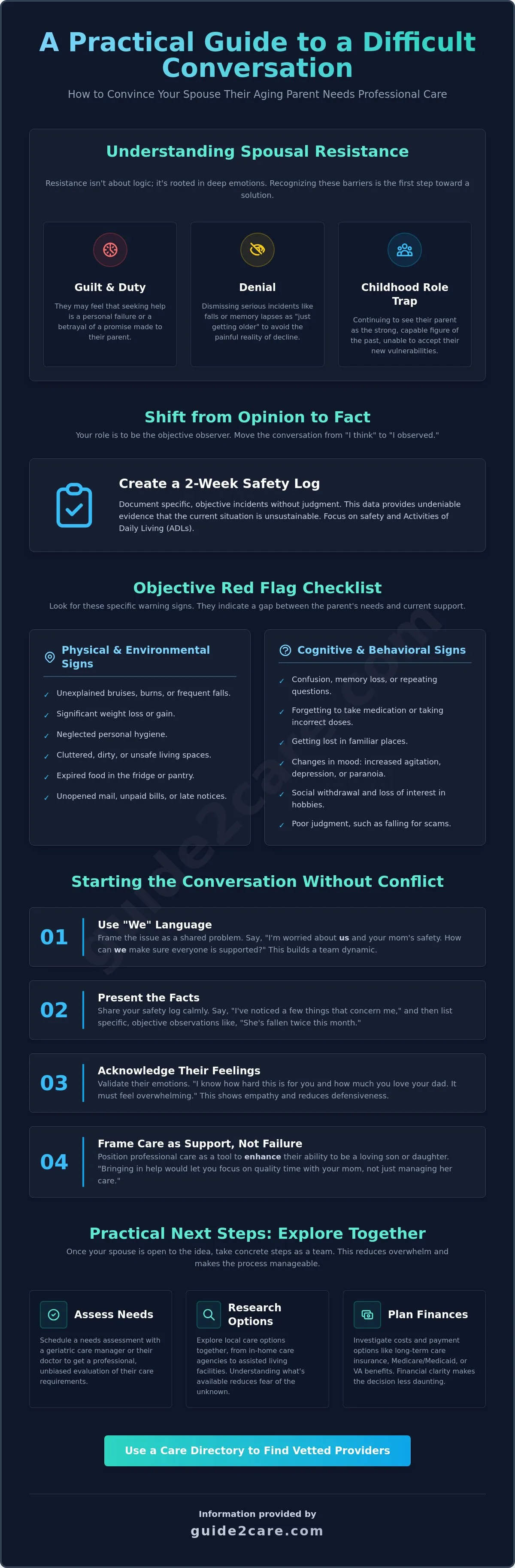
Resistance to professional care is rarely about logic. It usually stems from deep emotional roots like guilt, denial, or a rigid sense of duty. Your spouse may feel that accepting outside help is a failure to fulfill their role as a child. This internal conflict creates a barrier that prevents them from seeing the parent's actual physical or cognitive decline. They often view "care" as a loss of independence rather than a safety measure.
Many adults fall into the "Childhood Role" trap. In this dynamic, your spouse continues to see their parent as the strong, capable figure from their youth rather than a vulnerable senior. This cognitive dissonance makes it difficult for them to process how to convince a spouse care is needed for their parent because they haven't yet accepted that the parent has changed. Recognizing this shift is the first step in moving toward a practical solution.
To better understand this concept, watch this helpful video:
The Psychology of Spousal Denial
Denial often serves as a temporary shield against the grief of losing a parent’s health. Your partner might "normalize" dangerous situations, such as a mother-in-law forgetting to turn off the stove or a father-in-law experiencing frequent falls. They may dismiss these events as "just getting older" to avoid the painful reality of decline. This emotional weight contributes significantly to caregiver burden, as the spouse takes on more than they can handle to avoid "betraying" the parent. Over time, this guilt-driven decision making leads to burnout and compromises the safety of the entire household.
Your Role as the Objective Observer
As the spouse of the primary caregiver, your perspective is different. You aren't bound by the same childhood history or subconscious guilt. This allows you to see safety risks clearly. Your role is to act as a neutral facilitator rather than a critic. Avoid making the situation an ultimatum between your marriage and their parent. Instead, present yourself as a partner seeking a sustainable solution for everyone involved. Focus on factual observations rather than emotional judgements. Your outsider perspective is a valuable safety asset that can help identify when "managing" at home is no longer enough to protect the parent's well-being.
Managing the needs of aging parents while simultaneously raising young children is a common challenge for the "sandwich generation." To discover resources specifically for fathers in this position, you can learn more about GreatDad.com.
- Document specific safety incidents without using judgmental or inflammatory language.
- Acknowledge the difficulty of the situation before offering professional solutions.
- Frame professional care as a way to enhance the parent's quality of life and preserve your spouse's health.
- Identify the specific promises your spouse made to the parent and discuss how those can be honored through different types of support.
Identifying Objective Red Flags: When "Managing" Isn't Enough
Removing emotion from the care debate requires a shift from subjective opinions to objective data. Your spouse may feel that they are managing well, but a detailed record of daily events often reveals a different reality. Documenting specific incidents over a two-week period provides the evidence needed to move the conversation forward. This data-driven approach is essential when learning how to convince a spouse care is needed for their parent because it replaces "I think" with "I observed."
Carry a small notebook or use a digital notes app to track occurrences. Focus on safety lapses and changes in the parent's ability to perform Activities of Daily Living (ADLs). These include bathing, dressing, and eating without assistance. When you present this log, you aren't attacking your partner’s effort. You are identifying a gap between the parent’s needs and the current support level. It's about safety, not a lack of devotion.
Physical and Environmental Warning Signs
Inspect the parent’s living environment for subtle indicators of decline. These signs often go unnoticed by those visiting daily who have become accustomed to a slow deterioration. Look for the following red flags:
- Physical changes: Check for unexplained bruising on the arms or legs, which may indicate falls that weren't reported. Note significant weight loss or a decline in personal hygiene.
- Home safety: Inspect the kitchen for scorched pans or evidence of small fires. Look for piles of unopened mail, especially utility bills or medical notices.
- Medication management: Monitor pill organizers to see if medications are being skipped or taken in double doses.
If these signs are present, the parent's safety is at immediate risk. You can use a care provider directory to see what types of support are available locally to address these specific safety gaps.
The "Invisible" Burden on Your Spouse
The parent isn't the only one at risk. Your spouse’s health and your marriage are also affected. Chronic stress from caregiving often manifests as irritability, exhaustion, or a withdrawal from family activities. Assess the frequency of emergency "dash-overs" to the parent’s house. These unplanned interruptions indicate that the parent’s needs have exceeded the current management plan.
Discussing the concept of sharing caregiving responsibilities with your partner can help them see that they don't have to carry the entire load alone. Note if your spouse is neglecting their own medical appointments or hobbies. When a partner is in the middle of a crisis, they often fail to see their own burnout. Presenting these observations helps them recognize that professional care is a tool for their own survival, not just for the parent’s benefit. This realization is a critical turning point in the decision-making process.
How to Start the Care Conversation Without Conflict
Begin the conversation by establishing a shared goal. You are not two opposing sides; you are a team managing a family transition. Use "we" language to reinforce this partnership. Instead of saying "You need to do something," try "We need to find a way to make this safer for everyone." This subtle shift removes the burden from your partner's shoulders and positions you as an active participant in the solution. Understanding how to convince a spouse care is needed for their parent is a process of small, consistent steps rather than a single, high-pressure event.
Maintaining your own mental health is just as important as the care plan you are creating. If you are a father balancing these conversations with the responsibilities of a young family, you might explore Great Dad Coaching (1-on-1) to gain tools for managing these transitions effectively.
Frame professional care as a resource for your spouse. Focus on their well-being and the sustainability of their current pace. If you use "what if" scenarios, you can highlight the need for a safety net without being accusatory. For example, ask, "What if your dad falls while you're at work and can't reach his phone?" This encourages your partner to visualize risks and acknowledge that the current arrangement lacks necessary safeguards. It turns the discussion toward proactive planning rather than reactive crisis management.
The "Supportive Spouse" Script
Effective communication requires specific language that prioritizes your partner's emotional state. Start by acknowledging their effort. You might say, "I am worried about how much you are carrying lately, and I don't want you to burn out." Follow this with objective observations, such as, "I noticed your mum forgot her medication twice this week, and it concerns me for her safety." Emphasize that the goal is to improve family dynamics. State clearly, "I want us to find a way for you to be a daughter again, not just a carer." This reminds your spouse that professional help can restore their original relationship with their parent.
Timing and Environment
Select the right moment to talk. Avoid "ambush" conversations late at night when you are both exhausted or during high-stress moments like the morning rush. Choose a neutral, quiet location where you won't be interrupted by children, phones, or the parent in question. Keep the first session short. Your goal is to build awareness and plant the seed of a new idea, not to demand an immediate decision or a signed contract.
Prepare for a "not yet" response. Resistance is a common part of the process. If your spouse isn't ready to agree, don't push for a resolution immediately. Instead, suggest a specific follow-up time. Say, "I hear that you aren't ready to change things today. Can we agree to look at this again in two weeks?" This creates a structured timeline and prevents the issue from being ignored indefinitely. It allows your partner time to process the information while maintaining the momentum of the conversation.
- Use "we" statements to maintain a team-based approach.
- Highlight your spouse's health as a primary reason for seeking help.
- Schedule follow-ups to ensure the topic remains on the agenda.
- Keep initial talks brief to avoid emotional overwhelm.
Navigating Resistance and Common Objections
Resistance is a defensive reaction to change. When learning how to convince a spouse care is needed for their parent, expect specific objections regarding ethics, finances, and timing. Address these concerns with a plan rather than an argument. This approach shifts the focus from an emotional standoff to a logistical problem-solving session. Use the objective data you gathered in the previous weeks to answer objections with facts.
Part of this planning involves researching specialized care models. For instance, Providential Fijian Home Care offers a detailed guide on compassionate in-home dementia care, providing families with a clear example of how professional support can be tailored to maintain safety and dignity at home.
The "not bad enough" objection is common when a parent has "good days" and "bad days." Manage this by introducing the concept of respite care as a temporary trial. This allows everyone to see the benefits of professional support without a permanent commitment. It also gives your spouse a necessary break from the daily pressure of caregiving. If a residential setting feels too extreme, pivot the conversation to home care as a middle-ground solution. In the meantime, fathers can use resources like GreatDad.com to find ways to keep the rest of the family engaged and supported. This ensures safety while maintaining the parent's familiar routine.
Redefining the Promise
Many spouses resist because of a long-held promise to never "put a parent in a home." Explain that a promise made a decade ago didn't account for current medical realities or safety risks. Keeping a parent safe is the ultimate fulfillment of that promise. Argue that professional care is the only way to ensure that safety. Introduce the idea of "supported living" or home-based assistance as a way to maintain independence rather than take it away. This reframing helps your partner move past the guilt of "breaking" a word that was given under different circumstances.
Practical Solutions for UK Families
Address the "cost" objection by gathering facts rather than guessing at figures. Suggest a GP appointment to request an objective medical needs assessment. An external medical authority can often validate your observations, which removes the personal conflict from the decision. Contact the local authority to request a social care assessment. This process identifies the specific support required and determines if the parent is eligible for local government funding.
Research available financial supports like Attendance Allowance. This is a non-means-tested benefit for people over State Pension age who have a physical or mental disability. It can help cover the initial costs of home-based support or specialized equipment. To begin comparing your options, search our directory of local care providers to find services that fit your family’s specific needs and budget. Having concrete options ready can help lower the emotional temperature of the conversation.
- Request a GP review to provide an impartial medical perspective.
- Apply for a Social Care Assessment through your local council.
- Check eligibility for Attendance Allowance to assist with care costs.
- Start with respite care to test the waters without a long-term contract.
Practical Next Steps: Exploring Options Together
Once the initial conversation has occurred, move toward concrete action. Transitioning from abstract worry to specific choices reduces anxiety for both you and your partner. Start with low-stakes research to make the process feel manageable. This is a critical phase in how to convince a spouse care is needed for their parent because it replaces fear of the unknown with tangible information. Viewing options together ensures that the final decision is a collaborative effort rather than a directive from one person.
During this research phase, you can learn more about how professional non-medical assistance can be integrated into your family's planning to ensure both safety and peace of mind.
Schedule a "no-obligation" visit to a local care setting. Seeing a facility or meeting a home care manager in person often dispels myths about professional care. If the emotional weight remains too heavy for your marriage, consult a professional advisor. A social worker or a geriatric care manager can provide an impartial perspective. In the same way that Detox Rehab Clinics UK provides free, independent advice for families navigating addiction services, these professional advisors help remove the personal conflict by focusing strictly on the safety and medical requirements of the parent.
Using the Guide2Care Directory
Use a structured directory to view local home care agencies or residential homes. This allows you to filter providers by specific needs, such as dementia care, respite, or basic home help. Review Care Quality Commission (CQC) reports together to ensure quality and safety standards are met. These reports provide an objective assessment of a provider's performance, which helps remove personal bias from your search. Compare different types of care, such as nursing homes versus residential care, to define the exact level of support required for your father-in-law or mother-in-law.
The "Trial Run" Strategy
Propose a "trial run" to lower the emotional stakes. A two-week respite stay or a few hours of weekly home care serves as a practical test. Frame this as a "break for everyone" rather than a permanent lifestyle change. This approach allows your spouse and their parent to experience the benefits of professional support without feeling trapped by a long-term commitment. It often reveals that the parent enjoys the additional social interaction or specialized support. Find and compare local care providers on Guide2Care to start this exploratory phase and see what services are available in your area.
- Filter by specific care needs to narrow down your search results quickly.
- Read the latest CQC reports to verify the safety and leadership of local providers.
- Organize a trial period to demonstrate the benefits of professional help without pressure.
- Consult a GP or social worker to provide an external, authoritative recommendation.
Moving Toward a Sustainable Care Solution
Resolving the conflict surrounding parental care requires a shift from emotional debate to objective planning. You have identified the physical red flags and learned how to initiate a collaborative conversation. By focusing on "we" language and documenting specific safety incidents, you can help your partner see that professional support is a tool for family preservation. It's about safety and sustainability for everyone involved.
Understanding how to convince a spouse care is needed for their parent is the first step toward reducing household stress. Now is the time to gather specific information to make the process less overwhelming. Accessing verified data removes the guesswork from your search and provides a clear path forward for your family. If you are a father looking for resources to help manage your family’s evolving needs, you can visit GreatDad.com.
Search the Guide2Care directory for trusted UK care providers to find local assistance. This comprehensive UK-wide directory allows you to view the latest CQC ratings and access practical guides on care funding and selection. Taking this action ensures your decision is based on quality and transparency. You can create a safer environment for your parent-in-law while protecting your spouse from burnout.
Frequently Asked Questions
How do I tell my husband his mother needs a care home?
Frame the conversation around her safety and medical needs rather than personal opinion. Use specific examples of recent incidents, such as falls or missed medications, to demonstrate that the current living situation is unsustainable. This objective approach is part of learning how to convince a spouse care is needed for their parent while maintaining a supportive partnership. Avoid making it an ultimatum; instead, suggest a joint visit to a local facility to view the environment together.
What if my spouse refuses to admit their parent is declining?
Request an appointment with the parent's GP for a formal medical review. Often, a spouse will accept a professional diagnosis from a doctor more easily than observations from a partner. This external validation removes the emotional conflict between you and your spouse. You can also suggest a short trial period of home care to demonstrate the benefits of professional assistance without forcing a permanent decision. Seeing the positive impact of help can often break through denial.
Can I contact social services for my in-laws without my spouse's consent?
You can legally contact your local authority to request a care assessment or report a safeguarding concern for any adult. However, doing so without your spouse's knowledge may cause significant marital conflict. It is more effective to present the assessment as a free resource provided by the council to help the family understand available support. This keeps the focus on the parent's well-being and avoids creating a secret intervention that could damage trust in your marriage.
How do I handle the guilt of suggesting care for a parent-in-law?
Recognize that suggesting care is an act of advocacy, not a betrayal. Professional care ensures that your in-law's medical and physical needs are met by trained staff, which allows you and your spouse to focus on your emotional relationship with them. Guilt often stems from a false belief that family must provide all care. Accepting help is a responsible decision that protects the safety of the senior and the long-term health of the caregivers.
What are the first signs that an elderly person can no longer live alone?
Common signs include poor personal hygiene, significant weight loss, and unexplained bruising from recent falls. Environmental red flags include scorched cookware, an empty refrigerator, or piles of unopened utility bills. If the individual is forgetting to take essential medications or getting lost in familiar places, they require immediate support. These indicators suggest that managing at home is no longer a safe option for the individual and professional intervention is necessary to prevent a crisis.
How much does home care cost in the UK compared to a care home?
Home care is generally charged by the hour for specific tasks, while care homes involve a comprehensive weekly fee covering accommodation and 24-hour support. According to 2026 data, the national median cost for a home health aide is approximately $35 per hour. Residential care costs nearly $9,000 to $10,000 per month on average. Costs vary significantly by region, so check local directory listings for specific rates in your area to create an accurate financial plan.
What is a local authority care assessment and how do we get one?
A care assessment is a formal evaluation conducted by social services to identify the physical and emotional needs of an adult. To get one, contact the local council's adult social care department where the parent resides. This assessment is free of charge regardless of the person's financial situation. It serves as a vital step in how to convince a spouse care is needed for their parent by providing an official, third-party recommendation for support.
How can I support my spouse who is struggling as a primary carer?
Take over non-care tasks such as household chores, grocery shopping, or administrative duties to reduce their overall burden. Encourage them to use respite services or join a local support group to manage their stress. Your role is to provide a neutral space for them to express their exhaustion without judgment. By handling the logistical side of the household, you help them maintain the energy required for their caregiving role. Additionally, finding small ways to show appreciation—such as using resources from GreatDad.com—can help protect your partner's mental health and your relationship during this demanding time.