Getting Buy-In from Siblings on Care Decisions: A Practical Guide

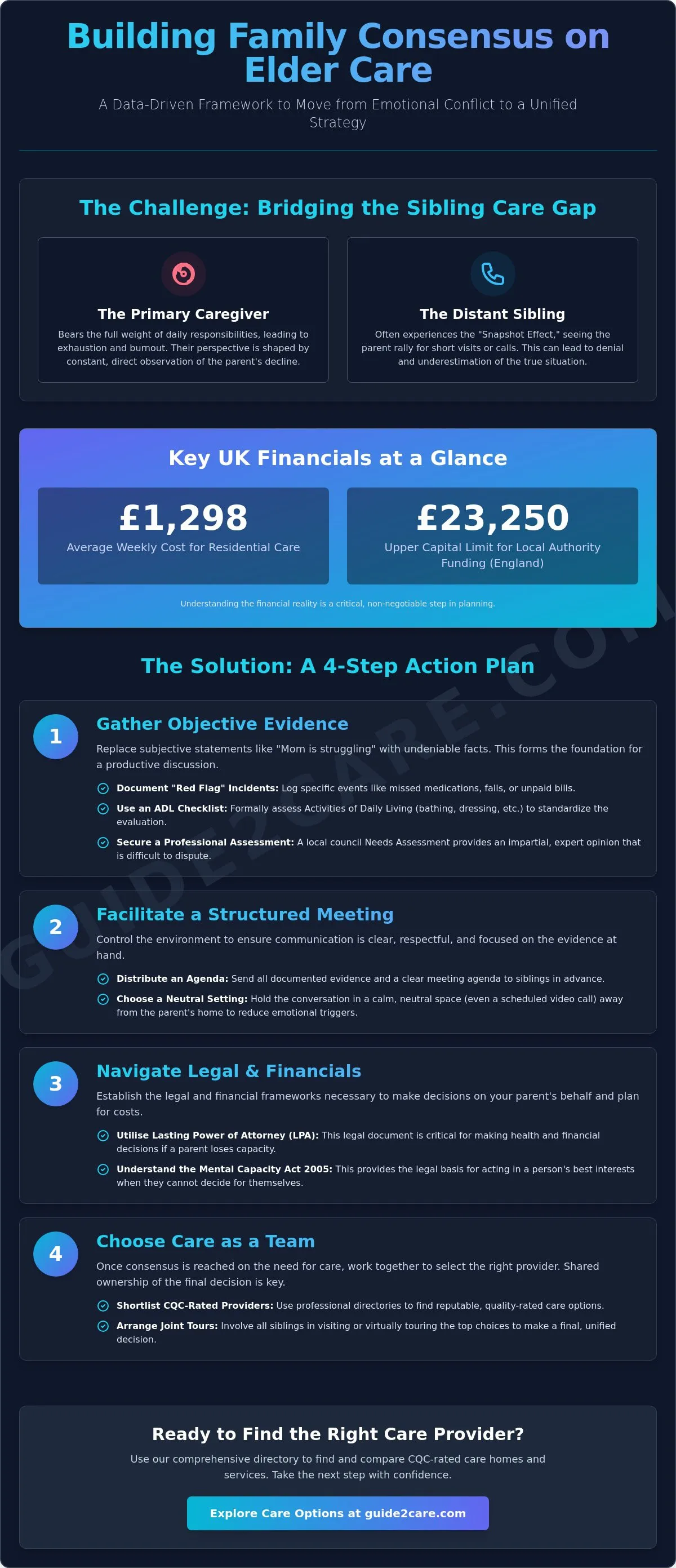
Family consensus on elder care isn't built on emotional appeals; it's built on objective data and structured protocols. You likely feel the weight of primary caregiving while your siblings remain in denial about a parent's decline. It's common to face friction when discussing the £1,298 weekly average cost for residential care or the £23,250 upper capital limit for local authority funding. Getting buy-in from siblings on care decisions requires moving past personal grievances and focusing on verifiable facts. For families struggling with the emotional weight of these disputes, therapeutic support from citizencoaching.com can help manage conflict and maintain focus on the parent's needs.
You'll learn how to replace family conflict with a unified agreement by following an evidence-based framework. This approach ensures a fair distribution of tasks and helps your family agree on a suitable care provider. This guide outlines the steps to establish a shared care plan, navigate inheritance concerns, and use directory resources to facilitate informed choices. Follow this logical process to move from individual frustration to a structured family strategy.
Key Takeaways
- Replace emotional debate with objective evidence by documenting specific incidents and securing a formal local council Needs Assessment.
- Coordinate family care meetings with pre-distributed agendas and neutral settings to facilitate clear communication between primary and distant caregivers.
- Apply the Mental Capacity Act 2005 and Lasting Power of Attorney as the primary legal frameworks for getting buy-in from siblings on care decisions during family disputes.
- Access professional directories to shortlist CQC-rated care providers and arrange joint tours to finalize the selection process as a family unit.
Understanding the Sibling Care Gap and Common Friction Points
Sibling roles often solidify during a parent's health decline. One child usually becomes the primary caregiver by default; others maintain a distance due to geography or work. This imbalance creates immediate friction when getting buy-in from siblings on care decisions. Denial often persists for those who visit less frequently. They don't see the daily struggle; they only see a parent who manages to "rally" for a short phone call or visit. These differing perspectives make it difficult to agree on the severity of the situation.
Long-standing family hierarchies also influence current disputes. Understanding Sibling Dynamics helps explain why an older sibling might still expect to make final decisions, even if they aren't involved in daily tasks. Many families also fall into the "Parental Promise" trap. This occurs when a child clings to an old promise like, "I'll never put you in a home," even when professional care becomes a medical necessity for safety. These emotional anchors prevent logical discussions about service providers or financial planning.
To better understand how these disagreements manifest and how to address them, watch this helpful video:
Why Geographical Distance Distorts Perception
Distance siblings often experience the "Snapshot Effect." They visit for a weekend and see their parent at their best. They don't see the midnight falls or the confusion that occurs during the week. To bridge this gap, use objective tools to share real-time updates. Digital health trackers or shared journals provide data that is harder to ignore than personal complaints. For siblings living outside the UK, schedule structured video calls to review specific health metrics rather than general feelings; using a digital provider like SimOnly Club can help ensure these critical communication lines remain open. This moves the conversation from opinion to evidence.
The Impact of Caregiver Burden on Decision Making
The emotional toll on a primary caregiver is significant. When you feel "dumped on" with all the responsibility, resentment builds quickly. This resentment often blocks productive conversation; you might sound angry or demanding when you're actually just exhausted. Engaging with Citizen Coaching and Counselling can provide the therapeutic support needed to manage these feelings and improve family communication. Use this checklist to assess your current burnout level:
- Do you feel constantly exhausted regardless of how much you sleep?
- Have you neglected your own health appointments to manage your parent's care?
- Do you feel a sense of hopelessness or anger when talking to your siblings?
- Is your parent's safety being compromised because you're spread too thin?
Gathering Objective Evidence to Build Your Case
Subjective observations often lead to conflict. When getting buy-in from siblings on care decisions, replace phrases like "Dad is struggling" with concrete data. Document specific "Red Flag" incidents. These include uncharacteristic weight loss, missed medication doses, or unpaid bills. Record "near-miss" events such as a stove left on or a fall that didn't result in injury. These data points provide a factual basis for discussion that's difficult to dispute with denial.
Use a formal Activities of Daily Living (ADL) checklist to categorize needs. This standardizes the assessment process. Evaluate your parent's ability to perform basic tasks like bathing, dressing, and eating without assistance. Supplement this with GP letters or medical reports that validate clinical requirements. Resources such as providentialfijianhomecare.com can help you understand the specific categories of non-medical support that can be included in these assessments. When you present a list of clinical needs rather than a list of personal frustrations, you shift the focus from family dynamics to your parent's safety.
Utilising Professional Assessments
Request a formal Care Needs Assessment from the local authority. In England, the upper capital limit for social care funding is £23,250 for the 2026-2027 period. A professional assessment provides an impartial view of what level of support is required. Invite a neutral third party, such as a social worker or district nurse, to state the facts. This separates "wants" from "clinical needs." It's often easier for siblings to accept a professional's recommendation than a sibling's opinion. You can use a care directory to find providers who specialize in the specific needs identified during these assessments.
Tracking the Progression of Daily Challenges
Maintain a 14-day diary of all care tasks you perform. This makes the "invisible" work visible. Record hygiene lapses, nutritional concerns, and medication errors. A log of specific events creates a timeline of decline that's often missed by siblings who don't live nearby. Use these metrics to build a compelling case for professional intervention:
- Medication Errors: Frequency of missed or double doses.
- Hygiene Lapses: Number of days between baths or laundry cycles.
- Nutritional Patterns: Daily calorie intake or evidence of expired food in the fridge.
- Mobility Issues: Documented trips, slips, or difficulty navigating stairs.
This level of detail transforms the conversation. It moves the family toward a consensus based on safety and medical necessity. Clear documentation prevents arguments about whether care is "really" needed.
Structuring the Family Care Meeting for Success
A structured meeting is the most effective tool for getting buy-in from siblings on care decisions. Without a clear framework, these discussions often devolve into emotional arguments or historical grievances. To help navigate these difficult conversations, Citizen Coaching and Counselling offers professional support to manage family conflict and improve communication. Choose a neutral location to minimize home-field advantage or use a structured video call for distant family members. Set a firm time limit of 60 to 90 minutes. This prevents decision fatigue and stops the conversation from circling back to unresolved issues.
Distribute a formal agenda at least 48 hours before the meeting. This allows every sibling to prepare their thoughts and review the objective evidence gathered in previous stages. An effective agenda should include:
- Review of recent health incidents and medical reports.
- Current gap between the parent's needs and available support.
- Discussion of specific care provider options from directory shortlists.
- Financial overview including the £23,250 capital threshold for local authority support.
- Assignment of specific oversight roles.
Assigning roles encourages involvement and reduces the primary caregiver burden. One sibling can manage financial oversight, including tracking the £92 LPA registration fees or monitoring inheritance tax thresholds. Another can handle social engagement or medical appointments. This distribution of labor ensures every sibling has a stake in the plan's success. It moves the family from a model of one person doing everything to a team-based approach.
Rules of Engagement for Care Discussions
Establish ground rules before the first item on the agenda. Use "I" statements to express concerns. For example, say "I am concerned about Dad's safety when he's alone" instead of "You aren't doing enough to help." Ban the mention of past family conflicts. Every proposed solution must pass the "Parent-First" test. If a suggestion doesn't directly improve the parent's safety or quality of life, it's dismissed from the current meeting. This protocol keeps the focus on the immediate objective.
Creating a Shared Care Action Plan
A shared action plan is the final step in getting buy-in from siblings on care decisions. Document every agreed-upon point in a shared digital document that all siblings can access. This eliminates future disputes over what was decided. Define who is responsible for financial, medical, and social oversight with clear deadlines for specific tasks. Set a date for a follow-up review meeting, typically in 30 days, to assess the plan's effectiveness. This structured follow-up ensures the care strategy remains responsive to the parent's changing health status.
Navigating Legal and Financial Buy-in in the UK
Legal clarity often resolves family stalemates. In the UK, getting buy-in from siblings on care decisions is governed by specific legislative frameworks. If a parent lacks the capacity to make their own choices, the Mental Capacity Act 2005 dictates that decisions must be made in their "Best Interests." This isn't a matter of sibling opinion; it's a legal requirement to consider the parent's past wishes and current welfare. Establishing a Lasting Power of Attorney (LPA) is the most effective way to prevent disputes. Each LPA document costs £92 to register with the Office of the Public Guardian as of May 2026. Having this in place ensures a designated person has the legal authority to act, which reduces friction among siblings.
The Mental Capacity Act and Best Interests
When capacity is in question, the hierarchy of decision-making power becomes critical. A "Best Interests" meeting may involve family members, but the final decision rests with the appointed attorney or a lead clinician. If siblings cannot agree, an Independent Mental Capacity Advocate (IMCA) might be involved to represent the parent's views. This professional oversight ensures that the care plan focuses on safety and clinical needs rather than family politics. It provides a neutral baseline that all siblings must respect under UK law.
Managing Financial Objections
Financial concerns often mask deeper anxieties about inheritance. Be transparent about the 40% Inheritance Tax rate that applies to estates above the £500,000 threshold for homeowners. Explain that spending on care is a necessary use of the parent's assets. In England, the social care funding thresholds for 2026-2027 are set at an upper capital limit of £23,250. If your parent's assets exceed this, they're responsible for their own costs. Getting buy-in from siblings on care decisions is easier when everyone understands these non-negotiable government limits.
- Attendance Allowance: Check eligibility for this non-means-tested benefit to help cover costs.
- Personal Expenses Allowance: Local authority-supported residents receive £31.80 per week for personal use.
- Capital Limits: Assets below £14,250 mean the local authority pays for care, subject to an income assessment.
Presenting these figures clearly prevents arguments based on misinformation. You can find care providers that match your parent's specific financial and clinical requirements through a verified directory. This structured approach ensures that financial discussions remain focused on the parent's immediate well-being.
Turning Consensus into Action with Professional Support
Moving from a verbal agreement to a practical care plan requires objective tools. Once you have established the legal and financial frameworks, focus on selecting a specific provider. Using an objective directory to shortlist CQC-rated providers removes personal bias from the selection process. Schedule joint tours of care homes or nursing facilities so every sibling sees the environment firsthand. This shared experience is vital for getting buy-in from siblings on care decisions. It's harder to disagree on a facility's suitability when everyone has walked the hallways together.
To gain a clearer perspective on the types of assistance available, you can discover Providential Fijian Home Care and explore how professional non-medical support is structured for seniors and those in recovery.
Reviewing CQC inspection reports together provides a factual basis for evaluating safety and staffing levels. These reports offer a level of detail that personal visits might miss. They provide a neutral baseline that prioritizes the parent's welfare over family preferences. You can use a care directory to filter providers by their specific ratings and service types. This structured approach ensures that the final choice is based on quality and clinical capability rather than the lowest price or the most convenient location.
Using CQC Ratings as a Neutral Arbiter
The Care Quality Commission (CQC) evaluates providers based on five key questions: Is the service safe, effective, caring, responsive, and well-led? Focus your search on facilities with "Good" or "Outstanding" ratings. Use these categories to answer specific concerns from skeptical siblings. If a sibling worries about medical oversight, point to the "Effective" or "Safe" scores in the latest report. Using these independent metrics helps in getting buy-in from siblings on care decisions because the data comes from a government body, not a family member. It simplifies the comparison process and justifies the choice of a specific care home or home care agency.
When to Involve an External Mediator
Family deadlock persists in some cases despite the presence of objective evidence. If arguments over inheritance or past grievances continue to block a decision, seek professional mediation. Specialized elder care mediators in the UK provide neutral ground for these discussions. They don't take sides; they facilitate a "Best Interests" outcome. You might also consult a care solicitor to clarify legal obligations or a financial advisor to model care costs against the £23,250 capital limit. Finalise the transition plan with a professional care manager who can coordinate the logistics. For families where care needs are further complicated by substance misuse, Detox Rehab Clinics UK offers free, independent advice to help navigate specialized treatment options. This professional oversight ensures the parent's safety remains the priority while the family navigates the transition into professional care.
- Identify signs of deadlock: Repeatedly circling the same arguments without a resolution.
- Consult neutral experts: Use solicitors or mediators to break emotional stalemates.
- Finalise the plan: Document the start date, chosen provider, and payment structure.
Executing Your Family Care Strategy
Success in family caregiving depends on replacing emotional appeals with verifiable facts. Use formal tools like the local council Needs Assessment and Activities of Daily Living checklists to define the level of support required. Getting buy-in from siblings on care decisions is significantly easier when the discussion centers on clinical safety and legal requirements rather than past family dynamics. By assigning specific roles and following a structured agenda, you move the family from a state of denial to a shared action plan.
Finalize your strategy by selecting a provider based on objective quality metrics. Find and compare CQC-rated care providers on Guide2Care to access a comprehensive UK-wide directory. This platform allows you to review the latest CQC inspection ratings side-by-side, answering safety concerns with independent data. Utilize these free resources for family caregivers to streamline the search and build total family consensus. Moving from conflict to cooperation preserves both your parent's well-being and your sibling relationships. Start your search today to establish a safe and sustainable care environment.
Frequently Asked Questions
What do I do if my sibling refuses to help with our parents care?
Set clear boundaries and present the care requirements as a shared family project rather than a personal favor. Use your 14-day care diary to demonstrate the actual volume of work required. Getting buy-in from siblings on care decisions often requires showing them the data they miss during short visits. If a sibling still refuses to help, you must focus on what you can sustainably provide and involve professional care providers to fill the gaps.
Can one sibling make all the care decisions if there is no Power of Attorney?
No single sibling has the legal authority to make care decisions without a registered Lasting Power of Attorney (LPA). If no LPA is in place, decisions are made by medical professionals or social workers under the Mental Capacity Act 2005. Registering an LPA costs £92 per document as of May 2026. It's the most effective way to ensure a family member, rather than the state, retains decision-making power during disputes.
How do I handle a sibling who is in denial about a parent’s dementia?
Replace your personal observations with professional medical evidence. Denial often stems from the "Snapshot Effect," where visiting siblings only see the parent on a good day. Present them with GP letters, formal Needs Assessments, or a log of "near-miss" incidents like falls or stove mishaps. Objective data is harder to ignore than emotional appeals and helps move the family toward a consensus on the parent's actual health requirements.
Who has the final say in care decisions if siblings disagree?
The final say rests with the person legally appointed as the Health and Welfare Attorney. If no attorney exists, the "decision maker" is typically the lead clinician or social worker responsible for the parent's care. They must act in the parent's "Best Interests" as defined by UK law. Disagreements among siblings don't grant any one child veto power; the focus remains strictly on the parent's clinical safety and welfare rather than family preference.
What is a "Best Interests" meeting in the UK care system?
A Best Interests meeting is a formal consultation held when a person lacks the mental capacity to make a specific decision about their care or residence. The meeting involves family members, attorneys, and health professionals. The goal is to reach a decision that reflects the person's past wishes and current needs. It's a structured process designed to ensure the safest outcome when families or professionals cannot agree on the necessary next steps for care.
How can we split the cost of care fairly between siblings?
Use the parent's own assets to fund care whenever possible. In England, individuals with assets above £23,250 are responsible for their own care costs for the 2026-2027 period. If siblings choose to contribute financially, document these contributions in a formal agreement to avoid future inheritance disputes. Getting buy-in from siblings on care decisions is easier when you provide a transparent breakdown of the £1,298 average weekly cost for residential care and available benefits.
What happens if we cannot agree on a care home for our parent?
Use independent CQC inspection ratings as a neutral arbiter to compare different facilities. If you cannot reach a consensus, arrange joint tours of the top three shortlisted homes. Seeing the environment and speaking with staff together often resolves subjective disagreements. If a deadlock persists, involve an external mediator or a care manager to facilitate a decision based on the parent's specific clinical requirements and the objective data found in inspection reports.
How do I tell my siblings I can no longer be the primary caregiver?
Present your decision as a matter of safety rather than a personal choice. Use your 14-day care log to show exactly why the current situation is unsustainable. Explain that the parent's needs have exceeded what one person can safely provide. This shifts the focus from your own exhaustion to the parent's requirement for professional intervention. Propose a transition period where you move from being the sole provider to a coordinator role using professional directory resources.