The Best Alternatives to Care Homes for the Elderly in 2026

What if moving into a residential facility wasn't the only way to secure high-quality support for your later years? Many individuals assume that a decline in mobility necessitates a move, yet there are various alternatives to care homes for the elderly that prioritise your independence. You likely want to stay in your own home while avoiding the institutional feel of a traditional facility. It's natural to feel overwhelmed by UK care terminology or anxious about how the £23,250 self-funding threshold in England affects your specific situation.
Discover the full range of UK care options that allow for 1-to-1 support and tailored assistance. This guide provides a practical breakdown of choices, including live-in care and specialised retirement housing. Use this information to compare costs and identify the right level of support for your lifestyle. We explain the latest 2026 regulations and financial limits to help you make an informed decision. Explore these structured categories to find a solution that preserves your dignity and keeps you in the home you love.
Key Takeaways
- Categorise support options into home-based care, specialised housing, and community schemes to see the full spectrum of choice.
- Understand the differences between visiting and live-in care to decide which model best supports your daily needs.
- Explore alternatives to care homes for the elderly such as sheltered housing and retirement villages to maintain a private residence.
- Learn how to request a formal care needs assessment to identify exactly what level of support you require.
- Use our directory to search for and filter UK care providers based on specific service types and locations.
Understanding the Spectrum of Elderly Care Alternatives
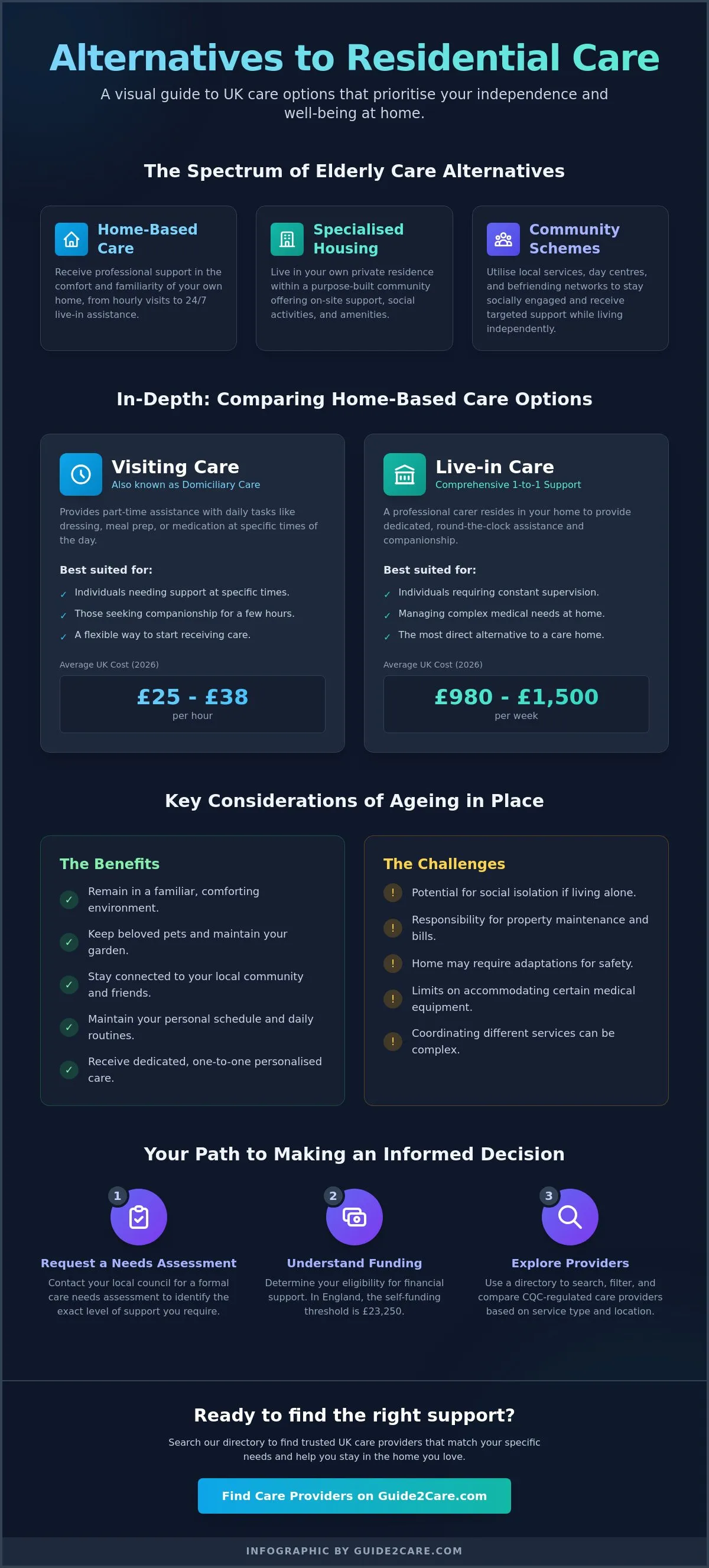
Classify alternatives to care homes for the elderly as any support model that prioritises your independence over a move to a residential facility. These options don't require you to move into a communal institution. Instead, they focus on three main pillars: home-based care, specialised housing, and community schemes. Each pillar offers a different balance of autonomy and professional assistance.
The UK long-term care market was valued at USD 38.2 billion in 2025 and continues to grow at over 7% annually. In 2026, the Care Quality Commission (CQC) shifted toward sector-specific frameworks, which improves the oversight of home-based services. This regulatory change supports the trend of "ageing in place." This model uses digital monitoring and visiting carers to keep you in your own house. It protects your emotional continuity and lets you keep your pets. You maintain your own daily routines without following a facility's schedule.
To better understand this concept, watch this helpful video:
Why Families are Moving Away from Traditional Residential Care
Modern families often prefer bespoke 1-to-1 attention over the group settings found in care homes. Residential care sometimes carries an institutional stigma that can lead to a loss of autonomy. Families now seek flexibility. Modern alternatives to care homes for the elderly scale with your needs; you can start with a few hours of help and increase it over time. This approach ensures you only pay for the specific support you require. It also avoids the disruption of moving away from friends and local community networks.
Finding the right balance of support requires careful planning. Specialized services like Het Zorgkabinet offer guidance and advice to help families navigate these choices, ensuring that the transition to home-based care is as seamless as possible.
Key Terminology: Domiciliary vs. Residential vs. Supported Living
Distinguish between these terms to choose the right path. Domiciliary care refers to visiting support in your own home. Residential care involves living in a facility that provides 24-hour assistance. Supported living or Assisted living facilities offer a middle ground where you have your own tenancy but access on-site staff. Don't assume nursing care requires a nursing home. In 2026, many complex medical needs can be managed through specialist home care agencies. Extra Care housing acts as a hybrid model. It offers high-level support within a self-contained apartment. This allows you to have your own front door while knowing that care teams are available on the same premises.
Care in Your Own Home: Domiciliary and Live-in Options
Evaluate home-based care as a primary solution for maintaining independence. Visiting care, also known as domiciliary care, provides part-time assistance with daily tasks like dressing, meal preparation, or medication management. This model suits those who only need support at specific times. In 2026, the average cost for visiting care in the UK ranges from £25 to £38 per hour. For individuals requiring constant supervision, live-in care offers 24/7 support. A professional carer resides in your home to provide dedicated 1-to-1 assistance. This is one of the most effective alternatives to care homes for the elderly because it preserves your existing lifestyle while ensuring safety.
For those interested in how person-centred models are implemented to support independent living, you can visit Elleson Care to explore their aged care and NDIS services.
Prioritise mental wellbeing by considering companionship care. This service focuses on social interaction and emotional support rather than just physical tasks. It helps reduce the risks of isolation and loneliness. If you're a family member providing regular assistance, respite care offers a necessary short-term break. It allows you to rest while a professional steps in to maintain the care routine. For those looking to support their physical vitality alongside these services, you can discover Ready Health and their range of private medical treatments. Standard live-in care for 2026 typically costs between £980 and £1,500 per week, depending on the level of need.
The Pros and Cons of Staying at Home
Staying in a familiar environment offers significant psychological benefits. You can keep your pets, stay near friends, and maintain your own schedule. It's often a more cost-effective choice for those with lower support needs. However, you must account for the potential for social isolation if you live alone. Property maintenance remains your responsibility, and some homes may have limits on the medical equipment they can accommodate; to help manage these practical requirements, you can discover FIVESTEP 五步健 for a wide range of rehabilitation and daily living products. Live-in care is the most direct alternative to residential care for those with high support requirements.
Night Care and Specialist Condition-Led Support
Differentiate between sleeping and waking nights when planning overnight support. A "sleeping night" carer can be woken up to two times and costs between £180 and £220 on average. A "waking night" carer stays awake all night to provide active assistance and costs between £260 and £320. These options facilitate safe long-term care choices for those with complex needs.
Complex conditions like dementia or Parkinson’s don't always require a move to a facility. Specialist dementia home care in 2026 averages approximately £29 per hour. This targeted support allows you to manage symptoms in a calm, known setting. For those with advanced dementia, live-in care costs can rise to £1,600 or £1,800 per week to reflect the increased expertise required. These alternatives to care homes for the elderly ensure that medical needs are met without sacrificing the comforts of home. Use our directory to search for local home care providers that offer these specialist services.
Specialised Housing: Sheltered, Extra Care, and Retirement Villages
Extra Care Housing vs. Traditional Care Homes
Niche Options: Homeshare and Co-housing
Investigate niche living arrangements if communal or institutional models don't appeal to you. Homeshare UK schemes have seen steady growth in 2026 as a way to combat isolation and rising costs. In this model, a younger person lives with a senior at a reduced rent. In exchange, they provide a set number of hours for help with shopping, cleaning, or companionship. For those seeking a community-led approach, co-housing offers intentional living. Residents share common spaces and resources while maintaining private dwellings. These community-focused alternatives to care homes for the elderly prioritise social connection and mutual support over professional intervention.
Practical Steps: How to Evaluate and Fund Your Choice
Follow a structured five-step process to secure the right support. Finding suitable alternatives to care homes for the elderly requires a clear understanding of both your physical needs and your financial position. Start by contacting your local council to request a Care Needs Assessment. This is a free service that identifies the specific level of assistance you require. Once the council determines your needs, they will conduct a Financial Assessment, also known as a means test. In England and Northern Ireland for the 2026-2027 financial year, individuals with assets over £23,250 must self-fund their care. In Wales, this limit is £50,000, and in Scotland, it is £35,000.
Use the Guide2Care directory to find rated providers that match your assessment results. Filter your search by care type and location to identify agencies or housing schemes in your area. Review the latest Care Quality Commission (CQC) reports for every provider on your shortlist. These documents offer impartial data on safety and leadership. Finally, arrange trial periods or visiting days. Testing the environment or the compatibility of a carer ensures the arrangement works before you commit to a long-term contract.
Understanding CQC Ratings for Home Care and Housing
The CQC assigns four distinct ratings to care providers: Outstanding, Good, Requires Improvement, or Inadequate. Look beyond the overall score. Check the "Effective" and "Caring" categories specifically to ensure the provider delivers high-quality daily support. If a provider requires improvement, read the full report to understand the specific failings. Our guide on CQC Ratings Explained provides a full breakdown of how these inspections work. It helps you distinguish between minor administrative issues and serious safety concerns.
Funding Alternatives: Attendance Allowance and Direct Payments
Explore different funding streams to manage the costs of staying at home or moving to specialised housing. If the council provides funding, request "Direct Payments." This gives you the cash directly so you can choose your own home care agency rather than using a council-selected one. You can also apply for Attendance Allowance. This is a non-means-tested benefit for those over State Pension age who need help with personal care. In 2026, this can provide up to £114.60 per week. If you decide to move into specialized housing, ask about the 12-week property disregard. This rule means the council ignores the value of your home for the first 12 weeks of care, giving you time to arrange a property sale. These steps help you identify the most viable alternatives to care homes for the elderly based on your specific budget. Search our directory for providers that accept direct payments and local authority funding.
Finding the Right Care Provider with Guide2Care
Use the Guide2Care directory to simplify your search for UK care providers. Our platform organises thousands of listings into manageable categories. You can filter results by specific care types, including home care, nursing, and supported living. This structured approach allows you to identify alternatives to care homes for the elderly that align with your medical and lifestyle requirements. Follow the "Search, Compare, Connect" workflow to move from a broad list to a direct conversation with a manager. Read our verified resources to stay informed about funding and quality standards before making a commitment. Our directory acts as a central hub for discovering providers that prioritise independence.
Local care businesses that prioritise independence also need to be easily found by the families who need them most. To learn more about how these providers enhance their digital presence and reach their community, visit Be Kind Local.
How to Use Our Directory to Filter by Location and Need
Enter your postcode into the search bar to find "home care agencies" or "care homes near me." Seeing multiple provider types in a single search result helps you compare the availability of different models in your region. For instance, you might find that a retirement village is closer than a high-quality home care agency. This transparency is essential for making a logistical choice. Consult our Finding a Care Home guide for specific tips on comparing facilities and services effectively. It provides a framework for evaluating different housing and support options side-by-side.
Next Steps: Contacting Providers and Arranging Visits
Contact the managers directly through our platform once you have a shortlist. Use this checklist to evaluate their suitability during your initial conversation:
- How do you match carers with clients' personalities and interests?
- What was your staff turnover rate over the last 12 months?
- How do you handle emergencies or unexpected staff absences?
- Can you provide the full version of your most recent CQC inspection report?
In live-in care scenarios, insist on meeting the specific carer before they move into your property. Compatibility is vital for a successful long-term arrangement. These alternatives to care homes for the elderly only work when there is mutual trust between the client and the support team. Verify that the provider has experience with your specific health conditions, such as mobility issues or early-stage dementia. Start your search for care alternatives today to find a provider that respects your independence and dignity.
Take the Next Step Towards Independent Living
Choosing the right support model is a vital decision for maintaining your quality of life. You now understand that the spectrum of care ranges from hourly visiting support to luxury retirement villages. Success depends on a structured evaluation of your care needs and a clear understanding of current funding thresholds. Use the latest CQC data to vet providers and ensure they meet safety standards. Identifying suitable alternatives to care homes for the elderly is a practical process that begins with accurate information and local comparisons.
Access our comprehensive UK-wide directory to view CQC-linked provider data and expert guides on funding and selection. Our platform simplifies the search by categorising services into manageable sections. You can filter by location and specific medical requirements to find the best fit for your circumstances. Find and compare care providers in your area today to secure the support you deserve. Taking these steps ensures you remain in control of your daily routine while receiving tailored assistance. You can find a solution that balances professional care with the independence of your own home.
Frequently Asked Questions
What is the most common alternative to a care home in the UK?
Domiciliary care is the most common choice among alternatives to care homes for the elderly. It involves visiting carers assisting with daily tasks like dressing and meal preparation in your own residence. This model has seen an 11% increase recently as more people choose to age in place. It allows you to maintain your current lifestyle while receiving professional help. You can scale the hours of support as your needs change over time to ensure safety.
Is live-in care cheaper than a residential care home?
Live-in care can be more cost-effective than residential care, particularly for couples who share the cost of one carer. Standard live-in care in 2026 costs between £980 and £1,500 per week. Residential care fees often include high overheads for facility maintenance and communal staff. By choosing home-based support, you only pay for the dedicated 1-to-1 attention you require in your own environment, avoiding the costs of a residential room.
Can I receive nursing care at home instead of in a nursing home?
You can receive nursing care at home through specialist agencies that employ registered nurses. These professionals manage complex medical conditions, wound care, and medication administration in a private setting. This ensures you receive clinical support without moving into a nursing home. Use our directory to find agencies that are registered to provide nursing activities. Check their specific CQC ratings for clinical effectiveness to ensure they meet your medical requirements.
What is "Extra Care" housing and how does it differ from a care home?
Extra Care housing provides a self-contained home with access to on-site support staff. Unlike a care home, you have your own tenancy and a private front door. It's often called assisted living and allows you to live independently while having 24-hour emergency support available on the premises. This model bridges the gap between independent living and residential care by offering communal facilities and optional care packages that you only pay for when used.
Can someone with advanced dementia stay in their own home?
How do I find reputable home care providers in my local area?
Use the Guide2Care directory to find and compare reputable providers in your local area. Enter your postcode to see a list of agencies and housing schemes nearby. You can filter results by specific care types and view integrated CQC data for each listing. This allows you to check if a provider is rated as Good or Outstanding before you contact them to arrange a visit or trial period for your family.
What happens if my care needs increase while I am in sheltered housing?
If your needs increase in sheltered housing, you can hire external domiciliary care agencies to provide additional support. Sheltered housing wardens don't usually provide personal care directly. If your requirements become too complex for visiting carers, you might consider moving to an Extra Care scheme or a Close Care apartment. These alternatives to care homes for the elderly offer higher levels of integrated support while maintaining your privacy and independence.
Are there government grants available for alternatives to care homes?
Government support is available through means-tested social care funding and non-means-tested benefits. If your assets are below £23,250 in England, the local council may contribute to your costs. You can also apply for Attendance Allowance, which provides up to £114.60 per week in 2026 regardless of your income. Direct Payments are another option, allowing you to receive cash from the council to pay for your chosen care agency instead of using council-managed services.