Staying Independent at Home with Support: A Complete UK Guide

What if maintaining your autonomy didn't mean doing everything alone, but rather choosing the right tools to stay in control? For many, staying independent at home with support is the preferred alternative to moving into residential care. You might feel overwhelmed by the variety of equipment available or confused by the 2026/27 capital limits for social care funding. It's common to worry that asking for help is the first step toward losing your freedom.
Key Takeaways
- Learn how to combine home adaptations, assistive technology, and professional care to maintain your autonomy.
- Understand the criteria for staying independent at home with support by distinguishing between social care and NHS healthcare services.
- Identify your legal right to a free Care Needs Assessment and learn how to navigate the local authority means-testing process.
- Discover the financial thresholds for social care funding in England and which benefits you can claim to offset costs.
- Use CQC ratings and directory listings to vet private care agencies and find a reliable partner for your specific needs.
What Does Staying Independent at Home with Support Actually Mean?
Staying independent at home with support is a strategic approach to maintaining your lifestyle through the use of external resources. It's based on the philosophy of independent living, which prioritizes personal choice and control over physical self-sufficiency. Instead of viewing support as a surrender of autonomy, define it as an optimization of your living environment. If your home adapts to your needs, you remain the primary decision-maker in your own life.
To better understand this concept, watch this helpful video:
The Benefits of Staying at Home
Signs That You Might Need Support
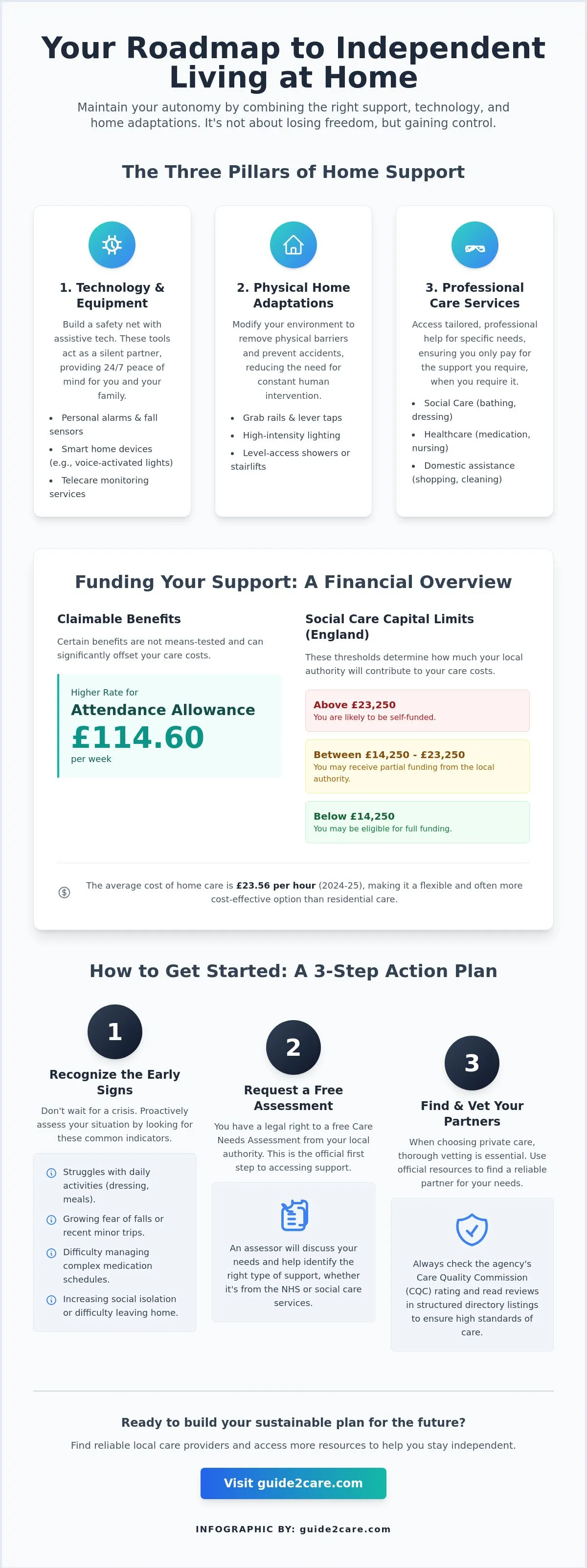
Identify the early indicators that your current setup needs adjustment. Don't wait for a crisis to evaluate your situation. Look for these specific signs:
- Difficulty with ADLs: You struggle with Activities of Daily Living, such as dressing, preparing meals, or managing personal hygiene.
- Safety Concerns: You've experienced minor trips or have a growing fear of falling in specific areas like the stairs or bathroom.
- Medication Errors: You find it increasingly hard to follow complex medication schedules or remember dosages.
- Social Isolation: You spend long periods alone or find it difficult to leave the house to meet friends or attend appointments.
The Three Pillars of Home Support
Success in staying independent at home with support relies on a balanced, three-pronged strategy. You don't need a full-time carer to begin. Instead, view support as a combination of technology, your physical environment, and human assistance. This holistic approach allows you to scale help as your needs change over time. Review the NHS Social care and support guide to understand how these elements fit into the wider UK system.
Technology and Equipment (TEC)
Start with low-intervention technology to build a safety net. Personal alarms and fall sensors provide 24/7 monitoring without invading your privacy. Smart home devices, such as voice-activated lighting or automated thermostats, reduce the physical effort required for daily tasks. Telecare services go further by alerting family members or professional responders to unusual activity patterns. These tools act as a silent partner in your independence, providing peace of mind for both you and your family.
Physical Home Adaptations
Integrate human assistance to handle tasks that technology cannot. Domestic help focuses on cleaning, laundry, and meal preparation. Personal care involves direct assistance with bathing, dressing, and managing medication. Don't overlook companionship services. Regular social visits prevent loneliness and support mental health. There are approximately 13,500 domiciliary care providers in the UK offering these services. You can search local provider listings to find specialized support in your area.
Funding Your Support: Grants and Benefits in the UK
Understand that social care in England operates differently from the NHS. While healthcare is free at the point of use, most social care services are means-tested. This means your income and savings determine whether the local council contributes to the cost of staying independent at home with support. For the 2026/27 financial year, the upper capital limit in England is £23,250. If your assets exceed this amount, you're a self-funder and must pay the full cost of your care. If your assets are below the lower capital limit of £14,250, the council will likely fund your care, provided you meet the needs-based criteria.
Don't assume that having savings prevents you from receiving any help. Non-means-tested benefits are available regardless of your financial status. These payments provide a vital income stream to help you manage the costs of home modifications or professional assistance. Prioritizing these claims is a practical first step in securing your future at home.
The Disabled Facilities Grant (DFG)
Apply for a Disabled Facilities Grant if you require significant home modifications to stay safe. This grant helps cover the costs of major works, such as:
- Installing a level-access shower or wet room.
- Adding a stairlift or through-floor lift.
- Widening doorways for wheelchair access.
- Improving heating or lighting systems for safety.
Your local council assesses applications based on whether the work is necessary and appropriate for your needs. An Occupational Therapist usually conducts this assessment. While the grant is means-tested for adults, it can provide up to £30,000 in England to facilitate essential changes. Start this process by contacting your local housing or environmental health department.
Attendance Allowance and Carer’s Allowance
Claim Attendance Allowance if you're over State Pension age and need help with personal care. This benefit is non-means-tested and doesn't require you to have a professional carer already in place. For 2026/27, the lower rate is £76.70 per week, and the higher rate is £114.60 per week. Use these funds to pay for private help that assists with staying independent at home with support. If you're under State Pension age, you should apply for Personal Independence Payment (PIP) instead, which offers similar rates for daily living needs.
If a family member or friend provides at least 35 hours of care per week, they may be eligible for Carer’s Allowance. For 2026/27, this is paid at £86.45 per week. This payment supports those who help you maintain your independence, ensuring they aren't financially penalized for their support. Combining these benefits with local grants creates a robust financial foundation for your home-based care plan.
How to Get Started: The Care Needs Assessment
The Care Needs Assessment is your legal gateway to accessing formal help. It is a statutory right for anyone who appears to have a need for care and support. This process is entirely free, regardless of your income or savings level. Don't let your financial status deter you from requesting an evaluation. The assessment determines exactly what is required for staying independent at home with support and provides the official documentation needed to unlock council funding or specialized services.
A social worker or trained assessor from your local council's Adult Social Care department conducts the meeting. Their role is to evaluate your ability to perform daily tasks and identify where your safety is at risk. Once your care needs are formally identified, the council will conduct a separate financial assessment. This second step uses the 2026/27 capital limits. Individuals with assets above £23,250 are expected to self-fund, while those with assets below £14,250 may receive full support. Understanding this link helps you prepare for the financial implications of your care plan.
Step-by-Step to Securing Support
Begin the process by contacting your local council's Adult Social Care team. Use these specific steps to ensure a thorough evaluation:
- Request the assessment: Contact the council via their website or phone line to ask for a formal Care Needs Assessment.
- Keep a diary: Create a "typical day" diary for one week. Record every instance where you struggle with tasks like preparing food, managing stairs, or washing.
- Involve an advocate: Arrange for a family member or professional advocate to be present during the meeting to ensure all your concerns are voiced.
- Review the Care Plan: Check the resulting document to ensure it meets your specific goals for staying independent at home with support.
Preparing for the Assessment Visit
Prepare to be completely transparent during the visit. Many people instinctively try to appear more capable than they are during a formal interview. However, the assessor needs to see your "worst days" to accurately judge your risk level. Focus on specific tasks that have become unsafe or physically exhausting. If you find it difficult to stand long enough to cook a meal or if you've had near-misses in the shower, state this clearly to the assessor.
Ask about the "Direct Payments" option during your meeting. If you're eligible for council funding, this choice allows you to receive the money directly into a dedicated account. It gives you the freedom to choose your own care staff or services rather than relying on council-contracted agencies. Once you have your Care Plan or budget confirmed, search our directory of care providers to find a local partner that matches your specific requirements.
Finding and Vetting Your Support Partners
Always verify the regulatory standing of an agency before signing a contract. In England, all home care providers must register with the Care Quality Commission (CQC). The CQC inspects services and issues ratings: Outstanding, Good, Requires Improvement, or Inadequate. Prioritize agencies with a "Good" or "Outstanding" rating. These reports are public documents. They provide objective data on safety, effectiveness, and leadership. Using this information ensures your support is reliable and professional.
Using the Guide2Care Directory
Finding a local provider is more efficient when you use a structured resource. A directory allows you to compare multiple agencies in one place rather than searching individual websites. Use the following features to narrow your search:
- Search by postcode: Identify providers that operate specifically in your neighborhood to ensure punctuality and local knowledge.
- Filter by care type: Select the exact level of help you need, whether it's hourly domestic assistance or 24-hour live-in support.
- Review verified listings: Read detailed profiles to understand the specific ethos and specialization of each care provider.
This organized approach saves time and brings order to what can be a complex search process. It empowers you to make an informed decision based on facts and service categories.
Questions to Ask a Home Care Agency
Conduct a thorough interview with potential partners. Use a consistent set of questions to compare their responses fairly. Focus on operational reliability and staff quality. Ask the following:
- "How do you train your staff and handle background checks?" Ensure they use the Disclosure and Barring Service (DBS).
- "What happens if my regular carer is unwell or on holiday?" A reliable agency must have a robust contingency plan for sickness or absence.
- "Can we start with a small trial period to see if the fit is right?" This allows you to test the service without a long-term commitment.
Selecting a partner for staying independent at home with support requires diligence. Clear communication from the start prevents future misunderstandings. Find registered home care providers in your area today to begin your search.
Take Control of Your Future at Home
Staying independent at home with support requires a structured plan that combines environmental changes, assistive technology, and human assistance. You've learned that securing a free Care Needs Assessment is the essential first step to unlocking local authority funding and personalized care plans. By understanding the 2026/27 capital limits and claiming non-means-tested benefits like Attendance Allowance, you can build a sustainable financial foundation for your future.
Find the right support to stay independent at home today. Start by identifying your immediate needs and layering in more help as your circumstances evolve. You have the tools and information to maintain your autonomy and live safely in the home you love.
Frequently Asked Questions
How do I know if I qualify for help from the council?
You qualify for support based on a Care Needs Assessment. The council evaluates whether you struggle with at least two "eligibility outcomes," such as managing nutrition, maintaining personal hygiene, or staying safe at home. They also consider if these difficulties have a significant impact on your wellbeing. While the assessment is free for everyone, financial help with the costs depends on your capital and income levels.
Can I stay independent at home if I have dementia?
Yes, staying independent at home with support is a viable option for many people living with dementia. Success requires a combination of specialist care providers and home safety technology, such as automatic shut-off valves or GPS trackers. Implementing these measures early helps maintain a familiar environment, which can reduce confusion and anxiety as the condition progresses. Many providers offer specialized dementia training to their staff.
What is the difference between home care and supported living?
Home care involves professional staff visiting you in your current private residence to provide assistance. Supported living is a housing arrangement where you have your own tenancy in a building designed for people with similar needs, often with support staff on-site. Home care allows you to stay in your existing family home, while supported living usually requires moving to a new, purpose-built property.
How much does home care typically cost per hour in the UK?
The average cost of an hour of home care was £23.56 in 2024-25. This rate often increases for specialized nursing care or visits during weekends and bank holidays. It's important to ask providers if their hourly rate includes travel time and mileage for the care staff. Prices vary significantly by region, so always compare multiple local agencies to understand the typical rates in your specific area.
Do I have to sell my house to pay for home care support?
No, you generally don't have to sell your house to pay for care provided in your own home. When the council conducts a financial assessment for home-based services, the value of your primary residence is usually disregarded. This is a major benefit of staying independent at home with support compared to moving into a care home, where the value of your property is often included in the means-test.
What equipment is available for free from the NHS or local council?
You can often receive minor adaptations and equipment worth up to £1,000 for free if they meet an assessed need. This includes items like grab rails, walking frames, and raised toilet seats. The NHS provides equipment for clinical needs, such as pressure-relieving mattresses or hospital beds. For more expensive major works, you may need to apply for a Disabled Facilities Grant as described in previous sections.
How long does it take to get a Care Needs Assessment?
Wait times for a Care Needs Assessment vary by local authority and typically range from a few weeks to several months. If your situation is urgent, such as a sudden illness or a hospital discharge, the council must prioritize your case. Contact your local Adult Social Care department directly to ask about their current wait times. Be clear about any immediate safety risks to help them prioritize your request.
What are Direct Payments and how do they work?
Direct Payments are cash sums paid by the council into a dedicated account so you can arrange your own care. Instead of the council choosing an agency for you, you receive the funding to hire your own personal assistants or choose a specific provider from a directory. This offers greater flexibility and control over your daily routine. You'll need to keep records of how the money is spent to show the council.