Home Care Services for Disabled Adults UK: A 2026 Guide to Support

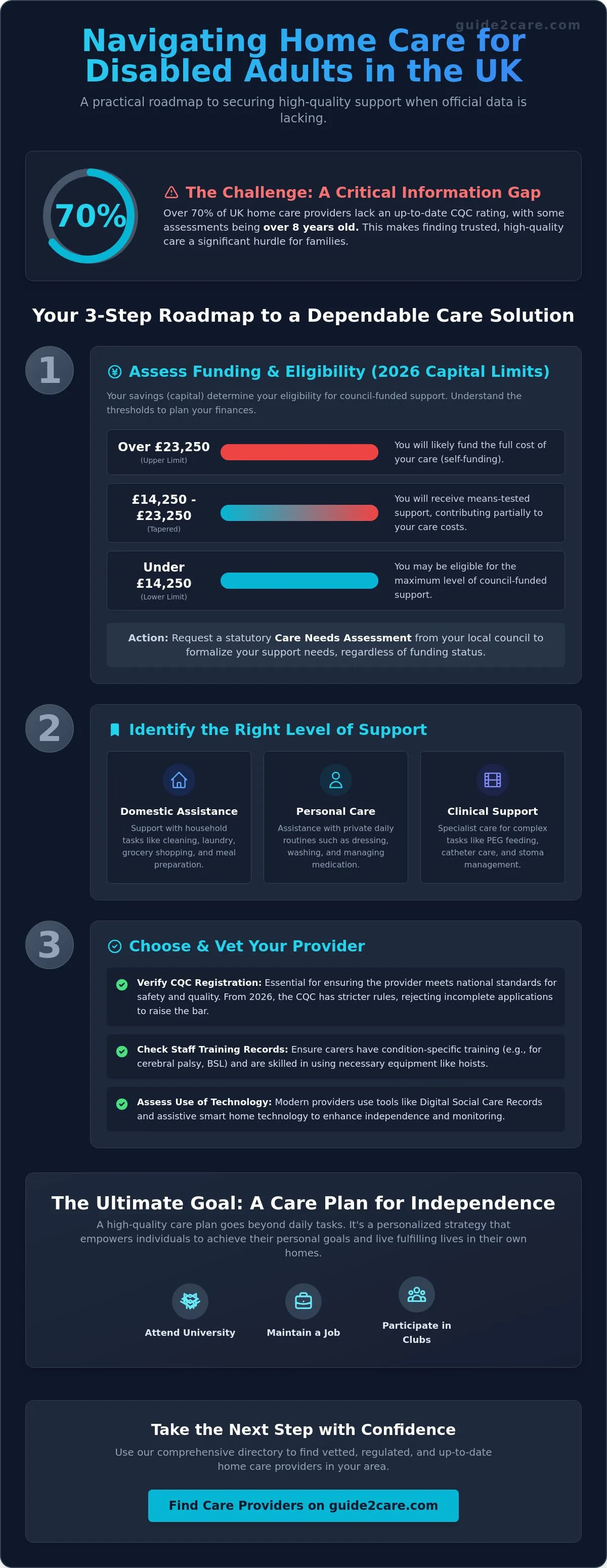
Over 70% of home care providers in the UK currently lack an up-to-date CQC rating, with some assessments dating back eight years or more. This lack of current data makes finding reliable home care services for disabled adults uk a significant challenge for families. You likely find the local authority assessment process complex and the high costs of private care intimidating. It's difficult to trust a service when official quality markers are outdated.
This guide provides a practical roadmap to help you secure high-quality support. Discover how to manage the 2026 capital limits of £23,250 and £14,250 to determine your funding eligibility. Learn the details of the latest Minimum Income Guarantee rates and the steps required to obtain a formal care assessment. We'll also explain how to use our directory to find vetted providers and compare service types. Follow this structured approach to find a dependable care solution for your specific needs.
Key Takeaways
- Learn the 2026 financial thresholds and how to request a statutory Care Needs Assessment from your local council.
- Use our directory to identify and compare regulated home care services for disabled adults uk based on specific support needs.
- Verify provider credentials using the latest CQC registration standards to ensure high-quality, safe support.
- Understand how tailored care plans facilitate independence by focusing on individual goals rather than residential placement.
- Access a clear roadmap for navigating the gap between local authority provision and private care options.
What are Home Care Services for Disabled Adults in the UK?
Home care, often called domiciliary care, refers to professional support provided in a person's own residence. For those seeking home care in the United Kingdom, these services are designed to help individuals maintain their independence. It's an alternative to moving into a residential facility or nursing home. Home care services for disabled adults uk focus on empowering the individual to manage daily tasks while remaining in a familiar environment.
The scope of support varies significantly based on individual requirements. Some people require a single one-hour visit per week for specific chores. Others need 24/7 live-in care to manage complex health conditions. In England, the Care Quality Commission (CQC) regulates these services. They monitor providers to ensure they meet essential standards of safety and quality. As of 2026, the CQC has implemented stricter registration rules. They now return or reject incomplete applications immediately to ensure only competent providers enter the market. Always check a provider's current registration status before making a commitment.
The Difference Between Home Help and Specialist Care
Understand the distinction between basic assistance and clinical support to choose the right service level. Providers often categorise their offerings into three main areas:
- Domestic assistance: This includes household tasks like cleaning, laundry, and grocery shopping. It often involves guidance on meal preparation to ensure nutritional needs are met.
- Personal care: These services assist with private daily routines. Examples include help with dressing, washing, and managing medication schedules.
- Clinical support: This level requires specialist training. Care teams manage complex tasks such as peg feeding, catheter care, and stoma management.
Who is Eligibility for Disability Home Care?
Eligibility depends on the impact a disability has on an individual's daily life. Support is available for adults with physical disabilities, sensory impairments, or learning disabilities. It also covers people recovering from serious injuries or those living with chronic, long-term conditions.
Under the Care Act 2014, local councils must assess anyone who appears to have a need for care and support. This statutory assessment determines if your needs meet the national eligibility criteria. Even if you don't qualify for council funding, you can still access private home care services for disabled adults uk by using a directory to find a suitable provider. The goal is to ensure you receive the specific level of assistance required to live safely and comfortably at home.
Types of Specialist Support for Different Disabilities
Specialist expertise is essential when selecting home care services for disabled adults uk. Generic care often fails to address the nuances of specific conditions like cerebral palsy, muscular dystrophy, or acquired brain injuries. A care team with condition-specific training ensures safety and measurable progress. It also provides the technical skills required to manage complex medical needs effectively. Check a provider's staff training records to ensure they match your specific requirements.
For individuals managing neurological or mobility-related disabilities, finding the right clinical specialists is just as important as finding the right home care. Many people use a chiropractor directory listing to connect with doctors who specialize in spinal health, which can complement the daily support provided by home care agencies. Building a comprehensive team of experts ensures all aspects of your wellbeing are addressed.
Transitioning from children's services to adult social care is a significant change. It requires proactive planning to prevent a loss of support during the move to adult life. You should Apply for a needs assessment through your local authority as early as possible. This statutory process defines your eligibility for funding and outlines the specific support required for your future care plan. It's the first step in building a sustainable support system.
Care plans are tailored to individual goals. They aren't just lists of domestic tasks. Your plan might include support for attending university, maintaining a job, or participating in local clubs. Modern home care also uses assistive technology to promote independence. This includes voice-activated smart home systems and Digital Social Care Records. These tools allow for real-time updates and more precise monitoring of your wellbeing. Use our directory search filters to identify providers with expertise in these specific areas.
Physical and Sensory Disability Support
Mobility assistance is a core component of physical support. Carers use safe lifting and handling techniques to prevent injury. This often involves using equipment like hoists or standing aids. For those with sensory impairments, communication is the priority. Specialist carers provide support through British Sign Language or by managing high-contrast visual aids for those with sight loss. Integrating equipment like smart sensors helps maintain safety without compromising your privacy.
Learning Disability and Mental Health Care
Support for learning disabilities focuses on supported living principles. The goal is to help you live independently in your own home using home care services for disabled adults uk tailored to your needs. Carers assist with developing life skills such as budgeting, cooking, and socialising. For mental health needs, emotional wellbeing monitoring is vital. Care teams use positive behavioural support strategies to create a stable environment. This structured approach helps you maintain control over your daily life while ensuring your safety.
Managing Costs and Funding for Disability Care
Secure a Care Needs Assessment from your local authority to begin the funding process. This is a statutory requirement under the Care Act 2014. The assessment identifies your specific support requirements and determines if you meet national eligibility criteria. Once your needs are established, the council conducts a financial means test to decide who pays for your care.
For the 2026-2027 period, England uses specific capital limits to determine financial support. If your savings and assets exceed £23,250, you're responsible for the full cost of your home care services for disabled adults uk. If your assets are between £14,250 and £23,250, the local authority contributes to the cost, but you'll also make a means-tested contribution. Individuals with assets below £14,250 receive the highest level of financial assistance. They generally only contribute from their weekly income, minus a protected Minimum Income Guarantee.
The council calculates a Personal Budget based on your assessment. This is the total amount of money required to meet your eligible needs. You can also access non-means-tested benefits to help cover costs. Personal Independence Payment (PIP) is available to adults under Pension Credit age, while Attendance Allowance supports those above it. These benefits are paid regardless of your income or savings. They provide essential additional funds to help you maintain your independence at home.
Direct Payments: Taking Control of Your Care
Request your Personal Budget as a Direct Payment to gain maximum autonomy. This allows you to receive the cash directly into a dedicated bank account. You can use these funds to employ your own personal assistants or contract with specific home care services for disabled adults uk. Remember that choosing this route makes you an employer. You'll be responsible for managing payroll, tax, and liability insurance. Use a directory to find agencies that specifically accept Direct Payments to streamline your search.
Grants and Additional Financial Support
Check for additional funding beyond social care budgets. The Disabled Facilities Grant (DFG) provides up to £30,000 in England for essential home modifications like stairlifts or walk-in showers. Many condition-specific organisations also offer support. For example, the Motability Scheme provides grants for adapted vehicles. Additionally, apply for a Council Tax reduction if your home has been modified to meet disability needs. This can move your property into a lower valuation band, reducing your monthly outgoings.
How to Choose and Vet a Home Care Provider
Selecting a provider requires a methodical approach to ensure safety and compatibility. Start by verifying that any agency offering home care services for disabled adults uk is registered with the Care Quality Commission (CQC). As of February 9, 2026, the CQC has implemented stricter registration rules, rejecting incomplete applications immediately. This ensures that only providers meeting high operational standards enter the market. Use our platform to search our directory of vetted providers and verify their current regulatory status before making contact.
Check the specific experience of the staff regarding your particular disability. A provider might have a "Good" rating for elderly care but lack the technical expertise required for complex spinal injuries or sensory impairments. Ask for evidence of specialist training modules completed by the team. Review the latest inspection report specifically for the "Safety" and "Responsiveness" categories. These sections highlight how well the agency manages risks and how quickly they adapt to changing client needs. Be aware that many providers have ratings that are several years old due to a significant inspection backlog. In these cases, ask the manager for their most recent internal quality audit.
Conduct a formal interview with the agency manager. Inquire about staff turnover rates. In late 2025, the median hourly rate for care workers was £12.60, leading to recruitment challenges across the sector. High turnover often results in a rotating cast of carers, which can be disruptive. Prioritise agencies that demonstrate high staff retention. Finally, always request a trial period or a meet-and-greet. This allows you to assess the personal rapport between the carer and the individual receiving support before signing a long-term contract.
What to Look for in a CQC Report
CQC reports use four standard ratings: Outstanding, Good, Requires Improvement, and Inadequate. Focus on the "Well-led" section. Red flags here, such as poor record-keeping or lack of management oversight, often predict future failures in care quality. For those with clinical disability needs, the "Effective" rating is the most critical. it measures whether the care provided leads to good outcomes and is based on the best available evidence and specialist guidance.
Interview Questions for Potential Agencies
Use these specific questions to evaluate the suitability of home care services for disabled adults uk:
- How do you match specific carers to the personal interests and communication needs of the client?
- What is your documented procedure for providing emergency cover if a regular carer is ill or unavailable?
- Can you provide anonymised case studies or references from other clients with similar disabilities?
- How do you use Digital Social Care Records to keep family members informed of daily progress?
Find Regulated Disability Care Providers with Guide2Care
Organising a search for home care services for disabled adults uk requires a reliable tool to manage the volume of data. Guide2Care operates as a comprehensive directory designed to simplify this process. It categorises providers based on their specific specialisms and geographic reach. By using our structured database, you can bypass generic searches and focus on agencies with verified experience in disability support. This approach brings order to your search and ensures you only engage with relevant organisations.
Review the detailed provider profiles on our platform to understand their specific capabilities. Each listing highlights specialised offerings, such as experience with neurodiversity, sensory impairments, or specific clinical training. This transparency allows you to vet potential agencies before making initial contact. It reduces the time spent on unsuitable enquiries and helps you build a shortlist of qualified candidates quickly. Use the information provided to ensure the agency's expertise aligns with your personal goals and requirements.
Using the Guide2Care Directory Efficiently
Use the search filters to narrow results based on your unique needs. Select "Home Care" and then refine by "Physical Disability" or "Learning Disability" to find niche experts. These filters identify providers who understand specific care protocols and have the necessary equipment expertise. Our platform provides direct contact details for each listing to speed up the enquiry process. You can also compare multiple providers side-by-side. Use this feature to evaluate differences in service delivery and staff specialisms without navigating multiple external websites.
Start Your Search Today
Secure your support system by beginning the search process early. High-quality providers often have limited availability, so proactive planning is essential for achieving the best care outcomes. Follow a logical path by identifying your needs, checking funding eligibility, and then using a regulated directory to find your provider. Use our interface to find home care services for disabled adults near you. Our categorical approach simplifies the task of finding regulated support and empowers you to make an informed choice with confidence.
Secure Your Home Care Support Today
Finding the right home care services for disabled adults uk requires a systematic approach. You must verify CQC registration status, understand the 2026 capital limits for funding, and interview potential agencies to ensure they have condition-specific expertise. These steps protect your personal safety and long-term financial stability. It's essential to plan your care needs ahead of time to avoid gaps in support during transitions or emergencies. Our platform simplifies this search by organizing complex data into a manageable format, allowing you to focus on providers that meet your specific requirements.
Access our comprehensive UK-wide directory to find CQC-regulated provider information and expert guides on funding and selection. Use our filters to narrow your search by location and specialist care type to find niche experts. Find and compare home care providers for disabled adults on Guide2Care. With the right information and a structured search strategy, you can secure the high-quality support necessary to maintain your independence and wellbeing at home. Take the first step toward a sustainable care solution today.
Frequently Asked Questions
How do I get a free care assessment for a disabled adult?
Contact your local council's social services department to request a Care Needs Assessment. Every adult in the UK has a statutory right to this assessment regardless of their financial situation. The council will evaluate your daily living needs and determine your eligibility for support based on national criteria. This process is the first step in accessing council-funded care.
How much does home care for disabled adults cost in the UK?
Hourly home care typically costs between £26 and £38 per hour in 2026. For those requiring constant support, live-in care costs range from £900 to £1,600 per week on average. These rates vary based on the complexity of your disability and your geographic location. Always request a detailed quote from a provider before starting any services.
Can I get help with home care if I have savings?
You qualify for partial local authority funding if your assets and savings are between £14,250 and £23,250. If your capital is below £14,250, you'll receive the maximum available financial assistance. Those with savings above £23,250 are considered "self-funders" and must pay the full cost of home care services for disabled adults uk themselves until their savings drop below the threshold.
What is the difference between a personal assistant and a home carer?
A home carer is employed by a regulated agency that manages their training, scheduling, and supervision. In contrast, a personal assistant is usually employed directly by the disabled adult using Direct Payments. While personal assistants offer more flexibility, you take on the legal responsibilities of an employer. This includes managing payroll, tax, and liability insurance.
Are home care services for disabled adults regulated?
Yes, all professional home care agencies in England must be registered with the Care Quality Commission (CQC). The CQC monitors, inspects, and rates these services to ensure they meet essential standards of safety and quality. However, individual personal assistants working directly for a client are currently not subject to CQC regulation. Always verify a provider's registration status before hiring.
How long does it take to arrange home care in the UK?
Arranging care can take anywhere from a few days to several months. Private care can often be set up within a week if a provider has staff availability. Council-funded care takes longer because you must wait for a Care Needs Assessment and a financial means test. These statutory processes often involve waiting lists depending on your local authority's current capacity.
Can I use PIP to pay for home care services?
Yes, you can use the daily living component of your Personal Independence Payment (PIP) to fund home care services for disabled adults uk. PIP is a non-means-tested benefit designed to help with the extra costs of living with a long-term disability. It's paid directly to you. This allows you to choose exactly how to spend the funds on your personal support needs.
What happens if my care needs change over time?
Request a care review from your provider or local council if your condition improves or deteriorates. Your care plan is a live document that should be updated regularly to reflect your current situation. If your needs increase significantly, the council may conduct a new Care Needs Assessment. This ensures your Personal Budget or funding level remains appropriate for your requirements.