Social Care Reform UK 2026 Update: A Comprehensive Guide to New Changes

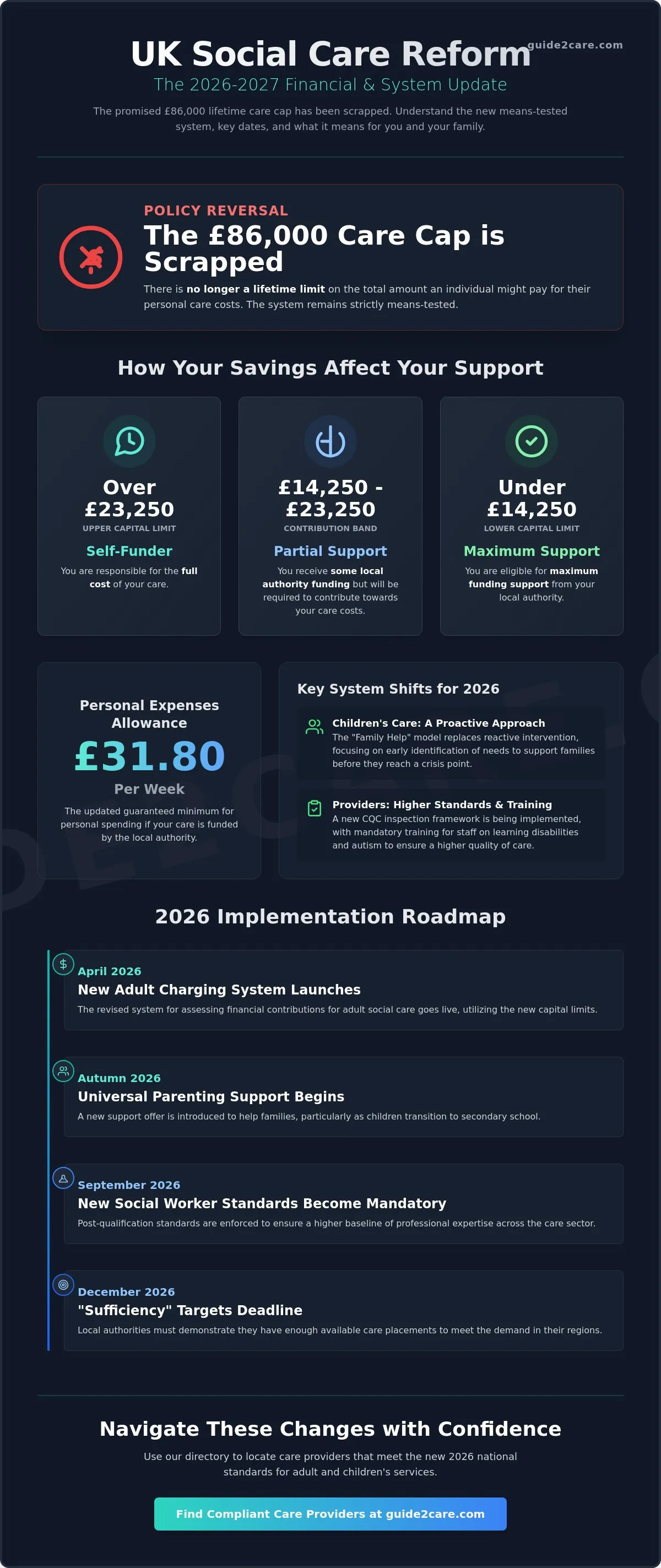
The promised £86,000 lifetime cap on personal care costs is officially scrapped. Families must now navigate a system that remains strictly means-tested. It's understandable to feel confused by technical jargon and shifting government policies. This social care reform uk 2026 update simplifies the current landscape so you can make informed decisions. Use this guide to master the 2026-2027 charging thresholds and understand your financial obligations.
Learn about the £23,250 upper capital limit and the updated £31.80 weekly personal expenses allowance. We also outline the "Children's Social Care Reset" and new CQC inspection standards. Follow this roadmap to identify quality care providers and secure necessary support. This article breaks down complex legislative changes into manageable sections, moving from broad funding rules to specific action steps for families and carers.
Key Takeaways
- Clarify why the £86,000 care cap was scrapped and how the 2026 means-testing rules impact your assets.
- Identify the new capital thresholds of £23,250 and £14,250 to determine your eligibility for local authority support.
- Review the mandatory training requirements for care staff regarding learning disabilities and autism under the updated CQC framework.
- Navigate the social care reform uk 2026 update using our practical checklist for financial audits and care account registration.
- Use our directory to locate care providers that meet the new 2026 national standards for adult and children's services.
The UK Social Care Landscape: What Changes in 2026?
2026 marks the point where the UK government transitions from testing social care models to full-scale implementation. This social care reform uk 2026 update highlights the culmination of the "Build Back Better" strategy. The system moves beyond the 2025 Pathfinder trials. It now focuses on nationwide consistency under the final provisions of the Health and Care Act 2022. Understanding the structure of Social care in England is essential for anyone managing care for themselves or a family member. These changes represent a move toward a more integrated, preventative system across all local authorities.
The core objective of these changes is a fundamental shift from crisis management to prevention. Local authorities must now prioritize "Family Help" over reactive intervention. This approach aims to identify needs earlier and reduces the reliance on emergency services. It creates a more sustainable model that supports individuals in their own homes for longer periods. By focusing on early intervention, the government aims to stabilize the care market and improve long-term outcomes for both adults and children.
To better understand how these changes impact the system, watch this session on the 2026 social care outlook:
The Move Towards Early Intervention
The "Family Help" model officially replaces traditional "Children in Need" categories as part of the "Delivering the Children's Social Care Reset" plan published in May 2026. This change simplifies how families access support by removing complex bureaucratic labels. 2026 is the final deadline for local authorities to prove that these preventative services are effective. Multi-agency safeguarding hubs serve as the foundation for the new framework. These hubs bring together social workers, police, and health professionals. They coordinate care before a situation reaches a breaking point, ensuring that support is proactive rather than reactive.
Key Dates and Deadlines for 2026
Stay informed about these critical milestones throughout the year. They dictate when specific parts of the social care reform uk 2026 update take effect:
- April 2026: The revised adult social care charging system launches. This update utilizes the new capital limits of £23,250 and £14,250 to assess financial contributions.
- Autumn 2026: A new universal parenting support offer begins. This helps families as children transition to secondary school.
- September 2026: New post-qualification standards for social workers become mandatory. These standards ensure a higher baseline of professional expertise across the sector.
- December 2026: Local authorities must meet year-end "sufficiency" targets. They must demonstrate they have enough available care placements to meet the actual demand in their specific regions.
Monitor these dates closely. They represent the transition from policy theory to operational reality for care providers and families across the UK. Use our directory to find providers that already align with these emerging standards.
Adult Social Care Funding: The 2026 Charging Cap Update
The 2026 financial landscape for adult care has shifted significantly from previous legislative proposals. This social care reform uk 2026 update clarifies the current rules regarding asset limits and personal contributions. While many expected a lifetime cap on care costs, the system continues to operate on a strict means-tested basis. It's vital to understand how your assets dictate your level of state support. Accurate financial planning depends on knowing the verified thresholds currently in use by local authorities.
The government has scrapped the proposed £86,000 lifetime cap on personal care costs. There's currently no limit on the total amount an individual might pay for their care over their lifetime. Individuals are responsible for the full cost of their care if their assets exceed the upper capital limit. This decision marks a major policy reversal from earlier reform targets. It makes early financial planning and accurate asset assessment more critical for families than ever before.
Understanding the Status of the Care Cap
The distinction between "personal care" and "daily living costs" was a central part of previous reform discussions. Personal care includes assistance with washing, dressing, and eating. Daily living costs refer to accommodation, food, and utility bills in a residential setting. Because the cap has been scrapped, you must prepare to cover both types of costs according to your means. Local authorities don't track progress toward a lifetime limit since the cap isn't in effect. This means the "Care Account" system, once intended to monitor spending, isn't the primary tool for 2026 self-funders.
New Means-Testing Thresholds
For the 2026-2027 period, the upper capital limit is £23,250. If your assets, including property in specific scenarios, exceed this amount, you're classified as a "self-funder." The lower capital limit is set at £14,250. If your assets fall below this level, you'll only pay what you can afford from your income. Between these two figures, the local authority provides partial support. These figures represent the verified legal standards following the 17 February 2026 local authority circular. While adult funding remains means-tested, the government is simultaneously implementing the UK Children's Social Care Reforms to overhaul other parts of the sector.
Request a "Financial Assessment" from your local council immediately upon seeking care. This process establishes your baseline for support and confirms your funding status. It also determines your eligibility for the Personal Expenses Allowance, which has increased to £31.80 per week for 2026. Understanding these distinctions helps you manage long-term care budgets effectively. Search our directory to find care providers that work within these local authority funding frameworks.
Children’s Social Care: From "Pathfinders" to National Policy
2026 marks the definitive shift from regional trials to a nationwide standard for children's services. This social care reform uk 2026 update focuses on the full implementation of the "Stable Homes, Built on Love" strategy. The government has allocated £2.4 billion for the Families First Partnership programme to ensure these changes reach every local authority by March 2027. Multi-agency child protection teams now operate as the primary operational unit. These teams integrate social workers, police, and health professionals to provide a unified response. The role of the "Lead Practitioner" is now expanded. This individual manages the coordination of all services for a specific family. They act as a single point of contact to reduce confusion and ensure accountability during critical safeguarding phases.
Data management is a critical component of this transition. The government is implementing a Single Unique Identifier for every child in the system. This tool balances the need for multi-agency data sharing with individual privacy rights. It ensures that health, education, and social care records are linked. This connectivity prevents information silos that previously delayed support. It also allows for smoother transitions when families move between local authority boundaries.
Support for Kinship Carers
New legal definitions for kinship care take effect in 2026. These definitions clarify the rights of family members who provide non-parental care. Councils must now publish a formal local kinship offer. This policy move aims for financial parity with foster care allowances. It ensures family guardians receive the same level of training and support entitlements as registered foster parents. Families can also access the £13 million Family Group Decision Making (FGDM) initiative. This programme empowers relatives to lead the planning process for a child's welfare before legal proceedings begin.
The New "Family Help" Model
The "Family Help" model prioritizes keeping families together. It merges early help services with "Child in Need" status to create a seamless support path. Families can access resources without the stigma of formal intervention. Use the new Family Network Support Packages to secure practical assistance in the home. From autumn 2026, a universal parenting support offer will also help families during the transition to secondary school. This proactive approach reduces the need for emergency placements. It ensures that support is available the moment a challenge arises rather than waiting for a crisis to occur.
Impact on Care Providers: New Standards and Inspections
This social care reform uk 2026 update introduces a higher level of accountability for all registered providers. The Care Quality Commission (CQC) has moved away from traditional, periodic inspections. Instead, the Single Assessment Framework now relies on continuous data collection and real-time monitoring. Providers must demonstrate ongoing compliance across five key quality questions. This shift ensures that safety and effectiveness are measured daily, not just during a scheduled visit. Organizations that fail to provide regular data updates risk a downgrade in their quality rating.
Compliance with the Data Security and Protection Toolkit (DSPT) is now a prerequisite for receiving local authority funding. Providers must also meet the 2026 deadline for Digital Social Care Records (DSCR). This move toward a paperless system allows for better information sharing between health and social care services. It reduces errors and ensures that care teams have immediate access to updated medical and personal histories. The social care reform uk 2026 update also mandates that these digital systems are interoperable with NHS records to streamline hospital discharges.
CQC Inspection Changes in 2026
The new framework prioritizes "Consumer Standards." This means that the lived experience of service users carries more weight in a provider's final rating. The CQC now uses evidence from people’s experiences and feedback from families as primary data points. Learn how to interpret CQC ratings when choosing a provider to ensure you select a service that meets these modern benchmarks. Monitoring is now a persistent process. Ratings can change at any time based on the data submitted by the provider or feedback received by the regulator.
Staffing and Training Mandates
The government has allocated £245 million to implement legislative commitments and reform the care market. This funding supports the transition to these rigorous new standards. Providers must now align their operations with the Children's Wellbeing and Schools Act 2026 where applicable. Use our directory to find providers that meet the latest CQC standards and training requirements.
Preparing for the Update: Checklist for Families and Providers
Preparation for the social care reform uk 2026 update requires immediate action to align with new financial and digital standards. Families must move from passive observation to active planning to manage the costs of care. For individuals, the priority is establishing a baseline for support through local authority channels. Providers must ensure their operational data is ready for continuous CQC monitoring. This checklist provides the specific steps needed to secure compliance and quality care under the 2026 framework.
For families, the first step is a thorough financial audit. The upper capital limit remains at £23,250 for the 2026-2027 period. If your assets exceed this amount, you're responsible for the full cost of your care. Individuals should contact their local authority to request a formal assessment. This process determines your eligibility for support and establishes your funding status. Providers must finalize their transition to Digital Social Care Records (DSCR) before the year-end deadline. Paper-based systems no longer meet the requirements for funding or CQC data sharing.
How to Audit Your Care Costs
Managing care budgets effectively requires a granular understanding of your invoices. Follow these steps to prepare for the 2026 charging system:
- Step 1: Separate "care costs" from "hotel costs" in your current invoices. Care costs include assistance with daily living, while hotel costs cover accommodation and food.
- Step 2: Document all self-funded care spending to date. Maintain clear records of all payments made to registered providers. This documentation is essential for any retrospective claims or local authority reviews.
- Step 3: Consult a SOLLA-accredited financial adviser. These specialists understand the specific nuances of the 2026 reform and can help protect your assets within the legal framework.
Finding the Right Care in 2026
Generic search engine results often lack the verification needed for the new regulatory environment. Directory-led searches are more reliable because they categorize providers based on their current CQC evidence and training compliance. When you speak with potential providers, ask specifically about their 2026 reform readiness. Confirm they have implemented the Oliver McGowan Mandatory Training and that their digital records are interoperable with local health hubs. Use verified resources to ensure the provider you choose meets the latest national standards. Search the Guide2Care directory for providers meeting the 2026 standards to begin your search with confidence. This proactive approach ensures your care choice is both safe and compliant with the social care reform uk 2026 update.
Secure Your Care Strategy for 2026
The 2026 landscape requires precise financial and operational planning. You now know that the £86,000 care cap is scrapped and asset thresholds remain strictly means-tested at £23,250 and £14,250. Local authorities are focusing on early intervention through the Family Help model and multi-agency child protection teams. This social care reform uk 2026 update emphasizes that quality care depends on meeting these new digital and professional standards. Use this information to review your current care arrangements or prepare for future needs. It's essential to act now to ensure your plans align with the latest legislative requirements.
Access our UK-wide directory of CQC-registered homes to find services that align with these updated requirements. We provide independent resources for families and providers to simplify the transition. Use our platform to filter for providers who demonstrate compliance with the latest 2026 guidance. Find a 2026-compliant care provider in our directory. Don't delay your financial audit or your registration for a local authority assessment. Taking these steps today protects your interests and secures high-quality care. You can move forward with confidence by using verified tools and up-to-date information.
Frequently Asked Questions
Is the social care cap definitely starting in 2026?
No, the government has scrapped the proposed £86,000 lifetime cap on personal care costs. Individuals now face potentially unlimited care costs subject to the standard means test. This policy reversal is a critical part of the social care reform uk 2026 update. You should plan your care budget based on current capital limits rather than an expected cap.
How much will I have to pay for care under the 2026 rules?
Your contribution depends on your total assets and income. If your assets exceed £23,250, you're responsible for the full cost of your care. If your assets are below £14,250, you'll only pay what you can afford from your income. For assets between these two figures, the local authority provides partial funding support.
What counts towards the £86,000 care cap?
Nothing currently counts toward a cap because the government cancelled the £86,000 limit in early 2026. Previously, only "personal care" costs would've counted, excluding "daily living costs" like food and rent. Since the cap is no longer in policy, all care and accommodation costs are billed according to the results of your means test.
Will my house be included in the means test for care in 2026?
Your home is included in the means test if you move into a residential care home and no protected person lives there. Protected persons include a spouse, partner, or a disabled relative. If you receive care in your own home, the value of that property is typically excluded from the financial assessment.
How do the 2026 reforms affect children with disabilities?
The social care reform uk 2026 update prioritizes integrated multi-agency support for children with disabilities. Reforms use a Single Unique Identifier to link health, education, and social care records. This ensures that different agencies share information instantly. The Families First Partnership programme also provides earlier access to specialized equipment and home support services.
What is the new "Family Help" service in children’s social care?
Family Help is a unified service that replaces traditional "Children in Need" categories. It merges targeted early help with formal support to provide a seamless experience for families. This model uses a single Lead Practitioner to coordinate all necessary services. It aims to reduce the number of different professionals a family must interact with during the support process.
How can I set up a Care Account with my local council?
You don't need to set up a Care Account because the government scrapped the care cap tracking system. Instead, contact your local council to request a "Needs Assessment" and a "Financial Assessment." These official documents establish your eligibility for support and determine your specific financial contribution toward care services.
Are care providers required to be digital-only by 2026?
Yes, the 2026 deadline requires all registered providers to use Digital Social Care Records (DSCR). This move ensures that care information is interoperable with NHS systems for safer hospital discharges. Providers must also maintain compliance with the Data Security and Protection Toolkit to remain eligible for local authority funding contracts.