How to Get More Private Clients for Home Care: The 2026 Growth Guide

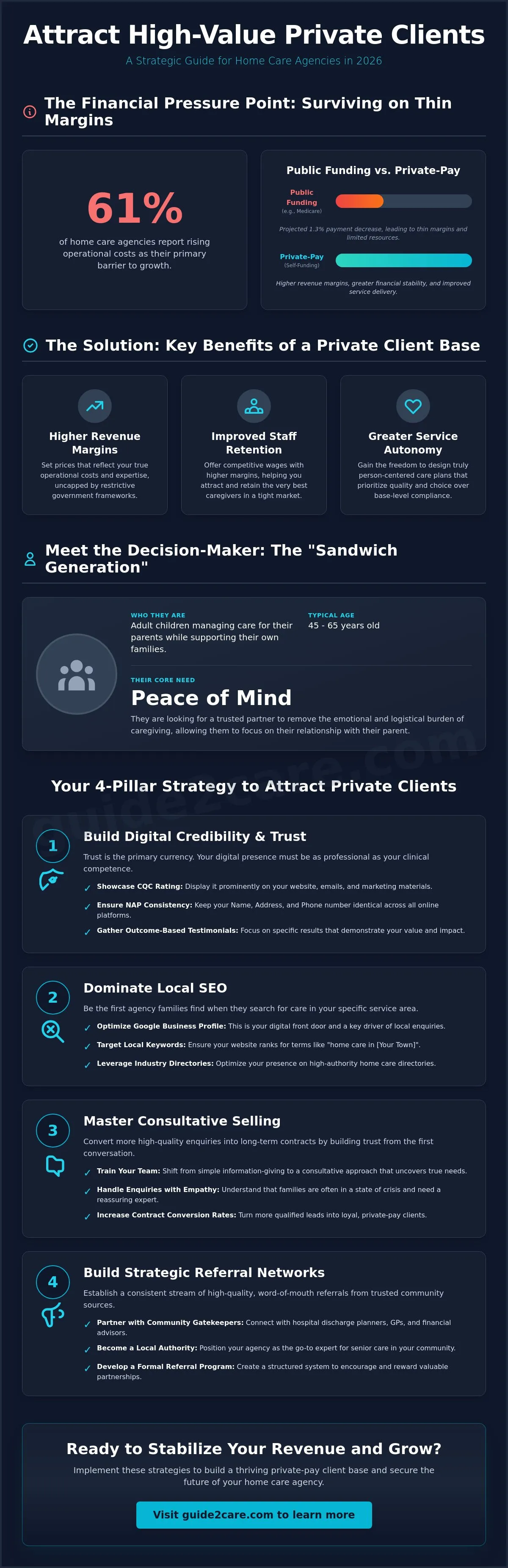
61% of home care agencies report that rising operational costs are the primary barrier to growth in 2026. With Medicare payments projected to decrease by 1.3% this year, relying on public funding often results in thin margins and limited resources. You must secure higher-value contracts to maintain a sustainable business model. Master the process of how to get more private clients for home care to stabilize your revenue and improve service delivery.
Attracting private-pay families requires a shift from traditional marketing to building digital credibility clusters. You likely face intense competition from national franchises and struggle to prove your value to cautious families. This guide provides the practical steps to establish your agency as a trusted local resource. Follow these strategies to utilize directory listings, leverage advertising partnerships, and create a consistent stream of high-quality private enquiries.
Key Takeaways
- Shift your business model toward private-pay services to secure higher margins and long-term financial stability.
- Discover how to get more private clients for home care by optimizing your presence on high-authority industry directories.
- Use local SEO strategies and Google Business Profile optimization to dominate search results in your specific service area.
- Build strategic partnerships with community gatekeepers to establish a consistent stream of word-of-mouth referrals.
- Train your team in consultative selling to handle sensitive enquiries and increase your contract conversion rates.
Understanding the Private-Pay Home Care Market in 2026
Private-pay home care, often referred to as self-funding in the UK, involves services paid for directly by individuals or their families. In 2026, this market segment is critical for agency sustainability. Local authority budgets are increasingly stretched, leading to commissioning rates that often fall below the actual cost of delivery. Learning how to get more private clients for home care allows you to bridge this funding gap and build a more resilient business. Understanding the wider context of home care services in the UK helps you position your agency within a market that prioritizes quality and choice over base-level compliance.
To better understand this concept, watch this helpful video:
The 2026 CQC Single Assessment Framework has shifted the marketing focus toward continuous quality evidence. Families no longer wait for a physical inspection report. They monitor digital platforms for real-time performance data. This shift means your digital credibility is now as important as your clinical competence. If you want to attract families who have the means to pay privately, you must demonstrate your value through transparent, up-to-date information.
Identify your primary decision-maker. This is usually a member of the "sandwich generation." These are adult children, typically aged 45 to 65, who manage care for their parents while supporting their own families. Their core objection isn't about the price or the specific tasks. They're looking for peace of mind. Effective strategies for how to get more private clients for home care focus on this emotional relief. Position your agency as the partner that removes the burden of caregiving, allowing them to focus on their relationship with their parent.
The Benefits of Increasing Your Private Client Base
- Higher Revenue Margins: Private rates aren't capped by local authority frameworks. This allows you to set prices that reflect your actual operational costs and expertise.
- Improved Staff Retention: Use your higher margins to offer competitive wages. In a market where agencies struggle with rising staff costs, paying more than the median rate helps you keep your best caregivers.
- Greater Service Autonomy: You gain the freedom to design person-centred care plans without the restrictions often found in government-funded care packages.
Key Barriers to Attracting Private Enquiries
- Lack of Brand Awareness: Many agencies remain invisible to the families who need them most. Without a strong local presence, you lose potential clients to national franchises with larger marketing budgets.
- Inadequate Online Presence: An outdated website or a lack of reviews creates skepticism. Families need to see professional authority before they trust you with a loved one.
- Difficulty Articulating Value: If you can't explain why your service is worth a premium price, families will choose the cheapest option or stick with basic council services.
Optimising Your Digital Credibility and Directory Presence
Trust is the primary currency in the private-pay market. Your Care Quality Commission (CQC) rating serves as the foundational proof of your service quality. Display this rating prominently on your homepage, email signatures, and marketing materials. Families often filter their searches based on these ratings before reading a single word of your copy. High ratings correlate directly with higher conversion rates for private enquiries.
Consistency across the web builds authority. Ensure your Name, Address, and Phone number (NAP) are identical on every platform. Search engines use this data to verify your legitimacy. Inaccurate information creates confusion and hurts your ranking in local search results. Implementing professional digital marketing for home care providers involves auditing these details monthly. This ensures that a family finding you on social media sees the same contact details as they do on a professional directory.
Focus on outcome-based testimonials. Generic praise like "the staff are lovely" is common. Private-pay families look for specific results. Ask clients to describe how your care improved their daily lives. A testimonial stating "Dad regained his mobility after three months of specialized support" carries more weight than simple compliments. These specific stories help families visualize the "peace of mind" they're actually buying. This transition in messaging is a vital step in how to get more private clients for home care.
Maximising Value from Care Directories
High-authority care directories often outrank individual agency websites for "home care near me" searches. Use platforms like Guide2Care to capture this high-intent traffic. These directories aggregate providers, making it easier for families to compare options. Complete your profile thoroughly. Upload high-resolution photos of your staff and community events. Avoid stock imagery; families want to see the real people providing the care. Speed is a competitive advantage. Respond to every directory enquiry within two hours. This fast response time signals reliability and professionalism to prospective clients. You can list your care agency on our directory to reach more local families actively seeking private support.
Building an Authority-First Website
Your website must act as a digital storefront. Create dedicated service pages for specific needs. If you offer dementia care or respite services, give each its own page. This structure helps you rank for specific search queries and shows deep expertise. Humanise your brand with a "Meet the Team" page. Include professional headshots and brief bios for your management and senior caregivers. This reduces the perceived risk for families. Most adult children search for care on their smartphones during lunch breaks or between meetings. Ensure your site is mobile-responsive. A site that loads slowly or displays poorly on mobile will lead to high bounce rates.
Local SEO and Digital Marketing Strategies
Local SEO is the most direct method for capturing families in immediate need. Claim your Google Business Profile to appear in the local map packs. This is often the first thing families see when searching for care options. Use long-tail keywords to attract specific enquiries. Instead of targeting broad terms, focus on phrases like "private dementia care in [Your Town]." These specific searches indicate a higher intent to purchase and lower competition from national franchises.
Social media advertising offers a way to reach the "sandwich generation" before they reach a crisis point. Use Facebook advertising to target users aged 45 to 65 within your local radius. Focus your targeting on interests related to elderly care and family caregiving. This demographic is the primary decision-maker for private-pay services. Monitor your online reputation across all platforms. Respond to every Google Review and directory feedback entry. A proactive approach to feedback demonstrates your agency's commitment to transparency and service quality.
Mastering Google Business Profile for Home Care
Treat your Google Business Profile as a dynamic marketing tool. Post weekly updates to show your agency is active. Share photos of staff training sessions or community engagement events to build trust. Encourage families and staff to leave detailed reviews. Ask them to mention specific services like companion care or personal care. This helps your profile rank for those specific terms. Use the Q&A section to address common concerns. Answer questions about the initial assessment process or how private funding works to reduce friction for prospective clients.
Paid Advertising for Immediate Enquiries
Run Google Ads to capture high-intent searches. Target keywords like "urgent live-in care" or "private home help near me" to reach families in crisis. These families often bypass organic results to find immediate solutions. Use lead magnets to build an email list of local prospects. Offer a free "Home Safety Checklist" or a "Guide to Choosing Care" in exchange for an email address. This allows you to nurture leads who aren't ready to book immediately. Retarget website visitors with testimonials. Seeing a success story after visiting your site keeps your agency top-of-mind during their final decision-making phase. This multi-channel approach is a proven way for how to get more private clients for home care while maintaining a steady enquiry pipeline.
Building Strategic Referral Networks in the Community
Referral marketing provides a high conversion rate because it relies on pre-existing trust. Identify "Gatekeepers" who interact with families before a care crisis occurs. Solicitors specializing in Wills and Probate are key partners. They often speak with families during estate planning or Power of Attorney discussions. Establish professional relationships with these firms to become their recommended provider for home support. This physical presence in the community is a core strategy for how to get more private clients for home care. Develop a formal referral programme for your existing families and staff. Offer small, practical tokens of appreciation for successful introductions. This encourages your current network to advocate for your brand.
Host educational workshops at local libraries or community centres. Focus on topics like "Home Safety for Seniors" or "Understanding Dementia Support." These events position your agency as an expert facilitator rather than a salesperson. Providing free, practical information builds local authority and reduces the skepticism families often feel when selecting a provider. If you want to expand your reach beyond local networking, list your agency on our directory to connect with families searching for care online.
Networking with Healthcare Professionals
Build direct relationships with GP surgery care coordinators and hospital discharge teams. These professionals manage the transition from clinical care to home support. Provide "discharge packs" to local hospitals. These packs should include checklists and contact information to simplify the process for families. Maintain a professional reputation through consistent communication with district nurses. They value agencies that provide reliable, high-quality care and clear reporting. Reliability in these professional circles leads to consistent, high-value private enquiries.
Non-Medical Community Partnerships
Connect with local financial advisors. Families often consult them when managing care funding or long-term estate planning. These advisors need reliable agencies to recommend to their clients. Partner with local branches of national charities for joint community events. This increases your local brand awareness through association with trusted organisations. Educate local pharmacists on your specialist services, particularly medication management. Pharmacists are often the first to notice when a senior is struggling with their prescriptions or basic mobility. They can provide a direct line to families who need private support immediately.
Converting Enquiries into Private Care Contracts
Handling the initial enquiry is the bridge between your marketing efforts and your agency's revenue. Train your front-of-house staff to handle emotional enquiries with professional neutrality and speed. Families calling about home care are often in a state of heightened stress or guilt. A prompt, calm response builds immediate confidence. Avoid complex phone menus that increase frustration. Direct access to a knowledgeable coordinator is essential for securing high-value private contracts. This first verbal interaction validates the digital credibility you established earlier in the journey.
Use a consultative selling approach during the enquiry phase. This method shifts the focus from your agency’s features to the family's specific challenges. Provide clear, transparent pricing brochures early in the conversation to avoid "bill shock" later. Transparency establishes you as a trustworthy partner from the outset. Follow up consistently without being pushy. Use a structured system to guide families through the decision-making process. Persistence demonstrates organizational reliability, which is a key factor in how to get more private clients for home care. Most families require multiple touchpoints before they feel comfortable signing a contract.
The Art of the Home Assessment
The initial home assessment is a critical conversion point. Focus on person-centred outcomes rather than a checklist of clinical tasks. Ask the client what they hope to achieve, such as regaining the ability to tend to their garden or attending a local community group. Highlighting these goals makes the service a tangible benefit to their quality of life. Address the specific concerns of the family, such as safety during the night or nutritional intake. Leave behind a high-quality welcome pack that includes your service agreement, senior staff profiles, and a clear breakdown of the next steps. This physical document reinforces your brand authority long after the meeting ends and serves as a professional reference point for the family.
Scaling Your Growth with Guide2Care
Refine your conversion strategy by using your directory listing as a central marketing hub. Monitor the analytics provided by the directory to see which service descriptions and photos generate the most engagement. If your profile sees high traffic but low enquiry rates, adjust your messaging to better align with the "peace of mind" families are seeking. Use this data to identify which local care needs are most underserved in your area. List your care service on Guide2Care today to start reaching more private families. By integrating directory data with your internal sales process, you can continuously improve your ability to find how to get more private clients for home care and grow your agency sustainably.
Securing Sustainable Growth for Your Agency
Building a robust pipeline of private-pay enquiries requires a structured approach to digital authority and local networking. Focus on optimizing your online presence and maintaining high CQC standards to build immediate trust with families. Implement consultative selling techniques during assessments to address the emotional needs of the "sandwich generation." These steps provide the foundation for how to get more private clients for home care while ensuring your agency remains profitable in a competitive 2026 market.
Consistent visibility is the key to converting interest into long-term contracts. Use high-authority platforms to reach families who are actively searching for support in your area. Join the UK’s leading care directory and grow your private client base today. Our platform offers comprehensive UK-wide coverage and high-authority SEO designed for local care searches. It's trusted by thousands of families monthly. Start implementing these strategies now to achieve higher margins and provide better quality care for your community.
Frequently Asked Questions
How do I find private-pay clients without a large marketing budget?
Focus on local networking and organic digital visibility. Claim your Google Business Profile and establish relationships with community gatekeepers like solicitors or local librarians. Use high-authority directories to capture local search traffic without the high cost of a full-scale national campaign. These platforms allow you to reach families who are actively searching for care options in your specific area.
What are the best keywords for home care marketing in 2026?
Target high-intent long-tail keywords that include specific locations and specialized care types. Examples include "private dementia care in [Town]" or "live-in care for seniors near me." These phrases attract families who are ready to commit to a service. Using specific terms helps you compete with larger franchises by capturing niche local demand.
How much should a home care agency spend on advertising?
Advertising spend varies based on local competition and your specific growth targets. Focus on a return-on-investment model rather than a fixed sum. Many agencies allocate a portion of their revenue to digital channels like Google Ads and local directory listings. This ensures a steady enquiry stream while keeping acquisition costs manageable. Monitor your analytics to adjust spending based on which channels provide the highest quality leads.
Can I get private clients through Facebook?
Facebook is an effective channel for reaching the "sandwich generation" of adult children aged 45 to 65. Use targeted ads to reach local users within this demographic. Share educational content and outcome-based testimonials to build trust. This audience often makes the primary care decisions for their parents and responds well to informative, local messaging.
How do I convince a family that my agency is better than a cheaper competitor?
Highlight your person-centred outcomes and the specific value of your service. Focus on reliability, staff continuity, and professional oversight. Explain that higher rates allow for better caregiver wages and training. This directly impacts the quality and consistency of care. Use testimonials to prove that your agency provides peace of mind that cheaper alternatives cannot guarantee.
Does a "Good" CQC rating actually help attract private clients?
A "Good" or "Outstanding" rating is a fundamental trust signal for families. They often use these ratings as a primary filter when researching how to get more private clients for home care. Display your rating prominently on all marketing materials to validate your professional authority. Families view these independent assessments as essential proof of safety and quality.
What is the most effective way to get referrals from GPs?
Build relationships with surgery care coordinators and provide professional discharge packs. These packs simplify the transition home for patients and their families. Maintain consistent communication with district nurses to ensure your agency remains top-of-mind. Professionals refer to agencies they trust to be reliable and easy to communicate with during complex care transitions.
How do I handle the "we will think about it" objection during an assessment?
Acknowledge the weight of the decision and schedule a specific follow-up time. Provide a high-quality welcome pack that includes testimonials and clear pricing. This gives the family the resources they need to discuss the options while keeping your agency at the center of their decision. Consistent, non-pushy follow-up shows your agency is organized and reliable.