Advertising Your Home Care Agency Effectively: The 2026 Strategy Guide

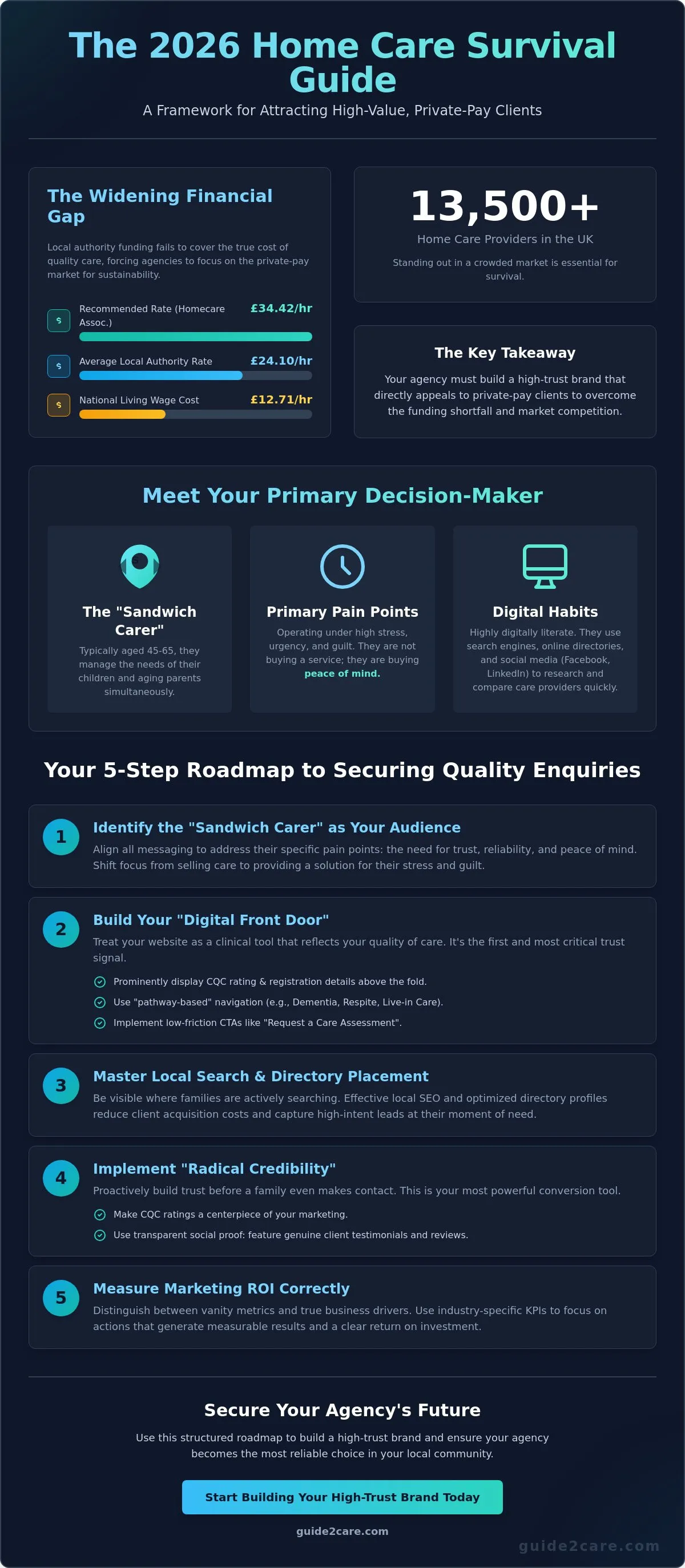
With the Homecare Association recommending a minimum rate of £34.42 per hour for 2026, yet local authorities paying an average of just £24.10, advertising your home care agency effectively to private-pay clients is now a necessity for survival. You likely feel the pressure of rising operational costs, such as the National Living Wage reaching £12.71, while trying to stand out in a market of over 13,500 providers. It's difficult to reach families when the local market feels crowded and your acquisition costs for new clients continue to climb.
This guide provides the frameworks required to build a high-trust brand and secure a consistent stream of quality enquiries. Follow our structured roadmap to leverage CQC data and digital tools, ensuring your agency becomes the most reliable choice in your local community. Use these tactics to simplify your marketing process and focus on the actions that generate measurable results for your business.
Key Takeaways
- Identify the "sandwich carer" as your primary audience to align your messaging with the main decision-makers in the private-pay market.
- Treat your agency website as a clinical tool by including essential trust elements that convert visitors into high-quality enquiries.
- Master local search and directory placement to reduce acquisition costs while advertising your home care agency effectively.
- Implement "Radical Credibility" by using CQC ratings and transparent social proof to build trust before the first phone call.
- Use specific industry KPIs to distinguish between lead generation and brand awareness for a clearer understanding of your marketing ROI.
Understanding the 2026 Home Care Market and Your Audience
The UK home care market in 2026 is defined by a widening gap between state funding and operational costs. Most agencies now prioritize private-pay clients to maintain a sustainable business model. While local authority rates average £24.10 per hour, the Homecare Association recommends £34.42 to cover costs like the £12.71 National Living Wage. Success in this environment requires a deep understanding of who pays for care and how they find it. For a broader perspective on industry structures, consider understanding the U.S. home care landscape, which shares similar distinctions between medical and non-medical support.
To better understand current marketing strategies for this sector, watch this helpful video:
Advertising your home care agency effectively depends on recognizing that the person receiving care is rarely the one searching for it. Most enquiries come from adult children who are facing a sudden crisis or a gradual decline in a parent's health. These individuals are often in a state of high stress, urgency, and guilt. Your marketing must address these emotions directly by providing clear, practical solutions rather than generic sales pitches.
The "Sandwich Generation" Persona
This group, typically aged 45 to 65, manages the needs of their children and their aging parents simultaneously. In 2026, they are highly digitally literate. They use LinkedIn for professional networking and Facebook for community support. They rely heavily on directory listings to compare providers quickly. Focus your advertising on platforms where these decision-makers spend their time. Address their primary pain point: the need for peace of mind and the desire to be a child again rather than a primary carer.
Self-Funders vs. Local Authority Clients
Private-pay clients have a higher credibility threshold than those using state funding. They expect transparency regarding fees, staff training, and CQC ratings. In 2026, the market has shifted toward boutique care services that offer highly personalized plans. Self-funders aren't just looking for a service; they are looking for a partner in care. Ensure your advertising highlights your agency's unique approach to quality. This differentiation is the key to advertising your home care agency effectively in a market with over 13,500 competitors. Distinguish between need-based marketing, which focuses on immediate safety, and lifestyle-based marketing, which emphasizes maintaining independence.
Building Your Digital Front Door: The Foundation of Care Marketing
A professional website serves as more than a marketing asset in 2026. It functions as a clinical tool that validates your agency's operational standards and safety protocols. Families often view your digital presence as a direct reflection of the care quality you provide. Since the industry is expanding rapidly, with Home Care Market Growth Projections indicating a 17 percent increase in employment through 2034, your site must work harder to distinguish your brand from new competitors.
High-converting home care homepages prioritize clarity and trust. You should place your CQC rating and local authority registration details prominently above the fold. Use "pathway-based" navigation to guide users toward specific services, such as dementia support, respite care, or live-in assistance. This structure allows "sandwich generation" carers to find relevant information without clicking through multiple pages. Ensure your site meets WCAG accessibility standards to accommodate older users or those with visual impairments. High contrast ratios and adjustable font sizes are essential features for this sector.
Conversion Rate Optimization (CRO) for Care
Implement low-friction Call to Action (CTA) buttons to capture enquiries efficiently. Use specific labels like "Request a Care Assessment" or "Download Our Pricing Guide" instead of generic "Contact Us" text. You can humanize your brand by featuring a short video introduction from your Registered Manager. This builds a personal connection before the first meeting. Keep your contact forms brief and include a statement on DSPT compliance to reassure users about the privacy of their sensitive health data. To improve your visibility, consider how optimizing your directory presence can drive more traffic to these high-performing pages.
Mobile-First Design in 2026
Most adult children conduct their initial research on smartphones during work breaks or commute times. Your mobile site must be the primary focus of your design strategy. Place a click-to-call button in a sticky header so users can reach you instantly. Advertising your home care agency effectively requires technical precision, so optimize all image assets for 5G networks to ensure load times under two seconds. Slow websites lead to high bounce rates, especially when users are in a state of high urgency. Test your mobile navigation regularly to ensure buttons are easy to tap and forms are simple to complete on smaller screens.
Local SEO and Directory Optimization
Local search represents the most cost-effective channel for home care providers in 2026. Most families begin their search with "near me" queries, making geographic relevance a primary ranking factor. Unlike broad national campaigns, local SEO targets individuals with immediate needs in your specific service area. This reduces wasted spend and increases the likelihood of converting enquiries into assessments. Mastering this channel is a core requirement for advertising your home care agency effectively.
Your Google Business Profile (GBP) acts as a secondary homepage. Ensure your agency name, address, and phone number (NAP) are consistent across all digital platforms. Select specific categories like "Home Help Service" or "Home Health Care Service" to align with user intent. Use the "Posts" feature to share updates on staff training or community events. This activity signals to search engines that your agency is active and reliable. High-quality GBP profiles often appear in the "Map Pack," which is the first thing users see on a mobile search result.
UK-specific care directories play a critical role in the final decision-making stage of the user journey. These platforms often rank higher than individual agency websites for competitive local terms due to their high domain authority. A presence on these sites provides third-party validation that builds trust. When a user sees your agency listed alongside other reputable providers, it reduces the perceived risk of choosing your service. Directories bridge the gap between a general search and a direct enquiry.
Optimising Your Guide2Care Listing
Maximise your visibility by completing every field in your Guide2Care listing. Detailed profiles attract more engagement from families who are comparing their options. Upload high-quality, professional photos of your office and staff members. This visual transparency humanises your brand and sets expectations for the care experience. You can also utilise the Advertising Partnerships feature to secure premium placement in your target postcodes. This ensures your agency appears at the top of search results when families in your area are actively looking for support.
Mastering Local Search Terms
Focus on long-tail keywords to capture specific care needs. Terms like "dementia home care in [Town Name]" or "respite care near [Landmark]" often have lower competition and higher conversion rates. Incorporate local landmarks and neighbourhood names into your website copy naturally. This reinforces your geographic authority to both users and search engines. Monitor your local reviews daily. Respond to every comment, whether positive or negative. Active review management demonstrates that you value feedback and are committed to maintaining high standards. This level of engagement is essential for advertising your home care agency effectively while building a high-trust brand in your community.
Utilising "Radical Credibility": CQC Ratings and Social Proof
Radical Credibility is the practice of using transparent, third-party validation to eliminate doubt in the minds of prospective clients. In a sector where trust is the primary currency, you cannot rely on self-proclaimed excellence. Advertising your home care agency effectively requires you to present objective evidence of your service quality before a family ever makes contact. This evidence serves as a psychological safety net for "sandwich generation" carers who are often fearful of making the wrong choice for their parents.
The Care Quality Commission (CQC) now operates under a Single Assessment Framework, focusing on continuous monitoring and "Quality Statements." This shift means your rating is no longer a static badge but a reflection of real-time performance. Treat your CQC data as a dynamic marketing asset. Use the specific evidence categories provided by the regulator to prove your agency is safe, effective, and well-led. Clear documentation of your compliance provides the "Radical Credibility" needed to convert cautious researchers into confident enquiries.
Turning CQC Reports into Marketing Assets
Don't just provide a link to the CQC website. Create a dedicated "What our CQC report means for you" summary page on your own site. Breakdown the technical language into practical benefits for the family. Extract specific, positive quotes from inspectors and feature them in your social media advertising. If your agency currently has a "Requires Improvement" rating, address it with total transparency. Build an "Action Plan" page that outlines the specific steps you've taken to resolve issues. This honesty often builds more trust than a perfect rating without context.
The Power of Video Testimonials
Video content provides a level of emotional proof that text cannot match. Record natural, non-rehearsed interviews with the families of your current clients. Ensure you have full written consent before filming. Ask them to focus on their emotional state before they found your agency and how their life has improved since. These "before and after" stories resonate deeply with other families in similar situations. Distribute these videos across Facebook and LinkedIn to reach your target audience where they already seek community support. To maximize your reach and establish local authority, list your agency in a professional care directory to ensure your credentials are visible to those actively searching for verified providers.
Real-time proof is the final layer of a high-trust brand. Share regular updates about your staff training sessions, new certifications, or community engagement activities. This signals that your agency is active, improving, and invested in its workforce. When you combine regulatory data with authentic human stories and consistent operational updates, you create a comprehensive credibility framework. This multi-layered approach is the most reliable way of advertising your home care agency effectively in 2026.
Measuring ROI and Scaling Your Advertising
Measuring performance is the final step in advertising your home care agency effectively. You must distinguish between lead generation and brand awareness to understand where your budget is most impactful. Lead generation focuses on immediate actions, such as a family requesting a care assessment. Brand awareness involves long-term visibility, ensuring your agency is the first name a "sandwich carer" remembers during a health crisis. In 2026, successful agencies prioritize data over intuition to refine their marketing spend.
Your budget allocation should reflect the realities of the current UK market. Digital channels often provide the highest volume of enquiries, but traditional local presence builds the deep trust required for private-pay contracts. Monitor your Cost Per Acquisition (CPA) closely. If your acquisition costs exceed the initial profit from a new care package, adjust your targeting or improve your website's conversion elements. Scaling your advertising must also align with your recruitment capacity. Avoid generating a surplus of enquiries that your current care team cannot fulfill, as this leads to poor service and damaged local reputation.
Tracking the "Care Enquiry" Journey
Implement call-tracking software to identify exactly which advertisements trigger phone enquiries. Many families prefer speaking to a Registered Manager before booking an assessment, making phone data more valuable than simple contact form submissions. Use a basic CRM system to follow the journey from the first click to the signed care contract. This allows you to calculate the conversion rate for different channels. Determine the Lifetime Value (LTV) of your private-pay clients by analyzing their average duration of care. Use this figure to set a sustainable maximum spend for each new lead you generate.
Scaling Through Community Referral Networks
Digital advertising works most efficiently when supported by local authority. Use your social media channels to advertise your presence at community events, dementia cafes, or health workshops. These activities provide the "real-time proof" mentioned in previous sections. Establish digital and physical partnerships with local solicitors and estate agents. These professionals often assist families with the financial and legal aspects of care and act as high-trust referrers. To expand your reach and secure premium placement in your target postcodes, list your agency on Guide2Care to start reaching more families today.
Review your marketing data monthly. Identify which keywords or directory listings produce the highest quality enquiries rather than just the highest volume. Focus your resources on the platforms that consistently connect you with self-funding families. By maintaining this disciplined, task-focused approach to data, you ensure that every pound spent contributes to the sustainable growth of your agency. This methodical process is the only way to maintain a competitive edge while advertising your home care agency effectively in a crowded market.
Secure Your Agency’s Future in the Private-Pay Market
Success in 2026 requires more than just listing services. You must align your digital presence with the specific emotional and practical needs of the "sandwich generation." By treating your website as a clinical tool and leveraging CQC data, you build the "Radical Credibility" necessary to convert enquiries into long-term care packages. Advertising your home care agency effectively means focusing on high-trust channels like local search and authority-building directories to manage your acquisition costs.
Take control of your local visibility and start reaching the families who need your support. As a comprehensive UK-wide directory, Guide2Care is trusted by thousands of families monthly and offers targeted advertising for care providers. Join the UK’s leading care directory and reach more families to establish your brand as a reliable local leader.
Implement these frameworks today to build a sustainable and high-quality home care business. Your expertise is vital to your community; the right strategy ensures it's accessible to those who need it most.
Frequently Asked Questions
How much should a home care agency spend on advertising?
Most agencies allocate 5% to 10% of their annual revenue toward marketing and advertising. This budget covers your digital presence, directory listings, and local community engagement. Track your Cost Per Acquisition (CPA) to ensure your spend remains sustainable relative to the lifetime value of a private-pay client. Adjust your budget based on your recruitment capacity to avoid generating more enquiries than your staff can handle.
Is Facebook advertising effective for attracting home care clients?
Facebook is highly effective for reaching the "sandwich generation" who use the platform for community support and research. Use targeted ads to reach individuals aged 45 to 65 within your specific service postcodes. Focus on educational content, such as dementia care tips or staff training updates, rather than direct sales pitches. This approach builds the trust necessary before a family initiates a formal care enquiry.
What is the best way to reach private-pay (self-funding) clients?
The best way to reach private-pay clients is through a combination of high-authority directory listings and local SEO. These clients often have a higher credibility threshold and rely on third-party validation to choose a provider. Advertising your home care agency effectively to this group requires transparent pricing information and clear evidence of your CQC compliance. Focus on lifestyle-based marketing that emphasizes independence and quality of life.
How long does it take to see results from home care SEO?
It typically takes three to six months to see measurable results from a home care SEO strategy. Search engines require time to index your content and recognize your agency as a geographic authority for terms like "home care near me." Consistent updates to your Google Business Profile and regular collection of local reviews can accelerate this process. View SEO as a long-term investment in reducing your overall client acquisition costs.
Can I advertise my home care agency if I don’t have an "Outstanding" CQC rating?
You can advertise with a "Good" or "Requires Improvement" rating by focusing on transparency and specific strengths. While an "Outstanding" rating is a powerful asset, most families prioritize agencies that show clear evidence of safe, reliable care. If your rating isn't where you want it, create an action plan page on your website. Detail the specific improvements you've made to reassure families of your commitment to quality.
Should I use Google Ads or a care directory like Guide2Care?
Use Google Ads for immediate lead generation and directory listings like Guide2Care for long-term authority and trust. Google Ads capture users at the start of their search, while directories often rank higher for competitive local keywords. Advertising your home care agency effectively usually involves using both. Directories provide the third-party validation that families need during the final decision-making stage, often at a lower cost than pay-per-click advertising.
How do I handle negative reviews on my care agency profile?
Respond to negative reviews professionally and promptly without being defensive. Acknowledge the feedback and offer to discuss the matter privately to resolve any concerns. This demonstrates to prospective families that you're an active manager who takes accountability for service quality. A balanced profile with mostly positive reviews and a few professionally handled negative ones often appears more authentic than a perfect score with no engagement.
What are the legal requirements for advertising care services in the UK?
UK care advertising must comply with the Committees of Advertising Practice (CAP) code and CQC registration rules. You must ensure all claims are truthful, not misleading, and can be substantiated with evidence. It's a legal requirement to accurately represent your CQC rating and registration status in all promotional materials. Avoid making medical claims or guarantees about health outcomes, as these are regulated strictly by the Advertising Standards Authority (ASA).