What is a Registered Care Manager? A Complete Guide to the Role

A care service can have many supervisors, but only one person carries the legal weight of the entire operation on their shoulders. If you are looking for accountability in a residential home or home care agency, you must first ask: what is a registered care manager? This individual isn't just an administrator; they are legally registered with the Care Quality Commission (CQC) and share personal responsibility with the provider for the safety and quality of every service delivered. Under the CQC Single Assessment Framework, they must remain inspection-ready at all times to prove the service is safe and effective.
You likely find the terminology around care leadership confusing, especially when trying to distinguish between a standard manager and one who is officially registered. It's frustrating when you don't know who to contact if standards slip or if you're unsure who holds the ultimate authority. This guide clarifies the legal responsibilities, daily duties, and critical importance of this role within the UK care system. We explain the Level 5 Diploma qualifications required for the position and show you how to verify a manager's status to ensure a service meets the necessary regulatory standards.
Key Takeaways
- Identify the legal status of the role and understand what is a registered care manager within the CQC regulatory framework.
- Examine the core daily responsibilities required to maintain safety, safeguarding protocols, and high-quality care standards.
- Differentiate between the operational authority of a Registered Manager and the strategic oversight of a Nominated Individual.
- Use specific criteria to evaluate a manager's impact on service quality when touring a facility or selecting a provider.
- Verify the mandatory qualifications and experience levels, such as the Level 5 Diploma, necessary for this senior position.
Defining the Registered Care Manager Role in the UK
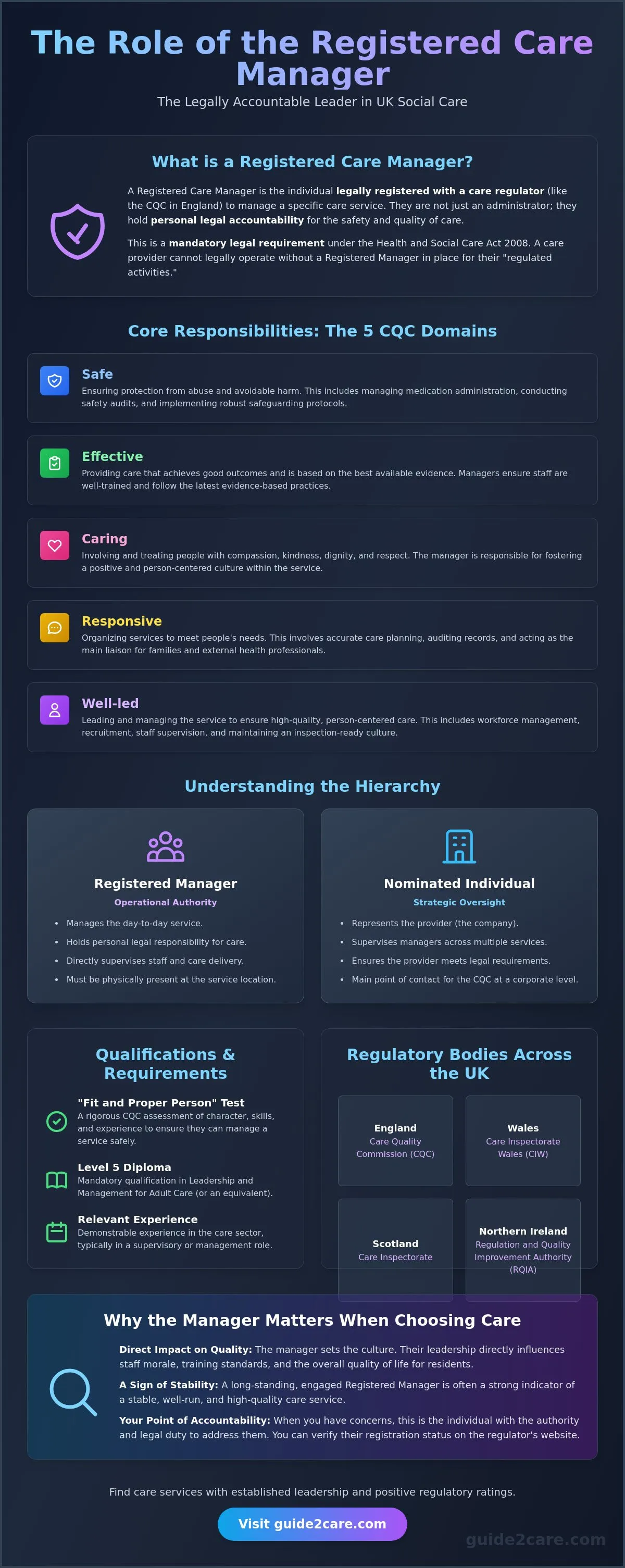
A Registered Manager is an individual registered with a care regulator to manage a "regulated activity" at a specific location. Under the Health and Social Care Act 2008, this role is a mandatory legal requirement for any provider delivering care services in England. When asking what is a registered care manager, you must look beyond the standard duties of a business leader. This person acts as the bridge between the service provider and the law, ensuring that every aspect of the care delivery meets strict national standards.
The Registered Care Manager is the person who holds personal legal accountability for care standards within a service. This responsibility covers specific "Regulated Activities" defined by law. These include providing personal care for people in their own homes, nursing care in residential settings, and the treatment of disease, disorder, or injury. Without a registered individual in place, a care provider cannot legally operate these services. To better understand this concept, watch this helpful video:
The Legal Weight of Registration
Registration isn't a mere formality or a standard employment contract. It represents a personal legal commitment to the regulator. Before taking the role, an individual must pass the "Fit and Proper Person" test. This rigorous assessment evaluates their skills, experience, and character to ensure they can manage a service safely. If a service fails to protect residents or service users, the regulator doesn't just look at the company. They hold the Registered Manager directly responsible. Consequences for regulatory breaches are significant and can include heavy fines, the removal of their professional registration, or criminal prosecution in cases of gross negligence.
Variations Across the UK Nations
While the core concept of a registered leader is universal, the specific regulatory bodies vary by nation. In England, the Care Quality Commission (CQC) manages the registration process and conducts inspections. In Wales, the authority is Care Inspectorate Wales (CIW). Managers in Scotland must register with the Care Inspectorate, while those in Northern Ireland are regulated by the Regulation and Quality Improvement Authority (RQIA). Each body has unique reporting requirements and inspection frameworks, but they all share a singular goal: ensuring that a designated, qualified individual is legally responsible for the safety of vulnerable people.
Key Responsibilities: What a Registered Manager Does Daily
The daily life of a Registered Manager revolves around five core regulatory domains. These domains require the manager to prove the service is safe, effective, caring, responsive, and well-led. When professionals ask what is a registered care manager, they're often referring to the person who manages the complex intersection of clinical care and business operations. According to official government guidance, the manager must oversee all safeguarding protocols and report significant incidents to the regulator immediately. Failure to report a serious injury or a safeguarding concern is a direct breach of their registration.
Workforce management is another critical pillar of the role. The manager leads recruitment, ensures all staff undergo mandatory induction and training, and provides regular supervision. They maintain the culture of the service. This involves auditing care records to ensure accuracy and acting as the primary liaison for family members, GPs, and district nurses. They must ensure the care team follows the latest evidence-based practices to maintain high standards. If you're currently researching providers for a loved one, you can use a care directory to find services with established leadership teams and positive regulatory ratings.
Clinical and Operational Oversight
Managing medication administration is a high-priority task. Managers conduct regular safety audits to prevent errors and ensure compliance with prescribing guidelines. They also perform initial assessments for new residents to determine if the service can safely meet their needs. This oversight extends to the physical environment. Whether it's a residential home or a domiciliary agency, the manager ensures that equipment is maintained and that care delivery follows agreed-upon risk assessments. They're responsible for ensuring that the service remains "inspection-ready" at all times, a requirement that's become more intense with recent regulatory shifts.
Leadership and Culture
A successful manager sets the tone for person-centred care. They don't just fill rotas; they build a staff team that respects the dignity of every individual. Handling complaints and feedback effectively is a key part of this role. By addressing issues transparently, the manager prevents small problems from becoming systemic failures. Under the CQC’s Single Assessment Framework, which is fully operational as of 2026, managers must adopt a model of continuous assessment. This replaces the old system of scheduled inspections. Now, the manager must provide ongoing evidence of quality through digital portals, making their daily commitment to data accuracy and service quality the backbone of the provider's reputation.
Registered Manager vs. Nominated Individual: Understanding the Hierarchy
Every regulated care service in the UK operates under a dual-leadership structure. The Nominated Individual (NI) represents the "Provider" or the organization itself. This person acts as the strategic link between the care business and the regulator. While the NI has oversight of resources and financial stability, the Registered Manager holds the operational responsibility for a specific location or branch. This hierarchy ensures that the business is both financially viable and clinically safe. The two roles must collaborate closely; the NI provides the funding and resources, while the manager ensures those resources translate into high-quality care.
In smaller businesses, such as a single residential home or a boutique domiciliary agency, it's common for one person to hold both roles. This means the owner is also the person managing the daily care delivery. When exploring what is a registered care manager, you'll find that regardless of whether they own the business, their legal duty to the regulator remains the same. They are the person who will be interviewed during inspections and held accountable for any service failures.
Manager vs. Registered Manager
A care service can employ a person with the job title of "Manager" who is not yet registered. This often happens during recruitment transitions. However, the regulator expects a new manager to apply for registration quickly, typically within 6 to 12 weeks of their start date. If a service operates without a registered manager for more than 6 months, it's often highlighted as a significant "Red Flag" in inspection reports. A lack of registered leadership usually leads to a downgrade in the "Well-led" rating. While a Deputy Manager provides essential support, they do not share the same level of legal liability as the individual who is formally registered.
The Provider’s Role
The Provider is the legal entity, such as a limited company or a partnership, that owns the care service. The Provider's primary role is to support the manager by ensuring the service is well-funded and adequately staffed. If a manager identifies a safety risk, the Provider must act to resolve it. This distinction is vital for accountability. The Provider handles the business strategy, while the manager handles the people. For those operating in this sector, A Guide for UK Care Providers: Get Your Service Listed can help you reach families who are looking for services with transparent and accountable leadership structures.
Why the Registered Manager Matters When Choosing Care
The stability of a manager often dictates the overall quality and safety of a care service. When families evaluate a residential home or home care agency, they must understand what is a registered care manager to gauge the level of accountability present. A service with a long standing manager usually demonstrates better staff retention and more consistent care standards. In contrast, high manager turnover is a primary predictor of declining CQC ratings. If a home has employed more than two managers within an 18 month period, it often signals systemic instability that could affect daily care.
During a facility tour, you should identify the Registered Manager immediately. They shouldn't be a distant figure in a back office. A high quality manager is visible on the floor and knows the residents by name. Ask specific questions before signing any contracts. Inquire about their length of service, their approach to staff training, and how they handle families' concerns. Their answers will reveal the true culture of the home. To find services with transparent leadership and verified ratings, search our care directory to compare local providers efficiently.
How to Verify Registration Status
Verify a manager's status by visiting the CQC website for England or the equivalent national regulator's portal. Search for the specific location and check the "Registered Manager" field to see if it matches the person you met. Always read the "Well-led" section of the latest inspection report. This section provides an impartial view of the manager's ability to run a safe service. If a home currently has no Registered Manager, the provider must have a clear plan for a new appointment. A vacancy lasting longer than six months is a significant risk factor that regulators often penalise.
Red Flags for Families
Be alert to warning signs during your initial visit or phone call. If a manager is consistently "unavailable" for meetings with prospective families, it's often a sign of an overwhelmed leadership team. A manager who lacks knowledge about specific resident needs or care plans suggests they're disconnected from the frontline staff. Watch for these specific red flags:
- The manager cannot explain the service's recent inspection findings or their plan for improvement.
- Staff members appear uncertain about who holds the ultimate authority for clinical decisions.
- The manager's name displayed in the entrance doesn't match the name on the regulator's official register.
- The manager focuses entirely on the building's aesthetics rather than the care outcomes of the residents.
Under the CQC Single Assessment Framework operational in 2026, managers must now provide continuous evidence of quality. Ask the manager how they use digital tools to monitor resident safety in real time. Their ability to answer this clearly shows they're prepared for modern regulatory requirements.
Requirements and Qualifications for Registered Managers in 2026
Entry into this leadership role is strictly regulated. When you ask what is a registered care manager, you're asking about a professional who has met specific educational and character benchmarks. In England, the standard mandatory qualification is the Level 5 Diploma in Leadership and Management for Adult Care. Most providers require candidates to demonstrate between 2 and 5 years of experience in a senior care position before they'll consider them for the role. This ensures the individual has a practical understanding of frontline care before taking on legal accountability.
The vetting process is thorough and non-negotiable. Every applicant must undergo an enhanced Disclosure and Barring Service (DBS) check to ensure their suitability for working with vulnerable adults. As of June 2026, the fee for an enhanced DBS check is £38. Following this, the CQC conducts a "Fit and Proper Person" interview. This assessment isn't a standard job interview. It's a formal regulatory evaluation of the candidate's character, physical and mental fitness, and their deep knowledge of the Health and Social Care Act 2008. The manager must prove they can maintain a service that is safe and effective under the current Single Assessment Framework.
The 2026 Care Workforce Pathway
The government's 2026 Care Workforce Pathway provides a clear structure for career progression in social care. It categorises the Registered Manager role as a senior professional tier with specific Continuous Professional Development (CPD) requirements. Managers must now demonstrate high levels of digital literacy and competence in data security, specifically meeting the Data Security and Protection Toolkit (DSPT) standards. This shift reflects the sector's move toward digital record-keeping and real-time data monitoring. Managers who fail to keep their digital skills updated may struggle to meet the "Well-led" criteria during continuous assessments.
Soft Skills and Values
Technical qualifications are only one part of the role. A manager needs immense resilience and empathy to handle the daily pressures of a care environment. They must be capable of crisis management, whether dealing with a sudden safeguarding issue or a staffing shortage. The best leadership styles in this sector are person-centred and transparent. A manager's ability to build a culture of openness directly influences the service's regulatory performance. Understanding CQC Ratings helps you see how a manager's personal leadership style translates into the official "Well-led" score, which is often the most critical indicator of a service's long-term success.
Securing Accountable Care for Your Loved Ones
The Registered Manager is the legal linchpin of a care service. Their registration with the Care Quality Commission ensures a specific individual remains personally accountable for safety and quality standards. Understanding what is a registered care manager helps you distinguish between general business oversight and direct clinical responsibility. As the sector moves toward continuous assessment in 2026, the manager's role in maintaining digital accuracy and safeguarding protocols is more critical than ever. Stability in this leadership position is often the most reliable indicator of a high-performing and safe care environment.
Take the next step in your search by using our professional tools. You can find CQC-registered care providers in your area today through our comprehensive directory of UK care homes and agencies. We offer up-to-date information on regulatory compliance and provide free resources for families navigating the complex care system. Selecting a service with verified, qualified leadership provides the clarity and peace of mind you need when making these important decisions for your family.
Frequently Asked Questions
Is every care home required to have a Registered Manager?
Every care home providing "regulated activities" must have a registered manager. This is a legal requirement under the Health and Social Care Act 2008. If a provider operates without one, they are in breach of their registration conditions. The regulator expects a manager to be in post to ensure daily accountability and safety for all residents at that specific location.
What is the difference between a care manager and a registered manager?
A care manager is a job title assigned by an employer, whereas a registered manager is a legal status granted by a regulator like the CQC. When asking what is a registered care manager, the distinction lies in legal liability. A registered manager is personally responsible for the service's compliance with national standards, whereas a standard manager may only have internal company responsibilities.
Can one person be the Registered Manager for two different care homes?
One person can manage two homes if the regulator grants permission. This usually happens when the locations are geographically close or the services are small. The manager must demonstrate they have enough time and resources to oversee both sites effectively. The CQC assesses these applications on a case by case basis to ensure resident safety isn't compromised by split leadership.
What happens if a care home does not have a Registered Manager?
Operating without a registered manager is a serious regulatory breach. The CQC can issue fixed penalty notices, warning letters, or even cancel the provider's registration. In most cases, a vacancy lasting more than a few months will lead to a downgrade in the "Well-led" assessment domain during a CQC inspection. It signals a lack of stable leadership to the regulator.
How much does a Registered Care Manager earn in the UK in 2026?
Salaries for these roles vary significantly based on the size of the service and the region. In 2026, many registered managers earn between £35,000 and £55,000 per year. Managers in large nursing homes or those with specialized clinical experience often command higher salaries. Regional differences in the UK also play a major role in determining the final pay package offered by providers.
Do Registered Managers need to be nurses?
You don't need to be a nurse to be a registered manager in most adult social care settings. The standard requirement is a Level 5 Diploma in Leadership and Management for Adult Care. However, if you're managing a nursing home, a nursing qualification is usually preferred or required to oversee the clinical staff and complex medical needs of the residents effectively.
How do I complain about a Registered Care Manager?
Follow the care provider's formal complaints policy first. Every registered service must have a clear process for handling grievances. If the provider doesn't resolve the issue, you can contact the Local Government and Social Care Ombudsman. You should also notify the CQC; they don't investigate individual complaints but will use your feedback to assess if the manager remains fit for their role.
What is a "Fit and Proper Person" test?
The "Fit and Proper Person" test is a regulatory check on an individual's suitability for the role. It assesses their character, experience, and qualifications to ensure they can manage a service safely. When the CQC evaluates what is a registered care manager during an application, they use this test to verify that the person is honest, reliable, and has the mental and physical health required for the position.