How to Move a Resident from One Care Home to Another: A UK Guide

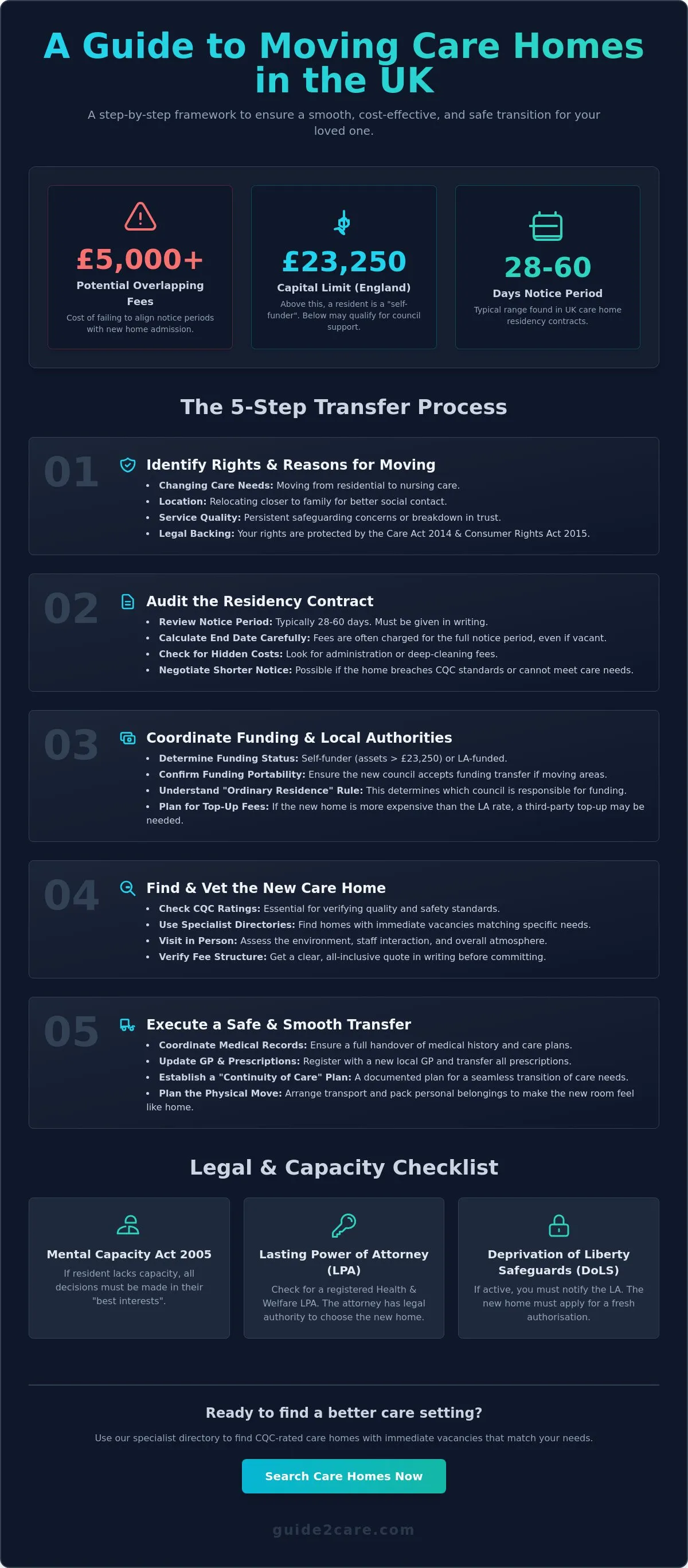
Did you know that failing to align your notice period with a new care home admission could cost you over £5,000 in overlapping fees? Learning how to move a resident from one care home to another uk requires more than just finding a new bed; it involves a precise coordination of legal notice periods and funding transfers. You likely feel overwhelmed by the fear of breaching contracts or the anxiety of how the move will affect your relative's health. It's a complex process that demands absolute clarity on local authority responsibilities and capital limits, which vary significantly across England, Scotland, and Wales.
This guide provides a comprehensive, step-by-step framework for navigating these transitions in 2026. You'll learn how to manage the £23,250 capital limit threshold in England, negotiate notice periods typically ranging from 28 to 60 days, and ensure a "Continuity of Care" plan is in place. We'll simplify the legal requirements under the Care Act 2014 and the Consumer Rights Act 2015 to protect your finances and the resident's wellbeing. Follow this structured approach to move from initial assessment to a successful relocation without unnecessary friction or cost.
Key Takeaways
- Identify the legal rights and common triggers, such as changing care needs or location, that necessitate a residential transfer.
- Learn how to move a resident from one care home to another uk by auditing residency contracts for specific notice periods and termination clauses.
- Clarify funding portability and the "Ordinary Residence" rule to ensure seamless local authority support between different council areas.
- Execute a safe physical transfer by coordinating medical record handovers and GP prescription updates between the old and new settings.
- Filter new care options using CQC ratings and specialist directories to find providers that address previous service failures.
Understanding Your Rights to Change Care Homes in the UK
Every care home resident in the UK has a legal right to choose where they live. This right is protected by the Care Act 2014 and the Consumer Rights Act 2015. Understanding how to move a resident from one care home to another uk starts with recognizing that you aren't bound to a single facility if it no longer meets specific requirements. Before initiating a transfer, it's helpful to clarify what is a care home? in a legal context to ensure the new setting provides the correct registration type for the resident's needs. Moving is a standard part of the care journey for many families.
Under the Choice of Accommodation regulations, Local Authorities must facilitate a move to a preferred home if it meets specific criteria. The home must be able to provide the necessary level of care and agree to the council's standard terms. If the resident's assets are above the £23,250 upper capital limit in England, they are considered a self-funder. Self-funders have the freedom to choose any registered home, provided they can meet the weekly fees, which averaged £1,298 for residential care in 2025. Local Authority-funded residents must ensure the new council accepts the funding transfer if moving across county lines.
To understand the physical practicalities of moving residents safely, watch this helpful video:
When is a Move Necessary?
Triggers for relocation often involve a shift in medical requirements. A resident may need to move from a residential setting to a nursing home if they develop complex health conditions that require 24-hour clinical supervision. Relocation is also common when families move house; moving a relative closer significantly improves social contact and mental wellbeing. Finally, persistent safeguarding concerns or a breakdown in trust with staff are valid reasons to seek a new provider immediately. Always document these reasons clearly to support the case for a funding reassessment.
Mental Capacity and Decision-Making
If a resident lacks the capacity to consent to a move, the Mental Capacity Act 2005 governs the process. Decisions must be made in the resident's "best interests." Check if there is a registered Health and Welfare Lasting Power of Attorney (LPA) in place. Attorneys hold the legal authority to choose the new care setting. If a Deprivation of Liberty Safeguard (DoLS) is active, you must notify the Local Authority. The DoLS authorization doesn't automatically transfer; the new home must apply for a fresh authorization once the resident arrives at the new facility.
Navigating the Residency Contract and Notice Periods
Review the original residency agreement immediately. This document contains the specific legal terms governing your exit. Standard UK notice periods typically range from 28 to 60 days. You must provide this notice in writing to the care home manager. Calculate the end date carefully. Most homes charge fees until the end of the notice period, even if the resident moves out early. If you don't have a copy of the contract, request one from the home's administration office today.
Watch for hidden exit costs. Some contracts include administration charges or mandatory deep-cleaning fees for the room. These can range from a few hundred pounds to a full week's fee. If the home can no longer meet the resident's medical or safety needs, you have grounds to negotiate a shorter notice period. Refer to the Care Quality Commission (CQC) fundamental standards to support your case. If the provider is in breach of these standards, they may waive the notice period to avoid formal disputes.
Understanding how to move a resident from one care home to another uk involves precise financial timing. When arranging for care in a new facility, verify their earliest available move-in date before giving notice to the current home. You can search specialist directories to find homes with immediate vacancies that match your required care level and budget.
Avoiding Double Funding Obligations
Paying for two beds simultaneously is a common financial pitfall. This happens when the new home requires a deposit and an immediate start, while the old home enforces a 28-day notice period. To avoid this, ask the new provider if they can hold the bed for a nominal fee rather than the full weekly rate. If the move is urgent due to safeguarding, request that the Local Authority covers the overlapping cost. Review the final invoice for any daily rate discrepancies compared to the monthly contract.
The "Trial Period" Clause
Most UK care contracts include a trial period, usually lasting the first four weeks of residency. During this window, notice periods are significantly shorter, often only 7 days or even 24 hours. If the placement isn't working, use this period to move without long-term financial penalties. Ensure you request a written refund for any pre-paid fees or advanced monthly payments if you exit during the trial phase. Verify the exact duration of the trial period in your specific agreement before taking action.
Coordinating with Local Authorities and Funding Portability
The "Ordinary Residence" rule is the primary legal mechanism for determining which council pays for care. If a resident is currently funded by a local authority, that council remains responsible for payments even if the resident moves to a facility in a different county. This rule ensures financial stability during the transition. Before finalizing any move, request a new Care Needs Assessment. This formal review confirms that the proposed home can meet the resident's specific health and social requirements. Consult the NHS guide to care homes to understand how different service levels are categorized during this assessment process.
Statutory guidance under the Care Act 2014 establishes the "Continuity of Care" principle. This rule dictates that there must be no gap in service when a resident relocates between local authority areas. The original council must continue to fund the care until the new council has completed its own assessment and satisfied itself that the new arrangements are appropriate. If you move to a more expensive area, be prepared for changes in Third Party Top-Ups. These are additional fees paid by family members when the chosen home's weekly rate exceeds the local authority's standard funding limit. Calculate these potential costs early to avoid budget shortfalls.
Moving to a Different Council Area
Initiate the "Transfer of Care" protocol by contacting the Adult Social Care department of both the "exporting" (current) and "importing" (new) local authorities. The current council must provide the new council with the resident's latest care plan and financial assessment. Start this coordination process at least six weeks before the intended move date to prevent administrative delays. Learning how to move a resident from one care home to another uk across council lines requires proactive communication with social workers to ensure the new authority is ready to assume responsibility on arrival.
NHS Continuing Healthcare (CHC) Transfers
NHS Continuing Healthcare (CHC) funding is a national package; the money follows the resident regardless of their location in the UK. You must notify the relevant Integrated Care Board (ICB) of the move to ensure the funding stream remains uninterrupted. If the resident only receives the NHS-funded nursing care (FNC) contribution, this will also transfer to the new nursing home. The new facility must be registered to provide nursing care to receive these payments directly from the NHS. Verify the new home's registration status with the Care Quality Commission (CQC) before signing any agreement.
Step-by-Step Logistics: Executing the Move Safely
Executing a safe transfer requires a structured timeline and clear communication between all parties. Start by finalizing the move-in date and conducting a final inspection of the new room. Ensure all requested modifications, such as grab rails or specific bed types, are installed and functional. Successful coordination of how to move a resident from one care home to another uk depends heavily on the administrative handover. Schedule a formal meeting between the outgoing and incoming care home managers to discuss the resident's daily routine, behavioral triggers, and specific care preferences.
Address medical continuity immediately. You must coordinate the transfer of medical records and current prescriptions with the resident's GP. If the move involves changing GP practices, register with the new surgery at least 14 days in advance. This prevents delays in medication delivery. Arrange specialized transport if the resident has mobility issues or complex medical needs. Private ambulance services provide trained staff who can manage physical transfers safely, reducing the risk of injury during transit. To find providers with experience in complex transfers, search our directory of specialized care services for professional assistance.
Care Plan and Medical Continuity
Verify that the Medication Administration Record (MAR) sheet is updated and physically accompanies the resident. The new home cannot legally administer medication without this document. Ensure the new facility receives a physical copy of any DNACPR (Do Not Attempt Cardiopulmonary Resuscitation) orders and the Advanced Care Plan. Create a specific checklist for personal equipment. This should include mobility aids, hearing aids with spare batteries, and any specialized pressure-relieving mattresses. Label every item clearly to prevent loss during the transition.
The Day of the Move
Plan the move for mid-morning, ideally after breakfast. This timing allows the resident to settle into their new environment before the evening routine begins. A familiar family member should be present throughout the day to mitigate "Transfer Trauma," which can cause temporary confusion or distress. Pack a "memory box" with items like family photographs or a favorite blanket and place these in the new room before the resident arrives. Share the resident's "Life Story" book with the new care staff immediately. This document helps staff build rapport and understand the resident's history, hobbies, and personality from the first hour of their stay.
Finding and Vetting the New Care Setting
Success in how to move a resident from one care home to another uk depends on selecting a provider that specifically addresses the shortcomings of the previous setting. Download the latest Care Quality Commission (CQC) inspection reports for potential homes. Don't just look at the overall rating. Focus on the "Safe" and "Well-led" categories. If the resident is moving due to poor clinical care, verify that the new home has a "Good" or "Outstanding" rating in the "Effective" domain. Check the report date; a report from over two years ago may not reflect current management standards.
Visit potential care homes unannounced during different times of the week. This allows you to observe authentic staff-resident interactions outside of scheduled tours. Look for hidden quality indicators. High staff retention rates often signal a stable environment and better continuity of care. Review the activity schedule to ensure it offers meaningful engagement rather than passive entertainment. If the home has a high occupancy rate, such as the 86.1% average seen in England in May 2026, it often indicates a strong local reputation.
The "settling-in" period is as critical as the move itself. Most guides overlook the first 14 to 28 days after relocation. During this window, monitor the resident's appetite, sleep patterns, and social engagement levels. Increased confusion or withdrawal can be signs of relocation stress. Ensure the care staff are actively using the "Life Story" book mentioned in previous sections to build rapport. Frequent communication with the deputy manager during this first month helps resolve minor issues before they become permanent barriers to wellbeing.
Questions to Ask the New Manager
Ask the manager for their specific protocol on resident transitions. Inquire about how they introduce new residents to their peers and communal areas. Verify the current staffing ratios for night shifts and weekends, as these often differ from daytime levels. Establish a clear communication frequency. Ask whether they provide weekly updates or if they use a digital care portal for real-time family access. Confirm their policy on family involvement in care plan reviews to ensure your voice remains central to the resident's support.
Using Guide2Care to Simplify Your Search
Our comprehensive directory simplifies the selection process by allowing you to filter providers by specific care specialisms, such as dementia or complex nursing needs. You can compare CQC ratings and service types across different regions in one central hub. Use our resource section to access deeper guides on funding limits and selection criteria. Find a trusted care provider in our comprehensive UK directory to begin your search with verified information.
Securing a Successful Transition for Your Relative
Coordinating a move requires balancing contractual notice periods with statutory funding protections. You now understand that residency agreements typically require 28 to 60 days of notice and that the "Ordinary Residence" rule protects funding continuity across council borders. Managing how to move a resident from one care home to another uk is a methodical process that prioritizes the resident's safety through medical record handovers and rigorous provider vetting. By focusing on CQC inspection data and conducting unannounced visits, you can ensure the new setting addresses previous service gaps effectively.
We provide a comprehensive database of CQC-registered providers and neutral, practical guidance to support UK families through these complex decisions. Utilize our expert resources on care funding and residency rights to simplify your search and avoid double-funding pitfalls. Search our UK directory for highly-rated care homes to find a provider that meets your specific requirements and specialisms. With the right preparation and a structured plan, you can facilitate a move that significantly improves your relative's quality of life and long-term wellbeing.
Frequently Asked Questions
Do I have to pay two sets of fees when moving care homes?
You are liable for fees at both facilities if the new admission date falls within the old home's notice period. To minimize these costs, align the end of your 28-day notice period with the arrival date at the new facility. Negotiate with the new provider to hold the bed for a reduced administrative fee rather than the full weekly rate during this transition window.
How much notice do I need to give a care home in the UK?
Standard residency contracts in the UK typically require 28 days of written notice. Some providers may stipulate a longer period of up to 60 days in their specific terms. If the care home can no longer meet the resident's medical needs or there is a documented safety risk, you can negotiate a shorter notice period based on a breach of the Care Quality Commission (CQC) fundamental standards.
Can a care home refuse to let a resident move?
No, a care home cannot legally prevent a resident from leaving their premises. The Protection from Eviction Act 1977 and the Care Act 2014 protect the resident's right to choice and freedom of movement. If a provider attempts to block a move, contact the Local Authority safeguarding team or the CQC immediately to report a potential unlawful deprivation of liberty.
What is "Transfer Trauma" and how can I prevent it?
Transfer Trauma, or Relocation Stress Syndrome, is a psychological reaction to changing environments that can cause temporary confusion or distress. Prevent this by maintaining a consistent routine on the day of the move and ensuring familiar items, like family photographs, are unpacked before the resident arrives. Having a familiar family member present during the first few hours helps the resident feel secure in the new setting.
Will the council still pay for care if we move to a different county?
The original council remains responsible for funding under the "Ordinary Residence" rule, even if the resident moves across county lines. This ensures continuity of care as long as the new home meets the council's standard fee rates. Learning how to move a resident from one care home to another uk involves notifying your social worker at least six weeks before the move to coordinate this inter-authority funding transfer.
How do I transfer my relative's GP and prescriptions to a new area?
Register the resident with a local GP surgery near the new care home at least 14 days before the move date. Request a summary of medical records and a current Medication Administration Record (MAR) from the existing home's clinical lead. Ensure the new GP issues a fresh prescription to the home's preferred pharmacy to avoid any gaps in the resident's medication cycle during the transition.
Can I move my relative if they have a Deprivation of Liberty Safeguard (DoLS) in place?
You can move a resident with an active DoLS, but the existing authorization does not automatically transfer between settings. The new care home must apply for a fresh DoLS authorization from the Local Authority once the resident has arrived. If you hold a Health and Welfare Lasting Power of Attorney (LPA), you have the legal right to decide on the new placement in the resident's best interests.
What happens to the personal possessions and furniture during the move?
Families are responsible for packing and transporting all personal belongings and furniture to the new facility. Verify the dimensions of the new room and check if the home provides specialized equipment, such as profiling beds, before moving large items. How to move a resident from one care home to another uk effectively requires a clear inventory to ensure all mobility aids and personal effects arrive safely at the new destination.