What is Reablement Home Care? A Complete Guide to Regaining Independence

What if the primary goal of professional care was to make itself unnecessary within 42 days? Understanding what is reablement home care is the first step for anyone facing a hospital discharge or a sudden illness. Many people assume these events mark the beginning of a permanent decline in independence. It's common to feel overwhelmed by complex social care terminology or anxious about the long term costs of daily support. You want to remain in your own home, and you need a functional plan to get back on your feet safely.
This guide explains how this short term service helps individuals regain their daily living skills. You'll learn how to access this free support through your local authority and what the assessment process involves. We also provide a clear plan for what happens after the initial six week period ends. Use this information to understand the UK care system with confidence and find the specific support you need to live independently.
Key Takeaways
- Understand what is reablement home care and how its "doing with, not for" philosophy differs from traditional home support.
- Identify the professionals in a multidisciplinary team and how they collaborate to create your personalised recovery plan.
- Clarify eligibility requirements for receiving up to six weeks of free reablement services funded by your local authority.
- Use our practical checklist to prepare your home for a safe recovery, including "zoning" techniques to minimise movement.
- Learn about the end-of-programme assessment and the three most common pathways for care once the reablement period concludes.
What is Reablement Home Care? Defining the "Rehab at Home" Philosophy
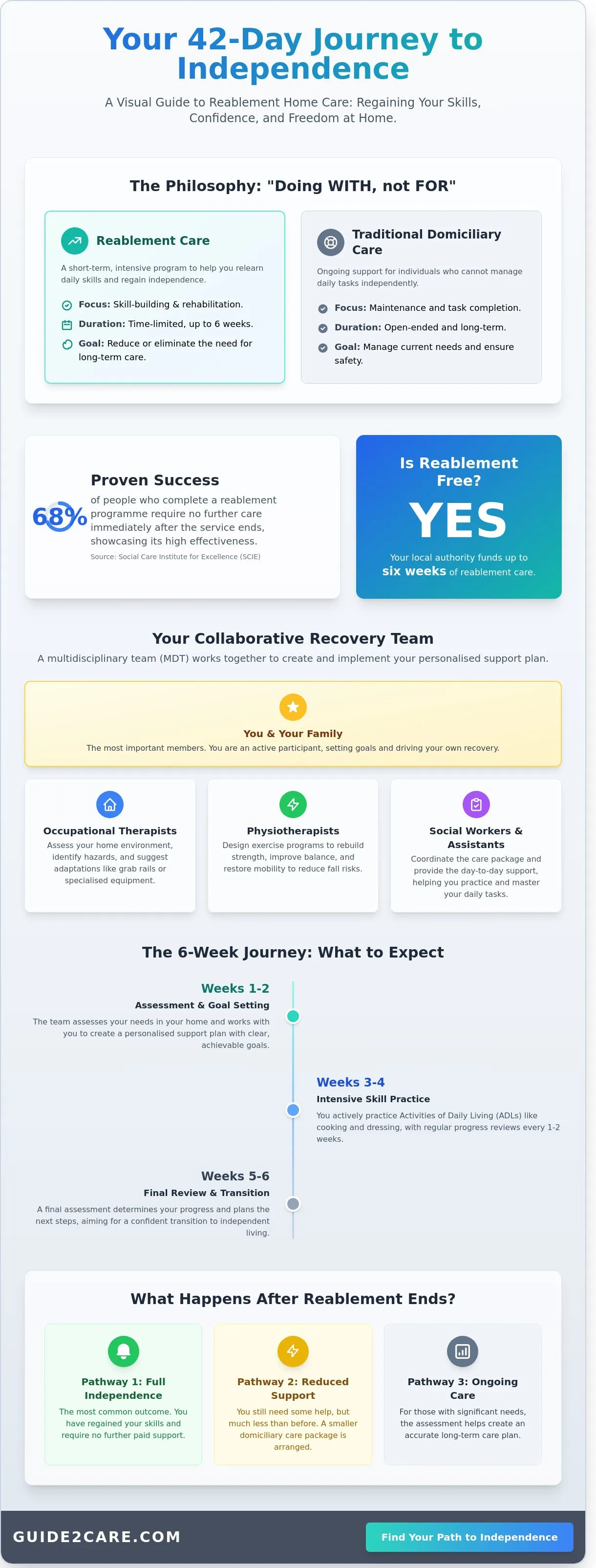
What is reablement home care? It is a short-term, intensive service designed to help you regain independence after an illness, injury, or hospital stay. Most programmes last for a maximum of six weeks. Unlike standard care, this service focuses on rehabilitation. It operates on a "doing with, not doing for" philosophy. This means care workers encourage you to perform tasks yourself rather than doing them for you. Reablement is a multidisciplinary approach to restoring daily living skills following an acute health event.
For medical professionals, recovering from such events often involves complex financial considerations regarding their career and property; in these cases, you can learn more about Mortgages for Doctors to see how specialized income protection can secure your livelihood during rehabilitation.
To better understand how this service supports independence, watch this helpful video from the Social Care Institute for Excellence:
Reablement vs Domiciliary Care: Key Differences
Domiciliary care provides ongoing support for individuals who cannot manage daily tasks alone. It is usually open-ended and focuses on maintenance. Reablement is strictly time-limited and focuses on skill-learning. Staff training is a major differentiator. Reablement workers receive therapeutic guidance from occupational therapists or physiotherapists. They use specific techniques to help you relearn movements. While domiciliary care manages your current needs, reablement actively works to change them.
The Core Objectives of a Reablement Programme
A structured programme targets specific outcomes to ensure safety and autonomy. These objectives include:
- Restoring ADLs: You will practice Activities of Daily Living such as dressing, washing, and cooking safely.
- Improving Mobility: Exercises focus on balance and strength to reduce the risk of future falls. Data from 2022 shows that falls are the leading cause of emergency hospital admissions for older adults.
- Real-world Assessment: Professionals evaluate your needs in your own kitchen and bathroom. This provides a more accurate picture of your abilities than a hospital assessment.
By the end of the six-week period, the service aims to leave you feeling confident. Statistics from 2021 suggest that approximately 63% of people who complete these programmes require no further immediate support. This success rate highlights the effectiveness of the intensive, home-based approach.
The Multidisciplinary Team: Who Supports Your Recovery?
Reablement is a collaborative process. It brings together various healthcare experts to help you return to your daily routine safely. When you ask what is reablement home care, the answer lies in the multidisciplinary team (MDT) that manages your transition from hospital to home. This team starts by creating a personalised support plan. This document lists your specific goals, such as climbing stairs or preparing a meal, and outlines the steps needed to achieve them.
You and your family are the most important members of this team. You aren't a passive recipient of a service. You're an active participant. The team works with you to decide which tasks you want to master first. Regular reviews happen every 1 to 2 weeks to track your progress. These meetings ensure the support level remains appropriate as your strength improves. Data from the Social Care Institute for Excellence (SCIE) indicates that 68% of people who complete a reablement programme require no further care immediately after the service ends.
Occupational Therapists and Physiotherapists
Occupational Therapists (OTs) focus on your living environment. They visit your home to identify hazards and suggest adaptations. This might include installing grab rails in the bathroom or providing a perching stool for the kitchen. Physiotherapists focus on your physical movement. They design tailored exercise programmes to rebuild your balance and muscle tone. These therapists supervise the daily work of reablement assistants, ensuring every activity aligns with your clinical recovery goals.
Social Workers and Reablement Assistants
Social Workers coordinate the entire package. They assess your needs and determine your financial eligibility for the service. They also act as a bridge between your hospital consultant and your local GP to ensure your medical records stay updated. Reablement assistants are the professionals you see most often. They visit your home daily, sometimes multiple times. Their role is to encourage rather than do. They watch you perform tasks and offer guidance, ensuring you complete them safely while regaining your confidence.
Understanding the roles of these professionals helps you set realistic expectations for your recovery. If you're ready to look at specific providers in your area, you can explore Guide2Care to find the support you need.
The success of the programme depends on clear communication. The team uses a shared log to record your daily wins and any setbacks. This ensures that whether it's the OT or the assistant visiting, they know exactly where you're in your journey. Most reablement packages last for up to 6 weeks, but the goal is always to reduce support as quickly as your safety allows.
Eligibility and Funding: Is Reablement Free in the UK?
Local authorities in England provide reablement services free of charge for up to six weeks. This intermediate care is a statutory requirement under the Care Act 2014. It aims to help you regain independence and reduce the need for a permanent care package. Eligibility usually follows a hospital stay or a crisis at home, such as a fall or a sudden illness. To qualify, a social worker or healthcare professional must determine that you have the potential to improve your daily living skills through a short-term programme.
Some individuals receive reablement as part of Section 117 aftercare. This applies to people who were previously detained under specific sections of the Mental Health Act 1983. In these cases, the care is free for as long as the person needs it to prevent their mental health from deteriorating. For most others, the service remains free only for the initial intensive period. While the staff's time is free, you might need to pay for permanent home adaptations or long-term equipment once the six weeks end. These items are often means-tested by the local council based on your financial situation.
How to Access Reablement Services
Accessing support usually begins with a referral from a hospital discharge team. This follows the "discharge to assess" model, where your needs are evaluated in your own home rather than a hospital ward. If you are already at home, contact your local Social Services department directly. Request a Care Needs Assessment to determine if you meet the national eligibility criteria. If you don't meet the threshold for state-funded care, you can hire private providers. Private reablement allows you to choose your own schedule and goals without local authority restrictions.
Understanding the "Six-Week Rule"
The six-week limit is the standard maximum for free intermediate care in the UK. It's designed as a burst of intensive support to jumpstart your recovery. Many people don't need the full 42 days; if you meet your goals in two weeks, the service will conclude. Extensions are rare and only happen if there is a specific clinical need or a high probability of further improvement. Understanding what is reablement home care means recognizing its temporary nature. Once the programme finishes, the council assesses whether you need ongoing domiciliary care. This long-term support is usually means-tested based on your income and savings.
When planning your recovery, consider these key funding facts:
- Free Period: Up to six weeks (42 days) of intensive support.
- Eligibility: Based on the potential for improvement, not just age or disability.
- Section 117: Mental health aftercare is exempt from the six-week limit and means-testing.
- Long-term Care: Any support needed after the reablement period is usually subject to a financial assessment.
Knowing what is reablement home care helps you prepare for the transition from hospital to home. It ensures you use the available free support to its full potential before considering long-term financial commitments for care.
Preparing Your Home for a Successful Reablement Period
A safe environment is the foundation of recovery. You must adapt your living space to support daily tasks while you regain your strength. Understanding what is reablement home care involves recognizing that the home itself becomes a tool for rehabilitation. This transition requires a proactive approach to home safety and organization, which may include using Courier Pro to transport necessary equipment or furniture to your home.
Safety Checks and Simple Adaptations
Start with a thorough sweep of your main living areas to eliminate hazards. Research from the UK government suggests that simple home modifications can reduce the risk of falls by up to 26 percent. Follow this checklist to prepare:
- Clear the floor: Remove loose rugs, mats, and trailing electrical cables. These are the most common trip hazards in hallways and lounges.
- Enhance lighting: Replace dim bulbs with brighter LED versions. Ensure hallways and bathrooms have at least 500 lumens of light to improve visibility at night.
- Relocate essentials: Move frequently used items like mugs, tea bags, and medications to waist-height counters. This prevents unnecessary reaching or bending.
- Install grab rails: Add temporary or permanent rails in the shower and next to the toilet to provide stability during personal care.
Use "zoning" to manage your energy levels during the first 14 days. This means setting up a single floor with everything you need: a bed, bathroom access, and a small kitchen station. Zoning minimizes the need for stairs and reduces fatigue while your mobility improves. Small aids also play a vital role. Items like kettle tippers, long-handled reachers, and perching stools allow you to complete tasks without overexertion. These tools don't replace your effort; they facilitate your independence.
Setting Realistic Goals with Your Team
Success in reablement is measured by your ability to perform specific daily activities. You and your care team should use the SMART framework to set targets. Goals must be Specific, Measurable, Achievable, Relevant, and Time-bound. For example, instead of aiming to "get better," set a goal to "walk to the kitchen and make a cup of tea independently by day five."
Your mindset during the first 72 hours is critical. It's common to feel frustrated when tasks take longer than usual. Maintain a positive behavior by focusing on small wins rather than limitations. To help manage the emotional side of recovery, Coach-spot can connect you with a professional coach to build your confidence and resilience. Involve your family in this process, but set clear boundaries. They must act as observers and encouragers rather than doing tasks for you. If a family member "over-cares" by performing tasks you're capable of, they may unintentionally hinder your physical progress. Reablement is about doing with, not doing for.
Explore our directory to find local providers who specialize in these services. Find the care you need to start your recovery today.
The Transition: What Happens After Reablement Ends?
Reablement services are designed to be short-term, typically lasting no longer than six weeks. As you reach the end of this period, a social worker or lead therapist performs an "End of Programme" assessment. This review is a formal process that measures your current abilities against the goals established at the start of your care. It identifies exactly what you can do for yourself and where gaps in your independence remain.
Understanding what is reablement home care involves recognising that it is a bridge to your future living situation. The assessment results in one of three outcomes. You may be discharged with no further care requirements if you've regained full independence. Alternatively, you might move to a reduced care package that targets only specific, difficult tasks. If your needs remain high, the assessment will recommend a transition to long-term domiciliary care. Even if you still require daily assistance, the programme is a success if it reduced the total number of care hours you need. This reduction increases your autonomy and lowers your long-term costs.
If you discover that you require ongoing support, you must act quickly to ensure a smooth handover. You can find the care you need by using the Guide2Care directory to filter providers by location and specialism. This helps you maintain the momentum gained during your recovery.
Arranging Long-Term Domiciliary Care
The transition to long-term care depends on your financial eligibility. If you qualify for local authority funding under the Care Act 2014, your social worker coordinates the move to a permanent provider. They ensure your care plan reflects the progress you made during reablement. If you are a self-funder, you're responsible for choosing a reputable home care agency. Check their latest Care Quality Commission (CQC) report for a "Good" or "Outstanding" rating. Ask potential providers if they use a "rehabilitative" approach. This means their staff will continue to encourage you to do things for yourself rather than taking over every task, which prevents your skills from fading.
Staying Independent: Community Support and Tech
Independence often requires a safety net beyond physical care. Local community groups, lunch clubs, and befriending services provide essential social contact that prevents isolation after your intensive programme ends. You should also explore "Telecare" options. These include wearable pendant alarms and wall-mounted sensors that detect falls or unusual activity. These devices provide 24-hour monitoring without the need for a live-in carer. To maintain your physical gains, continue the specific exercises and routines your reablement team taught you. Consistency is the only way to ensure the benefits of your recovery last for the long term.
Take Control of Your Recovery Journey
Understanding what is reablement home care is the first step toward regaining your autonomy after a hospital stay or illness. This targeted support typically lasts for a maximum of 6 weeks and focuses on rehabilitating your ability to perform essential daily tasks. A multidisciplinary team of occupational therapists and support workers guides this process to ensure you reach your specific mobility goals. After this period, you may transition to private domiciliary care or continue living independently. You don't have to navigate these choices without support.
Guide2Care provides a comprehensive UK-wide directory of care providers to help you make informed decisions. Use our independent and neutral resource to access practical guides on funding and selecting the right support for your circumstances. Our database includes thousands of registered providers across England, Scotland, and Wales to simplify your search. Find the care you need with our comprehensive UK directory. You have the tools to build a safe and independent future at home.
Frequently Asked Questions
Is reablement the same as intermediate care?
Reablement is a specific type of intermediate care. The NHS defines intermediate care as a broader category of services that includes crisis response, bed-based care, and hospital-at-home schemes. While all these services aim to prevent unnecessary hospital stays, reablement focuses specifically on helping you regain daily living skills within your own home after an illness or injury.
Can I get reablement if I haven’t been in hospital?
You can access these services without a prior hospital stay. Local authorities provide support to individuals who experience a sudden decline in health or a fall at home. A GP or social worker can request an assessment to determine if what is reablement home care provides is appropriate for your needs to help you avoid a future hospital admission.
What happens if I am still not independent after six weeks?
Your local council will conduct a formal care assessment if you aren't independent after the initial six weeks. Under the Care Act 2014, local authorities must assess anyone with ongoing care needs. They'll then transition you to a long-term plan, such as domiciliary care. Unlike the initial reablement period, these long-term services usually require a financial means test.
Do I have to pay for the equipment used during reablement?
You won't usually pay for basic equipment provided during your reablement period. Section 15 of the Care Act 2014 mandates that local authorities in England provide community equipment free of charge if it costs less than £1,000 per item. This covers essential aids like grab rails, perching stools, or walking frames. Major home adaptations exceeding this amount may require different funding.
Can my family refuse reablement and ask for a care home instead?
Families can state a preference, but the final decision depends on the individual's mental capacity and the care assessment. The NHS "home first" policy prioritizes reablement to keep people out of long-term residential care whenever safe. If the person has the capacity to make their own decisions, their choice to remain at home is legally protected under UK law.
Is reablement available for people with dementia?
Reablement is available and often beneficial for people living with dementia. Specialist teams use techniques like "errorless learning" to help individuals maintain familiar routines and daily skills. According to the Social Care Institute for Excellence (SCIE), tailored reablement programs can delay the need for residential care for those in the early or moderate stages of the condition by focusing on existing abilities.
How many hours of care will I receive during a reablement programme?
The hours you receive depend on your assessment, but most programs begin with 2 to 4 visits per day. You might start with 3 hours of daily support spread across morning, lunch, and evening slots. These visits focus on practicing tasks rather than doing them for you. As you become more confident, the team reduces the hours until you no longer require support.