Financial Help for Carers UK: The Complete 2026 Support Guide

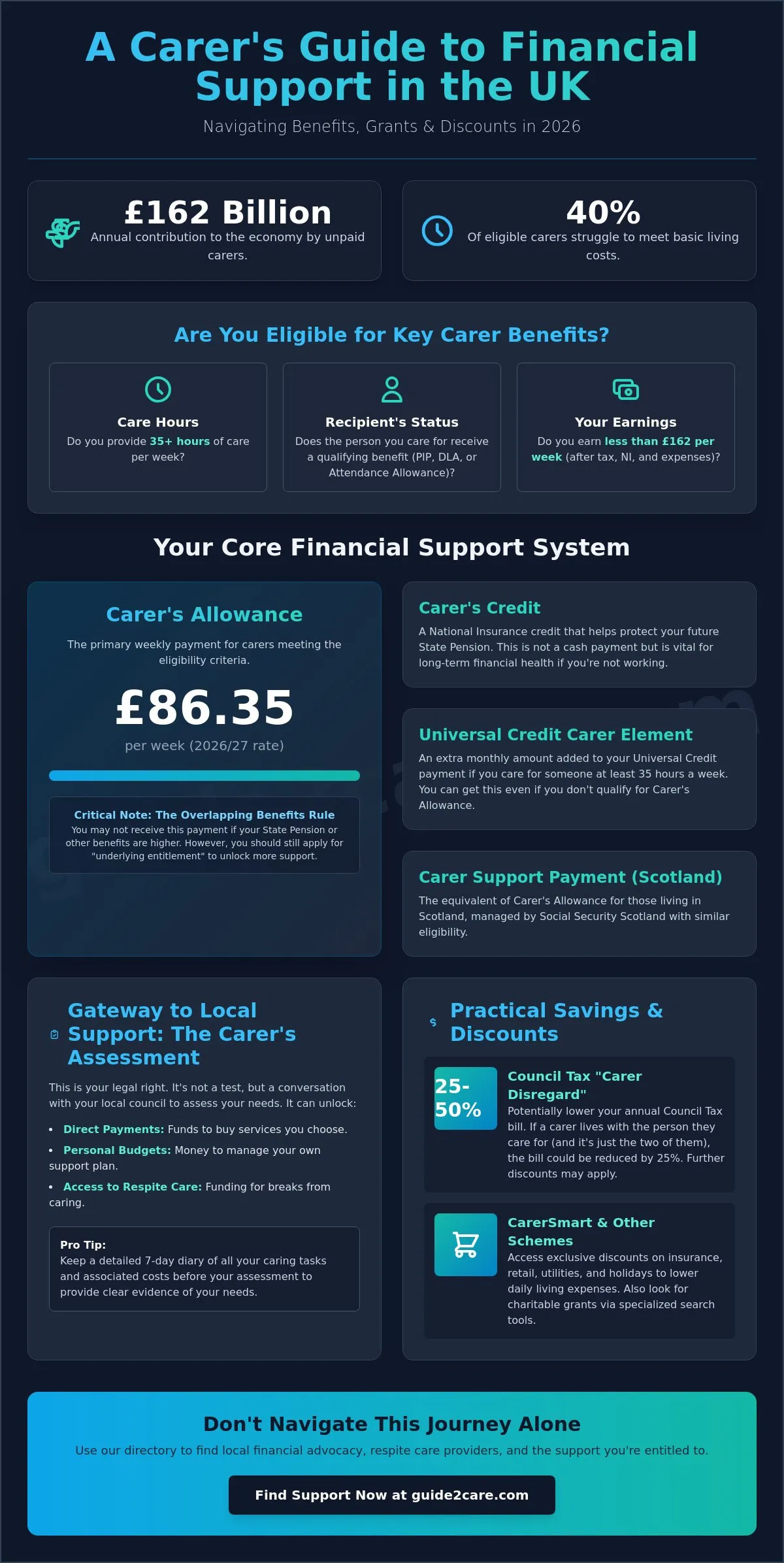
According to Carers UK, unpaid carers contribute £162 billion to the economy every year, yet nearly 40% of those eligible for support still struggle to meet basic living costs. Finding the right financial help for carers uk shouldn't be another full-time job. You likely feel that the system is overly complex and fear that applying for new support might disrupt your existing household budget. It's a common concern, especially as the cost of living continues to impact UK households in 2026.
This guide provides a clear, practical roadmap to the benefits, grants, and discounts available to you right now. We've simplified the process by breaking down eligibility rules for Carer's Allowance and identifying hidden local authority funds that many overlook. You'll find a direct list of available support and a step-by-step guide to completing difficult DWP forms. Use this resource to secure the funding you're entitled to and find the care you need.
Key Takeaways
- Identify the main statutory benefits available, including Carer’s Allowance and the Carer Support Payment in Scotland, to secure essential financial help for carers uk.
- Locate additional funding through charitable grants and emergency funds using specialized search tools tailored to specific medical conditions.
- Reduce household bills by applying for the Council Tax "Carer Disregard" to potentially lower annual costs by 25% to 50%.
- Access exclusive UK discounts on insurance, retail, and utilities through the CarerSmart scheme to lower daily living expenses.
- Use the Guide2Care directory to find local financial advocacy and respite care providers that support your ability to maintain employment or pursue flexible degree options with UK Home Students.
Understanding the UK Carer Support Landscape in 2026
Finding financial help for carers uk requires a clear understanding of the legal and financial framework. An unpaid carer is someone who provides support to a family member or friend without receiving a wage from an employer. This role differs from professional care work because it's based on personal relationships rather than a contract. For DWP purposes, a "carer" is someone providing 35+ hours of care to a person receiving qualifying benefits.
The UK support system operates through three primary tiers. Statutory support includes national benefits managed by the DWP. Local Authority support involves services and funding provided by your local council under the Care Act 2014. Charitable support consists of grants and respite services from third-sector organisations. Most financial assistance relies heavily on the 35-hour rule. This metric tracks the time you spend on physical assistance, emotional support, and household management. If you provide care for fewer than 35 hours a week, your eligibility for the main Carer's Allowance benefit is usually removed.
To better understand how to manage your household finances while caring, watch this helpful video:
Qualifying for Financial Assistance
Eligibility for financial help for carers uk depends on the status of the person you care for. They must receive a qualifying disability benefit. This includes the Personal Independence Payment (PIP) daily living component, Attendance Allowance, or the Disability Living Allowance (DLA) middle or highest care rate. Your employment status also affects your claim. In April 2026, the weekly earnings limit for carers was adjusted to £155 after tax, National Insurance, and allowable expenses. If you earn even £1 over this threshold, you lose your entire weekly allowance. New 2026 regulations also introduced a streamlined "run-on" payment, allowing carers to keep their benefits for 4 weeks after their caring role ends.
The Importance of the Carer’s Assessment
Every carer has a legal right to a Carer’s Assessment from their local council. This right was established by the Care Act 2014 and remains the primary gateway to local funding. The assessment isn't a test of your ability to care. It's a review of your own health, work, and wellbeing needs. Councils use these results to determine if you qualify for direct payments or a personal budget. These funds let you choose and pay for services that support your caring role, such as gym memberships or transport costs. Prepare for your assessment by keeping a detailed diary for 7 days. Record every task you perform and any extra costs you pay, such as increased heating bills or specialist equipment. Using a secure digital platform like SafeKeep can help you keep these essential records and administrative documents organised in one central hub.
Statutory Benefits: Carer’s Allowance and Carer’s Credit
Government benefits provide the foundation of financial help for carers uk. These payments aim to mitigate the impact of reduced working hours or the complete inability to remain in employment. Understanding the distinction between cash payments and National Insurance credits is essential for long-term financial security.
The primary benefit for individuals providing at least 35 hours of care per week is Carer's Allowance. If you live in Scotland, you will instead receive the Carer Support Payment. This is managed by Social Security Scotland and follows similar eligibility criteria but includes different delivery rules. For those on low incomes, the Universal Credit Carer Element provides a monthly supplement. You can claim this even if you don't qualify for Carer's Allowance, provided you meet the 35-hour care threshold and income requirements.
Carer’s Allowance Eligibility and Rates
For the 2026/27 tax year, the weekly rate for Carer's Allowance is estimated at £86.35. Eligibility depends on the person you care for receiving a qualifying benefit, such as Personal Independence Payment (PIP) or Attendance Allowance. You must also meet the earnings limit. In 2026, this limit is approximately £162 per week after tax, National Insurance, and allowable expenses like childcare or professional care costs.
The overlapping benefits rule is a common hurdle. If you receive a State Pension or other "replacement" benefits that exceed the allowance amount, you won't receive the cash payment. However, you should still apply to establish "underlying entitlement." This status often triggers higher rates in other means-tested benefits like Pension Credit or Housing Benefit. To begin your claim, follow the official Carer's Allowance guidance on the GOV.UK website. You will need your National Insurance number, bank details, and the details of the person you care for.
Carer’s Credit and Your Pension
Carer’s Credit is a National Insurance (NI) contribution that protects your future State Pension. Gaps in your NI record can significantly reduce your retirement income. You need 35 qualifying years to receive the full State Pension in the UK. This credit ensures that your time spent caring counts toward your record.
- Automatic Enrollment: You're automatically credited if you receive Carer's Allowance or Child Benefit for a child under 12.
- Manual Application: If you care for someone between 20 and 35 hours a week, you must apply manually for Carer's Credit.
- Verification: A health or social care professional must sign your application to confirm the care level provided.
Maintaining an NI record through caring prevents a "pension penalty" later in life. This is a vital step for those who cannot work enough hours to pay Class 1 NI contributions. To ensure you're accessing every available resource, explore Guide2Care for detailed breakdowns of local support options. Securing these credits today safeguards your financial independence in the future.
Grants and Charitable Support: Finding Extra Funds
Grants offer a vital source of financial help for carers uk that does not require repayment. These funds often cover costs that standard benefits like Carer's Allowance cannot meet. The Carers Trust works with a network of local partners to distribute emergency funds to those in immediate need. These local partners assess individual situations to provide small, one-off payments for urgent expenses. Use the Turn2us grant search tool to identify niche charities. This database allows you to filter results by location, age, and specific health conditions. Many organizations provide support tailored to the person being cared for, which indirectly assists the carer. These grants are a key part of the Carers UK financial support landscape. Occupational charities are another significant resource. These funds support individuals based on their former career or their partner's career history. For example, the Care Workers' Charity provides crisis grants for current or former care staff. Other sectors, including teaching, retail, and the armed forces, have similar benevolent funds. Check the eligibility criteria for each charity before starting an application.Accessing Hardship Grants
Hardship grants cover the cost of essential items. This includes white goods like washing machines, beds, or vital home repairs. Some charities offer energy-specific grants. These are useful for households where medical equipment, such as oxygen concentrators or electric hoists, increases electricity usage. You usually need a professional sponsor to apply. This is often a social worker, GP, or a representative from a local advice agency. They must verify your financial situation and the necessity of the item.Local Authority Personal Budgets
Practical Cost-Saving Measures and Discounts
Reducing daily expenses is as vital as claiming benefits. The Carer Disregard is a primary tool for financial help for carers uk. Local councils ignore certain carers when calculating Council Tax bills. If you live with the person you care for but aren't their spouse or partner, you might qualify for this status. This disregard can reduce your total bill by 25%. If every resident in the household is a carer or a person with a disability, the discount can reach 50%.
Register with the CarerSmart scheme managed by the Carers Trust. This initiative provides exclusive UK discounts on home insurance, legal advice, and high-street retail. Carers also qualify for help with health costs through the NHS. Apply for an HC2 certificate under the Low Income Scheme. This covers the full cost of NHS prescriptions, dental treatment, and vouchers for glasses.
In addition to retail discounts, you can further lower your costs by renting household items instead of buying them. A marketplace like Life4Rent allows you to rent various daily items, providing a cost-effective alternative for equipment you might only need temporarily.
Utility support provides another layer of security. The Warm Home Discount offers a £150 rebate applied to electricity bills between October and March. Eligibility usually depends on receiving certain benefits like Pension Credit or Universal Credit. Join the Priority Services Register with your energy and water suppliers. It's a free service that ensures you receive advance notice of planned power cuts and priority assistance during service interruptions.
Reducing Household Overheads
Apply for Council Tax Support if you have a low income. This is a means-tested reduction separate from the Carer Disregard. Use the WaterSure scheme to cap your annual water bills. It's designed for households that use high volumes of water for medical conditions and receive qualifying benefits. Switch to broadband social tariffs. Major providers like BT, Sky, and Virgin Media offer these for approximately £12 to £20 per month for those on Universal Credit.
Travel and Transport Assistance
The Blue Badge scheme assists those caring for people with significant mobility issues or hidden disabilities. A badge costs £10 in England and up to £20 in Scotland. Use the Motability Scheme to lease a new vehicle. This allows you to use the cared-for person's qualifying mobility allowance to cover lease costs, insurance, and maintenance. If you drive the person to medical appointments, check the Healthcare Travel Costs Scheme (HTCS). It provides reimbursements for fuel, parking, or public transport costs for eligible households. This is a critical part of financial help for carers uk that often goes unclaimed.
Find the support services available in your local area. Explore Guide2Care
Navigating the Journey with Guide2Care
Securing financial help for carers uk involves managing multiple applications and legal requirements. To simplify your administration, you can store and manage your essential paperwork at mysafekeep.com. Guide2Care acts as a practical resource to help you organize this process. Our directory allows you to locate local support groups that specialize in financial advocacy. These organizations provide direct assistance with complex benefit forms and can explain how local authority funding applies to your specific situation.
Professional advisors are often necessary for complex benefit appeals. If a claim for Carer's Allowance or Attendance Allowance is rejected, expert guidance increases the likelihood of a successful challenge. Use our search tools to find domiciliary care agencies and local advisors who understand the 2026 UK benefit regulations. This structured approach ensures you do not miss out on essential funding due to administrative errors.
For carers whose situation involves complex residency or visa requirements, seeking professional immigration support from 1 Absolute Advisor is a crucial step in securing their future and stability in the UK.
Finding Local Support via the Directory
The Guide2Care directory simplifies the search for professional assistance. Use the "Home Care" and "Respite" filters to find providers that help you manage your daily workload. Maintaining part-time employment or advancing your education is often a financial necessity. Finding reliable respite care allows you to keep your job or explore flexible degree options with UK Home Students while ensuring the person you care for remains safe.
Identify CQC-rated providers through our platform. All listed services include their current Care Quality Commission rating to ensure high standards of safety and effectiveness. Many of these providers accept local authority direct payments. This system gives you more control over how your care budget is spent. We update our resources regularly to reflect policy changes, ensuring you have access to the most current information regarding financial help for carers uk.
- Filter results by "Respite Care" to find short-term support options.
- Check provider profiles for "Direct Payments" compatibility.
- Verify CQC ratings before contacting a care home or agency.
- Use local support filters to find advocacy groups for benefit appeals.
Taking Action Today
Managing care finances feels overwhelming when viewed as a single task. Follow the 24-hour rule. Commit to taking one small step today. This might be downloading a claim form, calling a local advisor, or even taking a moment to visit BelleVie Cosmetic to explore organic self-care products for your own wellbeing. Starting one application now prevents delays in receiving backdated payments.
Create your personal Financial Support Checklist to track your progress:
- Verify your eligibility for Carer's Allowance or the Carer Support Payment.
- Contact your local council to request a formal Carer's Assessment.
- Search our Care Home Directory for respite options that fit your budget.
- Gather necessary documents, including National Insurance numbers and recent bank statements; using a secure digital hub like SafeKeep can help you keep these essential records organised and accessible.
You are not alone in this journey. Use the tools available to simplify the search and secure the funding you deserve. Find the care you need by using our organized, searchable database. Taking action today ensures a more stable financial future for both you and the person you support.
Take Control of Your Carer Support Strategy
The 2026 support landscape offers multiple pathways to reduce the financial pressure of caregiving. You should prioritize claiming statutory benefits like Carer’s Allowance and ensuring your National Insurance record stays intact through Carer’s Credit. Many carers overlook additional funding from local authority grants or specialized charitable trusts that provide one-off payments for equipment. Finding the right financial help for carers uk involves a methodical approach to checking eligibility across both state and private sectors. Using structured resources ensures you don't miss out on essential funds.
Guide2Care acts as an efficient facilitator for those navigating the UK care system. We maintain a comprehensive directory of UK-wide care providers. You'll find trusted resources on care funding and selection on our platform. We provide neutral and impartial guidance to help you navigate complex regulations without the confusion. We break down your options into manageable sections. This helps you make informed decisions quickly. You can access the tools needed to organize your search and secure a reliable outcome for your situation.
Explore our database to identify the specific resources available in your area today. Find local care providers and support services near you and start building a sustainable care plan.
Frequently Asked Questions
Can I get Carer’s Allowance if I work part-time?
You can claim Carer’s Allowance while working part-time if your weekly earnings are £151 or less after tax, National Insurance, and allowable expenses. You must also provide care for at least 35 hours every week. This earnings threshold is set by the Department for Work and Pensions for the 2025/26 tax year. If your income exceeds this limit by any amount, you lose the entire benefit for that week.
What is the "Carer’s Element" of Universal Credit?
The Carer’s Element is an additional monthly payment of £198.63 added to your Universal Credit award. To qualify, you must provide care for at least 35 hours a week for someone receiving a qualifying disability benefit. Unlike Carer’s Allowance, there's no earnings limit for this specific element, though your total Universal Credit payment reduces as your overall income increases. It's a vital source of financial help for carers uk within the modern benefits system.
Does being a carer affect my State Pension?
Being a carer protects your State Pension through Class 3 National Insurance credits. If you receive Carer’s Allowance, these credits are added automatically to your National Insurance record. If you don't qualify for the allowance but care for at least 20 hours a week, you should apply for Carer’s Credit. This ensures you reach the 35 qualifying years needed to receive the full New State Pension upon retirement.
How do I apply for a Council Tax discount as a carer?
Apply for a Council Tax discount directly through your local authority's finance department or website. You may qualify for a 25% discount if you live with the person you care for and meet specific criteria. Under the Local Government Finance Act 1992, carers must provide at least 35 hours of care and cannot be the spouse or partner of the person receiving care. The person you care for must also receive specific high-rate disability benefits.
Can I get financial help if the person I care for does not receive benefits?
Most statutory financial help for carers uk requires the person being cared for to receive a qualifying benefit like Attendance Allowance or Personal Independence Payment. If they don't receive these, you won't qualify for Carer’s Allowance or the Carer’s Element. However, you can still request a Carer’s Assessment from your local council. They can provide one-off grants or direct payments for respite care based on your individual needs and local eligibility criteria.
What happens to my benefits if the person I care for goes into a care home?
Your Carer’s Allowance and the Carer’s Element of Universal Credit usually stop 12 weeks after the person you care for enters a care home permanently. If they're in a care home for a temporary stay, payments continue for up to 28 days. You must notify the Department for Work and Pensions immediately to avoid overpayments. This transition period is designed to give you time to adjust your finances and explore new employment or support options, such as the flexible degree programmes offered by UK Home Students.
Are there specific grants for young carers in the UK?
Young carers in Scotland aged 16, 17, or 18 can apply for the Young Carer Grant, which is a yearly payment of £383.75. In England and Wales, support is managed through local councils and charities like the Carers Trust. These organizations offer small grants for equipment, education, or essential hobbies. Contact your local council’s children’s services to access the Young Carers Package and find available local funding opportunities.
How long does a Carer’s Assessment take to result in funding?
A Carer’s Assessment typically takes between 4 and 12 weeks from the initial request to the final decision. Local authorities are required under the Care Act 2014 to carry these out within a reasonable timeframe. If the assessment confirms you're eligible for financial support, payments usually begin within 28 days of the support plan being agreed. Timelines vary depending on the local council's current backlog and the urgency of your situation.