How to Compare Nursing Home Costs Online in 2026: A Complete UK Guide

Why is it that you can compare the price of a mortgage or a car in seconds, yet finding clear information to compare nursing home costs online remains one of the most difficult financial tasks in the UK? While some forward-thinking facilities work with a local SEO agency to ensure their services and pricing are easy to find, many families still find the lack of transparency on provider websites creates unnecessary confusion. It's common to struggle with the distinction between residential and nursing fees or to have concerns regarding how savings thresholds affect the family home.
This guide simplifies the complexities of the UK care system to help you make an informed decision. You'll gain a clear understanding of the 2026 savings thresholds and learn how to use digital resources to find transparent pricing in your local area. We provide a step by step checklist for evaluating provider quotes alongside the specific information you need to choose a home that fits your budget. This article details current funding regulations, online comparison techniques, and the essential questions to ask every care provider.
Key Takeaways
- Understand the 2026 cost landscape, where combined accommodation and nursing care fees average approximately £1,535 per week across the UK.
- Navigate the local authority Means Test to determine how your savings, property, and income impact your eligibility for care funding.
- Use the Guide2Care directory to effectively compare nursing home costs online and filter providers by location and specific medical needs.
- Identify the differences between all-inclusive and fee-for-service pricing models to ensure full transparency and avoid unexpected billing.
- Learn the legal regulations surrounding third-party top-up fees to protect personal capital from unauthorized provider charges.
Understanding the 2026 UK Nursing Home Cost Landscape
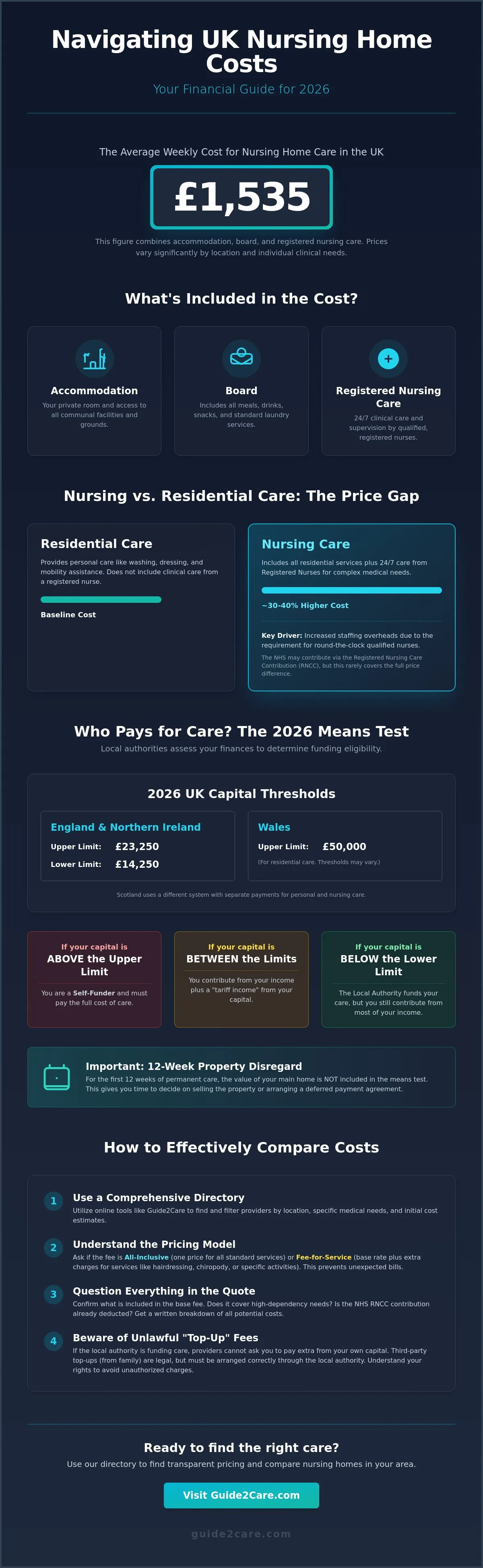
Nursing home costs consist of three primary elements: accommodation, board, and registered nursing care. Accommodation covers your room and the use of communal facilities. Board includes all meals, snacks, and laundry services. The third element, registered nursing care, provides for clinical tasks performed by qualified nurses. In 2026, the average weekly cost for nursing care in the UK is approximately £1,535. This figure represents a baseline, but actual prices fluctuate based on your location and the specific provider's facilities.
Recent inflation and the 'Fair Cost of Care' initiatives have pushed prices higher in 2026. These government-led initiatives aim to ensure local authorities pay a sustainable rate to providers. While this supports the long-term stability of the UK nursing home care system, it also means private payers often face higher fees to balance provider budgets. When you compare nursing home costs online, you'll see that these systemic changes are now fully reflected in the advertised rates.
To better understand this concept, watch this helpful video:
Nursing vs. Residential: Why the Price Gap Matters
The price gap between nursing and residential care is significant. Nursing homes require a 24/7 presence of Registered Nurses, which increases staffing overheads by roughly 30% to 40%. The Registered Nursing Care Contribution (RNCC) is a flat-rate payment from the NHS that helps cover these clinical costs. However, it rarely covers the full difference in price. To compare nursing home costs online effectively, you must check if the quoted price includes or excludes the RNCC. Nursing fees guarantee clinical supervision for complex medical conditions, a service not provided in standard residential settings.
The Role of Clinical Need in Pricing
Your specific medical requirements dictate the final price you pay. High-dependency needs, such as advanced dementia, bariatric care, or peg-feeding, require more intensive staffing and specialized equipment. Clinical need is the primary driver of fee variance in 2026. Most providers use a tiered pricing structure based on an initial assessment. This assessment determines whether you fall into a standard, medium, or high-dependency category. These levels directly influence the final quote you receive online, as providers must match their staffing ratios to your specific care plan requirements.
The Financial Assessment: Who Pays for Care in 2026?
Local authorities use a financial assessment, or means test, to determine who pays for long-term care. This process examines your total financial situation to see if you qualify for public funding. The assessment separates your assets into two categories: capital and income. Capital refers to your savings, investments, and property. Income includes your state pension, private pensions, and certain benefits.
When property is a major part of your capital, finding the right buyer is essential; you can check out HomesGoFast to see how international advertising can help you fund your care needs.
If your capital exceeds the set limits, you're classified as a self-funder. This means you're responsible for the full cost of your care fees. If your capital falls below the threshold, the local authority contributes toward the costs. Understanding your status is essential before you compare nursing home costs online to ensure your budget is realistic.
Homeowners often worry about selling their property immediately. The 12-week property disregard period provides a buffer. For the first 12 weeks of permanent care, the local authority ignores the value of your home in the means test. This period allows you time to sell the house or arrange a deferred payment agreement without the pressure of immediate fees. During such transitions, ensuring your property is correctly insured is essential; independent insurance brokers like Just Quote Me can help you find bespoke solutions for homes that may be unoccupied during the sale process.
2026 Savings Thresholds Across the UK
Capital limits are not uniform across the United Kingdom. In England and Northern Ireland, the upper capital limit is £23,250. If your assets are above this, you pay the full fee. Wales currently maintains a higher limit of £50,000 for residential care. Scotland uses a different system that includes separate payments for personal and nursing care.
- Above the Upper Limit: You pay the full cost of care.
- Between Upper and Lower Limits: You contribute a "tariff income" from your capital alongside your regular income.
- Below the Lower Limit: The local authority pays for your care, though you still contribute your income.
Be aware of the Deprivation of Assets rule. Local authorities investigate gifts or property transfers made to avoid care costs. If they decide you intentionally reduced your wealth to qualify for funding, they may assess you as if you still own those assets. This can lead to significant legal and financial complications.
NHS Continuing Healthcare (CHC) and Funded Nursing Care (FNC)
NHS Continuing Healthcare (CHC) is a package of care funded entirely by the NHS. To qualify, your primary need must be health-based rather than social. This is not means-tested; it's based on the complexity and intensity of your medical needs. If you qualify, the NHS pays for both your care and your accommodation.
Most residents in nursing homes receive NHS-funded nursing care instead. This is a flat-rate weekly contribution paid directly to the care home to cover the costs of registered nursing staff. In 2026, ensure the home clarifies if their quoted price includes or excludes this FNC payment.
Always request a CHC screening before moving into a home. This ensures you don't pay for services that the state should provide for free. Knowing these funding options allows you to accurately compare nursing home costs online and protect your retirement savings.
How to Effectively Compare Nursing Home Costs Online
Follow these four structured steps to accurately compare nursing home costs online. First, use the Guide2Care directory to filter results by "Nursing Care" and your specific location. This ensures the search results only include facilities with 24-hour registered nursing staff on-site. Second, examine the descriptions for "all-inclusive" versus "fee-for-service" pricing models. All-inclusive rates provide a flat weekly fee, while fee-for-service models add costs for specific medical supplies or personal items.
Third, check the latest Care Quality Commission (CQC) rating alongside the listed price. A high cost does not always correlate with an "Outstanding" or "Good" rating. In 2024, some premium-priced homes received "Requires Improvement" notices, making this cross-reference essential. Finally, request a "Key Information Guide" from the provider through the online portal. This document is a regulatory requirement that details the standard charges and potential extra fees you might encounter.
Reading Between the Lines of Online Listings
Be cautious of "Prices from" labels on digital listings. This figure usually represents the lowest possible cost for the smallest room, which may lack an ensuite bathroom or a garden view. Verify if the listed price includes essential services like laundry, basic toiletries, and social activities. Some homes charge extra for these items, adding £50 or more to the weekly bill. You should also ask if the provider charges "Assessment Fees" before admission. These one-off charges often range between £200 and £500 and are non-refundable. Understanding these details is vital when paying for a care home to avoid unexpected financial strain.
Using Digital Tools to Shortlist Providers
- Weekly Price: The base cost for nursing care.
- CQC Rating: The most recent inspection result.
- Included Services: A checklist of laundry, hair care, and trips.
- Notice Period: How much notice is required to end the contract.
This structured method allows you to evaluate value for money rather than just the headline rate. It simplifies the selection process and ensures you find a home that fits your budget and care requirements.
Identifying Hidden Fees and 'Top-Up' Charges
Understanding the full price of residential care requires looking beyond the advertised weekly rate. When you compare nursing home costs online, the initial figure often excludes mandatory or optional extras that increase the monthly bill. You must distinguish between the core care fee and additional service charges to maintain an accurate budget.
Third-party top-up fees occur when a local authority agrees to fund a placement but the chosen home costs more than the council's standard budget. A family member or friend must pay this difference directly to the home or the council. Residents cannot legally pay their own top-up fee from personal capital if their assets are below the £23,250 threshold. This rule prevents residents from exhausting their remaining funds too quickly. For families looking to manage these additional financial commitments, I Need Cash can help identify personal or homeowner loan options that suit their needs.
Notice period fees are a frequent source of financial stress. Most contracts include a clause requiring payment for 7 to 14 days after a resident passes away. This charge covers the period when the room is being cleared and cannot be re-let. Depending on the home's weekly rate, this can cost estate executors upwards of £2,500. Always check if the contract allows for a fee reduction if the room is occupied by a new resident before the notice period ends.
Local authority funding is designed to cover essential care, food, and accommodation. It rarely covers "luxury" elements. If a home offers premium room features or high-end lifestyle amenities, these are often excluded from state-funded budgets. This gap is what typically triggers the need for a top-up payment.
Common Extras Not Included in the Base Rate
Base rates typically cover 24-hour care, meals, and laundry. Personal services are usually billed as extras. Budget for these common additions:
- Personal Care: Hairdressing, barber services, and chiropody.
- Connectivity: Private telephone line installation and monthly rental.
- Logistics: Escorted visits to hospital appointments or social outings.
- Lifestyle: Individual newspapers, specialized toiletries, and guest meals.
Ask the home manager for a written "Schedule of Extras" during your first enquiry to see a full list of unit costs.
Annual Fee Increases: What to Expect
Care home fees usually increase every April. These adjustments reflect rising staff costs and the Consumer Price Index (CPI). In 2024, many UK providers implemented increases between 6% and 11% to account for National Living Wage changes. Review your contract for a "Fee Increase Cap" to ensure long-term affordability.
If your private capital falls below the £23,250 limit, you qualify for the "Social Services Safety Net." At this stage, the local authority takes over funding. You must inform the council at least 12 weeks before your funds reach this limit to ensure a smooth transition. Some homes may ask you to move to a standard room if the council's rate doesn't cover your current premium accommodation.
Finding the Right Care with Guide2Care’s Directory
Guide2Care provides a central, unbiased hub to begin your search for UK care providers. It functions as a practical tool to help you compare nursing home costs online without the clutter of general search engines. The directory organizes information logically, allowing you to filter results based on specific medical needs such as nursing care, dementia support, or respite stays. This structured approach ensures you only view homes capable of providing the required level of clinical assistance.
To understand the local market, you should explore multiple listings within a specific postcode. Fees vary significantly between regions like South East England and the North East. By reviewing several providers, you can establish a realistic baseline for local rates. Use our "Information and Guidance" section to supplement your search. This resource provides detailed articles on funding thresholds and legal requirements, helping you build a complete picture of the care system before making a commitment. For families traveling to evaluate these options, MyWaymore Services Corp offers a comprehensive directory to discover the best hotels and local businesses worldwide.
Simplifying Your Search
General search engines often return irrelevant or sponsored results that complicate your decision. Our directory uses precise categories to save you time. You can view the Care Quality Commission (CQC) status and provider contact details in one place. This transparency helps you identify high-performing homes quickly. Viewing the CQC rating alongside cost information allows for a more balanced assessment of quality versus price. Find the care you need by exploring our directory today.
Next Steps for Families
Once you've used the directory to compare nursing home costs online and create a shortlist, you must take active steps to verify your choice. Follow this checklist to move forward:
- Book at least three tours of homes found in the directory to compare the atmosphere and facilities.
- Prepare specific financial questions for the home manager. Ask for a breakdown of what the weekly fee includes and the frequency of historical price increases.
- Check the latest CQC inspection report for any "Requires Improvement" or "Inadequate" ratings in the safety or leadership categories.
- Request a sample contract to review the terms regarding notice periods and deposit returns.
The cheapest home isn't always the best value for your family. A lower price might reflect lower staffing ratios or fewer specialized activities. Focus on the CQC report and the feedback from current residents. Use the data gathered here to make an informed, practical decision that prioritizes long-term safety and well-being.
Take Control of Your Care Search
Navigating the UK care system in 2026 requires precise information and early preparation. Understanding how the latest government funding caps and local authority means-testing affect your budget is the first step toward a secure future. When you compare nursing home costs online, you gain the clarity needed to distinguish between standard residential rates and complex top-up charges. This transparency ensures your family avoids the financial strain of hidden fees while prioritizing providers that meet high CQC standards.
Guide2Care simplifies this journey by offering a comprehensive database of care providers across the UK. It's an independent resource designed to provide neutral guidance and up-to-date data on care funding. You can access detailed profiles to make an informed decision without the stress of navigating fragmented information. Use our structured tools to organize your search and find a provider that meets both your clinical needs and your specific financial requirements.
Find The Care You Need: Search Our UK Nursing Home Directory
Finding the right care is a significant milestone; start your search today to ensure peace of mind for your loved ones.
Frequently Asked Questions
How much does a nursing home cost per week in the UK in 2026?
Average nursing home fees in the UK for 2026 are estimated to range between £1,350 and £1,650 per week. These figures vary significantly by region; for instance, costs in London and the South East often exceed £1,800. These fees cover 24 hour medical supervision, accommodation, and meals. Use regional data to compare nursing home costs online to get an accurate figure for your specific area.
Can I compare nursing home costs online without giving my personal details?
You can browse general price ranges on many care directories without providing personal information. Most sites show a "from" price for basic rooms to help you shortlist options. However, obtaining a tailored quote usually requires sharing your location and specific care requirements. This ensures the price reflects the level of nursing support you actually need for your specific health condition.
Do I have to sell my house to pay for nursing home fees?
You don't necessarily have to sell your home immediately to cover care costs. If your spouse or a dependent relative still lives in the property, its value is disregarded in the local authority means test. You might also qualify for a Deferred Payment Agreement from your local council. This allows the cost of care to be paid back later, typically after the property is eventually sold. For those who prefer to settle their finances sooner, options to sell house fast UK can provide a swift resolution and immediate clarity for care planning.
What is a third-party top-up fee and who pays it?
A third-party top-up fee is the difference between what a local authority pays and the actual cost of a chosen nursing home. A family member, friend, or charity must pay this amount directly to the provider. You cannot usually pay your own top-up fee using your own capital. Ensure you understand this ongoing financial commitment before signing any residency contract.
How much savings can I have before I have to pay for my own care?
In England, you must pay the full cost of your care if your assets exceed £23,250. If your savings fall between £14,250 and £23,250, the local council provides partial funding. Those with less than £14,250 in total assets receive maximum state support for their care costs. These thresholds are set by the Department of Health and Social Care and are subject to annual review.
Is nursing care free for people with dementia in the UK?
Nursing care isn't automatically free for people with dementia. You only receive free care if you qualify for NHS Continuing Healthcare (CHC) because your primary need is health-based. If you don't meet the strict CHC criteria, you'll be means-tested by your local authority. Most people with dementia pay for their accommodation while receiving the NHS Nursing Care Contribution for their medical needs.
What is the difference between a care home and a nursing home cost?
Nursing homes typically cost £200 to £400 more per week than standard residential care homes. This price gap accounts for the 24 hour presence of registered nurses and specialized medical equipment. When you compare nursing home costs online, check if the price includes the NHS Funded Nursing Care (FNC) contribution. This payment currently sits at £235.88 per week for the 2024/25 financial year.
What happens to nursing home fees if I run out of money?
Your local authority takes over the funding if your capital falls below the £23,250 threshold. You should contact your council's social services department at least three months before your funds reach this limit. They'll perform a new financial assessment to determine their contribution level. The nursing home must agree to the council's standard rate, or a third-party top-up fee might become necessary.