Assisted Living vs Residential Care: Which Option is Right for You?
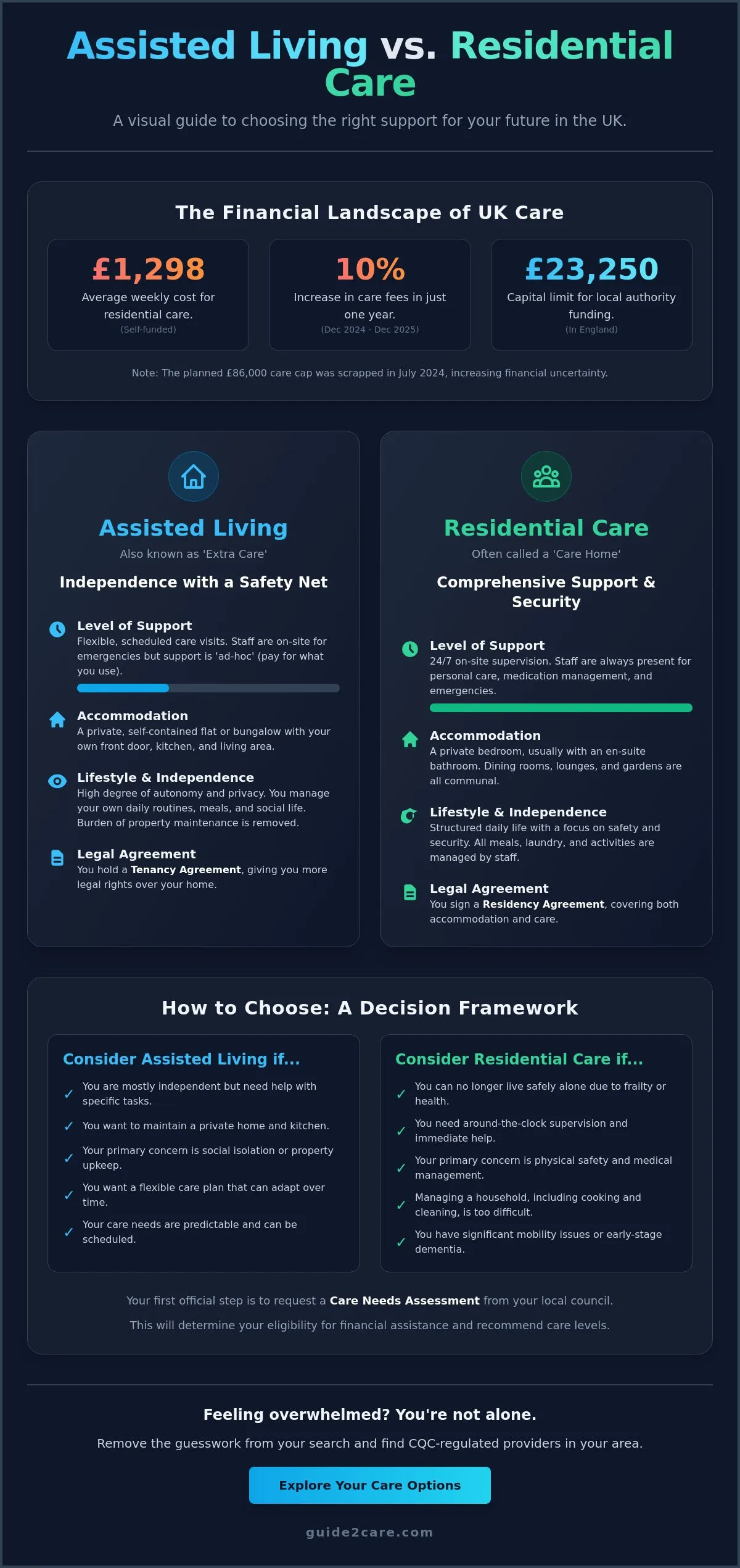
Did you know that self-funded care home fees increased by 10% between December 2024 and December 2025? With the average weekly cost of residential care now reaching £1,298, selecting the wrong type of support is an expensive mistake. You likely feel overwhelmed by complex terminology and the July 2024 scrapping of the planned £86,000 care cap. It's common to worry about losing your independence or falling just above the £23,250 capital limit for local authority funding in England.
Understanding the differences between assisted living vs residential care is the first step toward a secure future. This guide explains how each option impacts your lifestyle, costs, and daily support levels. You'll find a clear comparison of CQC-regulated services and a practical roadmap to guide your next steps. Use this information to remove the guesswork from your search and gain confidence in your decision. Find the care you need by exploring our detailed breakdown of these two essential care models.
Key Takeaways
- Distinguish between 'Extra Care' housing models and 24-hour residential care settings to find the right level of support.
- Compare the legal protections of assisted living vs residential care, specifically the difference between holding a tenancy and a residency agreement.
- Evaluate your need for independent facilities, like a private kitchen, against the security of communal dining and on-site supervision.
- Learn how to request a Care Needs Assessment from your local council to determine your eligibility for financial assistance.
- Use our decision framework to assess whether physical safety or social isolation is the most urgent priority for your future care.
Defining Assisted Living and Residential Care in the UK
Understanding the terminology is the first step in your search for the right support. The comparison of assisted living vs residential care often boils down to the level of autonomy you maintain over your living space. In the UK, these terms aren't always used consistently by local authorities or providers. You might hear assisted living referred to as 'Extra Care' or 'Supported Living' depending on your location and the specific support package offered. Both models are regulated by the Care Quality Commission (CQC) in England to ensure safety and quality standards.
Regional variations add another layer of complexity. While the core principles remain similar, Scotland often uses the term 'Very Sheltered Housing.' In Wales and Northern Ireland, the terminology might shift based on whether the care is provided by a housing association or a private company. Regardless of the name, the primary difference remains the legal status of your home and the intensity of the daily care provided.
To better understand this concept, watch this helpful video:
What is Assisted Living (Extra Care)?
Assisted living provides a middle ground for those who don't need 24-hour supervision but require help with specific tasks. You live in a self-contained flat or bungalow, which means you have your own front door, kitchen, and living area. It's a housing-led model. Support staff are on-site to assist with planned visits for personal care or to respond to emergencies via an alarm system. This option removes the burden of property maintenance while allowing you to keep a high degree of independence. You typically hold a tenancy agreement, giving you more legal rights over your living space than in a care home.
To ensure these private spaces remain in top condition, many residents choose to supplement their routine with professional help; for example, Carpet Cleaner In Manchester provides expert deep-cleaning for upholstery and floor coverings to maintain a healthy living environment.
What is Residential Care?
Residential care is a service-led model where the focus is on 24/7 support and safety. Residents live in a care home setting, usually occupying a private bedroom with an en-suite bathroom. All other areas, such as lounges and dining rooms, are communal. This environment is designed for individuals who can't live safely alone due to physical frailty or cognitive decline. Staff are present around the clock to provide personal care and manage medication; if you are coordinating such a move and require premium care for your pet during the transition, you can visit The Fur Seasons for professional support. Unlike assisted living, you don't have a tenancy; instead, you sign a residency agreement that covers both your accommodation and your care package.
Level of Support: Comparing Personal Care and Supervision
The primary differentiator in the debate of assisted living vs residential care is the frequency and intensity of support. You must identify the "care gap" in your current situation. This is the point where occasional visits from family or neighbors no longer ensure safety. As of September 2025, 683,000 people in the UK were receiving long-term, local authority-funded care. Identifying the right provider, such as WithCare Support Services for those needing professional disability support, is essential to ensuring that care levels match changing needs over time. Many of these individuals started with light assistance before transitioning to more structured environments.
In an assisted living setting, support is typically scheduled. You might have a carer visit for thirty minutes in the morning to help with dressing. Another might arrive in the evening to assist with meal preparation. This is often delivered by external domiciliary care agencies. Medical needs are usually met by visiting district nurses or GP appointments, just as they would be in a private home. Emergency help relies on technology like pull cords or wearable pendants. If you require more frequent intervention, you can explore care providers to see which level of service they offer in your area.
The 'Ad-Hoc' Nature of Assisted Living
Assisted living is built on flexibility. You only pay for the care you use. If you only need help with laundry and heavy cleaning, your care package reflects that. It's an ideal solution if you're mostly independent but struggle with specific physical tasks. As your needs change, you can increase the hours of support. This "extra care" model allows you to age in place without moving to a full-care facility prematurely. Social interaction here is often organic, occurring in communal lounges or gardens, but it isn't strictly supervised or mandated. For pet owners in Scotland who want to keep their outdoor areas clean, Scot Pooper Scoopers provides professional waste removal services to help maintain a healthy environment.
The 24/7 Supervision of Residential Care
Residential care provides a safety net that never switches off. Staff are present in the building 24 hours a day. This is essential for individuals with significant mobility issues or those in the early stages of dementia who might wander or forget to eat. In this setting, the care team manages everything. They handle medication administration, nutrition, and personal hygiene. You don't need to coordinate with outside agencies because the support is built into the service. Social life is also more structured. Most homes employ activity coordinators to run daily events, ensuring residents stay engaged and reducing the risk of isolation.
Accommodation and Lifestyle: Independence vs. Security
The physical environment is the most visible difference when comparing assisted living vs residential care. You're choosing between a private home with support and a communal facility built for safety. This decision impacts your daily autonomy and how you interact with your surroundings. Examine the layout of each option to determine which matches your preference for privacy or proximity to others.
Tenancy agreements are standard in assisted living. You have the same legal rights as any other tenant, which means you have exclusive possession of your flat. In contrast, residential care homes operate under residency or license agreements. These contracts grant you the right to occupy a room and receive care, but they don't provide the same level of security of tenure as a tenancy. You aren't "renting" a flat; you're paying for a service that includes accommodation.
Property maintenance and utility management also vary between these settings. Assisted living residents usually pay a service charge that covers communal repairs, gardening, and building insurance. You remain responsible for your own council tax and electricity bills within your flat. Residential care is an all-inclusive model. The weekly fee covers all utilities, property maintenance, and even laundry services. This structure removes the administrative burden of managing multiple household bills.
In premium assisted living developments, residents may choose to supplement basic maintenance with specialized services; for instance, luxury residential cleaning London can ensure that private apartments are kept in pristine condition.
Life in an Assisted Living Community
Freedom defines this lifestyle. You have a full kitchen to cook your own meals, but most complexes also offer on-site restaurants or cafes for convenience. You can host family members overnight and keep pets in your own home. For those who want to maintain their hobbies without cluttering their new apartment, platforms like Life4Rent make it easy to rent specific equipment or list items you only use occasionally. Shared facilities like gyms, hair salons, and landscaped gardens are also available. These hubs allow you to socialize on your own terms while your private space remains entirely separate from the communal areas.
Life in a Residential Care Home
Structure helps reduce stress and anxiety for many residents. Daily life follows a routine of set meal times and organized activities. Communal dining rooms play a vital role in preventing the social isolation that affects many seniors living alone. While you live in a communal building, you can personalize your bedroom with your own furniture and photos to make it feel familiar. With UK occupancy rates around 85%, these homes are lively environments designed for constant social engagement and safety.
UK Costs and Funding: Navigating the Financials
Financial planning is a critical component of the decision between assisted living vs residential care. Self-funded care home fees increased by 10% between December 2024 and December 2025. The average weekly cost for residential care currently stands at £1,298. Before committing to a provider, you must request a Care Needs Assessment from your local council. This free service identifies the specific support required and is the prerequisite for any local authority financial assistance.
The financial means test follows the needs assessment. In England and Northern Ireland, the upper capital limit is £23,250. If your assets, including property and savings, exceed this amount, you're expected to self-fund your care. In Scotland, the upper limit is £35,000, while Wales sets this threshold at £50,000. These figures are vital because the planned £86,000 lifetime care cap was scrapped in July 2024. This means individuals are responsible for the full cost of their care until their assets fall below the local thresholds. To see how these costs apply to specific facilities, find care providers in your area and request their current fee structures.
Funding Assisted Living
Assisted living costs are usually split into two categories: housing and care. You pay rent, a mortgage, or a leasehold fee for the property itself. The care package is billed separately based on the hours of support you receive. Many residents qualify for Attendance Allowance, a non-means-tested benefit for those over state pension age. You might also be eligible for Pension Credit to help with daily living expenses. Service charges are standard in these complexes; they cover the maintenance of communal areas and the provision of 24/7 emergency alarm monitoring.
Funding Residential Care
Residential care fees are generally all-inclusive. These costs cover "hotel services" such as accommodation, meals, and laundry, alongside personal care and 24-hour supervision. If you have complex or intense healthcare needs, you might qualify for NHS Continuing Healthcare (CHC). This is a package of care funded solely by the NHS. For those who don't meet the CHC criteria, the local authority means test will include the value of your home. However, the property is ignored if a spouse, partner, or a relative over 60 still resides there.
How to Choose: A Decision Framework for Families
Choosing between assisted living vs residential care requires a structured assessment of your current circumstances. Avoid making this decision under the pressure of a sudden health crisis. Instead, use a systematic framework to determine which environment provides the appropriate balance of safety and autonomy. This approach removes the emotional guesswork and focuses on practical outcomes for long-term stability.
- Step 1: Assess physical safety. Evaluate the ability to manage daily risks. Can the individual navigate stairs or use the kitchen without supervision? If mobility issues lead to frequent falls, the 24-hour monitoring of residential care is often safer than the ad-hoc support of assisted living.
- Step 2: Evaluate social needs. Determine if social isolation is impacting mental health. Assisted living offers privacy, but residential care provides a built-in community with structured daily activities. With UK occupancy rates around 85%, these homes offer a high level of peer interaction.
- Step 3: Review CQC ratings. Check the latest Care Quality Commission reports for local providers. These independent inspections verify if a facility is safe, effective, and well-led.
- Step 4: Use a directory. Compare local options side-by-side. Look for specific services like dementia support or rehabilitation that match your needs.
- Step 5: Visit multiple facilities. Atmosphere cannot be measured online. Visit at least three locations to observe staff interactions and communal cleanliness before signing any agreement.
When is it Time to Move?
Recognizing the transition point is vital for maintaining dignity. Red flags include unexplained weight loss, missed medication doses, or a decline in personal hygiene. To help monitor health and wellbeing more closely from home, you can check out Ready Health for accessible testing kits. You might also notice a "step-up" requirement where assisted living no longer provides enough hours of care to ensure safety. Involve the senior in every stage of this conversation. Respecting their preferences during the search process helps reduce the anxiety associated with leaving a long-term family home.
Finding Your Local Care Options
Finding the right provider is easier when you can filter by specific criteria. Use Guide2Care to search by location and the specific type of care required. Our directory listings provide essential details, including photos, service lists, and direct links to CQC reports. This transparency allows you to build a shortlist of providers who meet your standards for both quality and cost. England has approximately 17,000 care homes, and our platform helps you organize these options into a manageable selection process. Find the care you need near you today by exploring our comprehensive database of UK providers.
Take the Next Step Toward Quality Care
Choosing between assisted living vs residential care is a significant decision that impacts your lifestyle and your financial security. You now understand that the primary difference lies in the level of autonomy you maintain and the intensity of daily support. Assisted living offers a private home with flexible help; residential care provides 24-hour security in a communal setting. For those transitioning with pets in South West London, you can check out London Veterinary Surgeries to find award-winning care in the Wimbledon area. With the UK projected to need 470,000 additional care posts by 2040, starting your search early ensures you have the best range of options available.
Use our practical tools to simplify this complex process. Our platform offers a comprehensive UK-wide directory with neutral, expert guidance on every care type. We provide direct links to CQC ratings and specific provider details to help you make an informed decision. You can explore our directory to find care homes and assisted living near you today. Armed with a clear decision framework, you can move forward with certainty. Find the care you need and secure a comfortable future for yourself or your loved one.
Frequently Asked Questions
Is assisted living the same as a nursing home in the UK?
No, these are distinct service models with different levels of clinical support. Nursing homes employ registered nurses to provide 24-hour medical supervision for complex health conditions. Assisted living focuses on housing with ad-hoc support for personal care tasks. While the average weekly cost of nursing care reached £1,535 in May 2026, assisted living costs are usually split between property rent and specific care hours.
Can I get help with the costs of assisted living?
Financial assistance is available through several UK benefit routes. You can apply for Attendance Allowance if you're over state pension age and require help with personal care. Local authorities may also fund the care element of your package if your assets fall below the £23,250 threshold in England. Pension Credit and Housing Benefit can sometimes assist with the accommodation costs when comparing assisted living vs residential care.
Do I have to sell my house to pay for residential care?
You don't always need to sell your home immediately to fund your support. If your spouse or a relative aged over 60 still lives in the property, its value is ignored during the local authority means test. You might also be eligible for a Deferred Payment Agreement. This arrangement allows the local authority to pay for your care and reclaim the costs from your estate at a later date.
What is the difference between sheltered housing and assisted living?
The main difference is the level of personal care and regulation involved. Sheltered housing offers low-level support, such as an emergency alarm and a part-time warden, but isn't regulated by the CQC for care delivery. Assisted living, often called Extra Care, provides structured personal care services that are CQC-inspected. It's designed for those who need help with dressing or bathing but wish to keep a private flat; if you are moving to such a facility in Lanarkshire with your pets, you can explore Bi-Weekly Service (2 Dogs) to keep your outdoor space clean.
Can couples stay together in residential care or assisted living?
Most providers offer options for couples to stay together. Assisted living is particularly suitable for this because you live in a self-contained apartment with enough space for two people. In residential care, many homes provide companion suites or larger double rooms. You should confirm with the provider if they have the capacity and appropriate registration to support both individuals' specific health needs simultaneously.
How do I know if a care provider is high quality?
Verify the provider's current rating from the Care Quality Commission (CQC) before making a decision. The CQC inspects facilities and rates them as Outstanding, Good, Requires Improvement, or Inadequate. As of September 2025, over 80% of UK care homes held a 'Good' or 'Outstanding' rating. Read the full inspection report to see how the facility performs in specific areas like safety, effectiveness, and leadership.
What happens if my care needs increase while in assisted living?
You can usually increase your care hours to meet changing physical or cognitive needs. This flexibility is a key benefit of the housing-with-care model. However, if you eventually require 24-hour supervision or regular clinical intervention, the facility might recommend a transition to residential or nursing care. This ensures your safety when scheduled visits from carers are no longer sufficient to manage your health risks; for those who also need to arrange professional pet care during this time, click here.
Are pets allowed in UK assisted living facilities?
Planning for your pet's ongoing health is a crucial part of any move. If you are relocating within the city, you can learn more about London Veterinary Surgeries to discover a multi-award winning group of independent practices that has been caring for London's pets for over 20 years.
Beyond medical check-ups, cat owners may need reliable daily support to maintain their pet's routine during a move; Mission Cats In-Home Care provides professional sitting services that ensure your cat receives dedicated attention in the comfort of their own environment.
Many assisted living providers allow pets, provided they don't disturb other residents in the complex. Since you hold a tenancy for your own self-contained flat, you generally have more freedom to keep a companion animal than in a communal care home. Always check the specific terms of the lease or residency agreement before moving. If you are looking for top-tier care for your companion during your transition or while traveling, The Fur Seasons offers a premium service model that ensures your pet is well-looked after by professionals.