Respite Care in Devon: A Complete Guide to Breaks and Support

What if taking a break from caregiving actually improved the quality of support you provide? Many carers feel that seeking respite care in devon is a sign of struggle, but it's actually an essential tool for long-term health. You're likely managing the emotional weight of care while trying to understand the local system. It's common to feel confused by assessment processes or worried about the high costs of private residential stays and rural isolation.
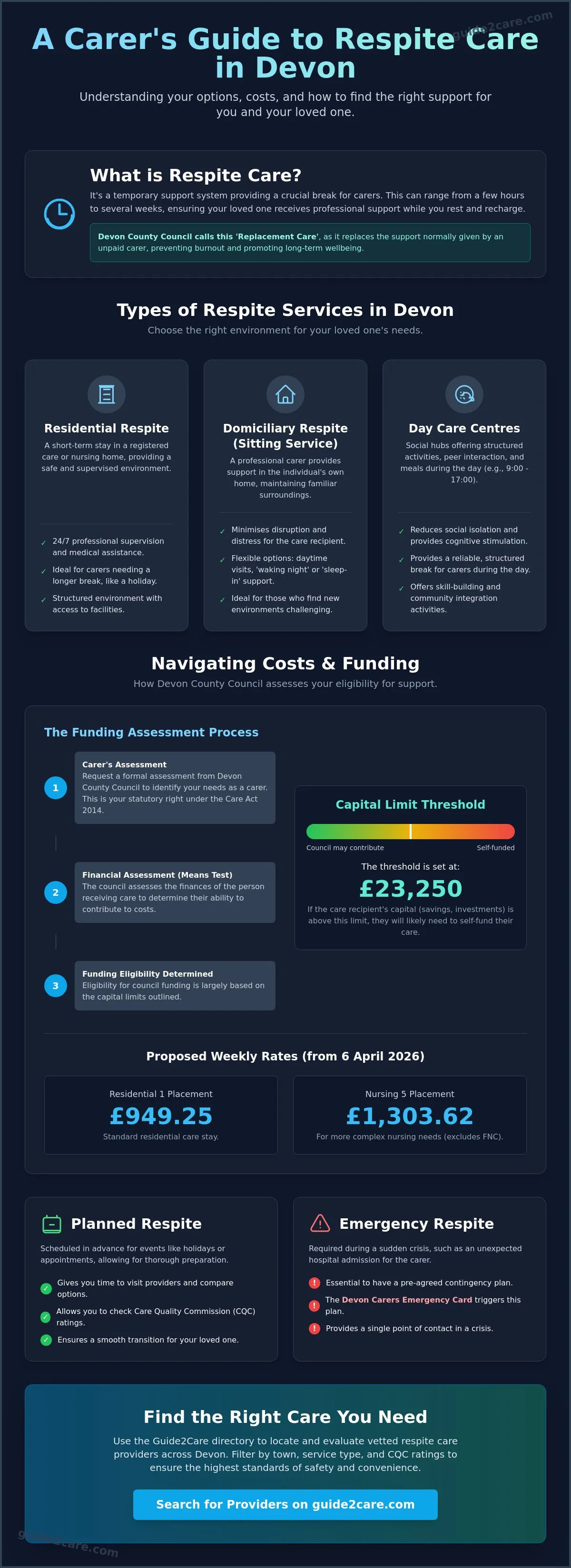
You want to ensure your loved one is safe while you recharge. This guide simplifies the search by detailing the Devon County Council assessment steps and the latest funding thresholds, including the £23,250 capital limit. We'll explore the new 2026/27 fee models effective from 6 April 2026, including the £949.25 weekly rate for Residential 1 placements. We also address practical challenges like transport to day centres and finding local providers. Read on to learn exactly how to secure the support you need to maintain your own wellbeing.
Key Takeaways
- Learn the difference between short-term residential stays and home-based sitting services to find the most appropriate environment for your loved one.
- Discover how to navigate the Devon County Council financial assessment process and understand how means-testing affects funding eligibility.
- Locate the most suitable respite care in devon by filtering providers by town and service type within the Guide2Care directory.
- Evaluate potential providers using Care Quality Commission (CQC) ratings and geographic accessibility to ensure high standards of safety and convenience.
- Understand the concept of 'replacement care' and how a carer’s assessment can help you access essential breaks from your daily routine.
What is Respite Care and How Does it Work in Devon?
Understanding What is Respite Care is the first step for any caregiver. It's a temporary support system designed to provide a break for the primary carer. This support can last for a few hours during the day or extend to several weeks in a residential setting. Arranging respite care in devon allows you to attend appointments, take a holiday, or simply rest while your loved one receives professional support.
Devon County Council often uses the term 'replacement care' to describe these services. This term highlights that the care is provided directly to the person with care needs to replace the support normally given by the unpaid carer. Regular breaks are essential to prevent carer burnout. Without these intervals, the physical and emotional demands of constant care can lead to health issues for the carer. Taking a break is a proactive strategy to maintain a sustainable care routine, which might involve a relaxing visit to The Corner House Hotel in Taunton for a meal or overnight stay.
To better understand this concept, watch this helpful video:
You can choose between two main delivery models. Residential respite involves a short-term stay in a registered care home. Domiciliary or 'sitting' services involve a professional carer coming to your home. This allows the person receiving care to remain in familiar surroundings while you take time away. Both options ensure safety and continuity of care for your loved one.
The Role of Devon County Council and Devon Carers
Devon County Council works in partnership with the Devon Carers organisation to support the local community. Under the Care Act 2014, you have a statutory right to a Carer's Assessment. This check identifies your specific needs and determines if you qualify for support. The council's 2026/27 budget of £395.9 million prioritises home-based care to help residents stay independent. You can use the Pinpoint Devon directory, a local government resource, to find registered providers and community groups in your area.
Emergency vs. Planned Respite: Knowing the Difference
Planned respite is scheduled in advance for specific events like medical procedures or annual leave. It gives you time to visit providers and check CQC ratings. Emergency respite is required during sudden crises, such as a carer's unexpected hospital admission. For 2026/27, the council proposed a 3.8% uplift for care placements to manage rising demand and ensure service availability. The Devon Carers Emergency Card scheme provides a single point of contact to trigger a pre-agreed contingency plan if you are suddenly unable to provide care.
Types of Respite Services Available Across Devon
Choosing the right support requires understanding the specific models available. Residential respite involves the person you care for moving into a nursing or residential home for a set period. This provides 24-hour supervision and professional medical assistance if required. For many, exploring NHS respite care options in Devon helps clarify local availability. In major hubs like Exeter and Barnstaple, homes offer tailored short-term placements. From 6 April 2026, the proposed weekly rate for a Residential 1 placement is £949.25, while a Nursing 5 placement is £1,303.62 excluding FNC. You can search for local providers to see current vacancies.
Domiciliary respite, or 'sitting services', allows the individual to stay in their own home. A professional carer visits to provide companionship or personal care. This model is often preferred for those who find changes in environment distressing. Beyond daytime visits, you can arrange 'waking night' or 'sleep-in' support. This ensures safety overnight while the primary carer rests. Identifying agencies that cover rural parishes on Dartmoor or Exmoor is vital, as transport links can limit some providers. For 2026/27, the council proposed a 3.56% uplift for these non-residential services to account for the 4.1% National Living Wage increase.
Day care centres serve as building-based social hubs. Located in urban areas like Plymouth or Torbay, these centres offer structured activities and peer interaction. They are effective at reducing senior isolation and providing cognitive stimulation. For adults under 65, the 'Reaching for Independence' initiative focuses on skill-building and community integration. Typical activities include arts, light exercise, and communal meals. These centres often operate between 9:00 and 17:00, providing a reliable window for carers to manage other responsibilities. For those with care needs who want to travel, supported holidays in Devon provide specialized tourism options with on-site medical support. To help manage the logistics of travel, you can find various daily items and equipment for hire through Life4Rent, ensuring you have everything needed for a comfortable trip.
Home-Based Care and Sitting Services
Maintaining a familiar routine is critical for dementia patients. Home-based care ensures that meal times, medication schedules, and surroundings remain constant. This stability reduces confusion and anxiety during the carer's absence. Agencies in Devon are increasingly specialising in dementia-trained staff for these roles, often incorporating therapeutic approaches similar to those used by Accessible Care to support complex needs. If you live in an isolated area, check if the agency includes travel time in their service duration. Waking night support is particularly useful for individuals who experience 'sundowning' or frequent nighttime agitation, allowing you to sleep undisturbed.
Day Centres and Community Enabling
Community enabling services go beyond simple supervision. They focus on empowering the individual to participate in local life. This might include visiting a library in North Devon or attending a community garden in the South Hams. These services are often part of a wider support plan following a social care assessment. By engaging in these social settings, individuals maintain their social skills and physical mobility. This proactive approach supports the Better Care Fund's goal of keeping residents safe and independent at home for longer.
Navigating Costs and Funding for Respite in Devon
Understanding the financial landscape is essential for securing respite care in devon without unexpected expenses. Devon County Council uses a financial assessment process, often called means-testing, to determine how much an individual contributes toward their care. As of May 2026, the upper capital limit is £23,250. If the person receiving care has savings or assets above this amount, they are classified as a self-funder and must pay the full cost of their stay. Those with assets between £14,250 and £23,250 will contribute a portion of the costs, while assets below £14,250 are disregarded in the calculation.
The financial assessment focuses on the person receiving the care, not the carer. This distinction ensures that the carer's personal savings or property are protected during the assessment of the loved one's eligibility. If you prefer more control over your support, ask about Direct Payments. This option allows the council to pay the care budget directly to you, enabling you to choose and book your own providers. For the 2026/27 period starting 6 April 2026, the council has proposed a 3.56% uplift for non-residential support services to reflect rising operational costs. Use this flexibility to find a provider that matches your specific routine.
Funding pathways differ significantly between planned and emergency situations. Planned respite is typically part of a long-term care plan following a Care Needs Assessment. Emergency respite, triggered by a sudden crisis such as a carer's illness, may involve rapid funding approval through the council’s duty team. Self-funders should prepare for higher costs in the private market, where rates often exceed council-set benchmarks. While the council’s 2026/27 rate for a Residential 1 placement is £949.25 per week, private providers in coastal areas or premium facilities may charge significantly more based on demand and location.
Grants and Financial Support for Carers
Carers can access specific financial aids to subsidize the cost of a break. Devon Carers offers 'Health and Wellbeing' grants to help with the costs of replacement care or personal activities that support the carer's mental health. You can also use non-means-tested benefits like Attendance Allowance or the care component of Disability Living Allowance to pay for private respite services. Local Devon charities, such as those focused on specific conditions like Parkinson's or dementia, often provide small subsidies or vouchers for their members to access local day centres.
Budgeting for Private Respite Care
Several factors influence the final price of a private stay. Nursing respite is consistently more expensive than residential respite because it requires 24-hour medical supervision by registered nurses. For example, the 2026/27 proposed rate for Nursing 5 care is £1,303.62 per week, compared to £949.25 for Residential 1. Facilities in popular coastal towns or rural retreats often carry a premium compared to inland urban centres. Private rates in Devon vary by provider, but market averages for 2026 typically range from £1,000 to £1,600 per week depending on the complexity of needs and the level of luxury provided.
How to Choose a Respite Provider in Devon
Selecting the right respite care in devon requires a methodical approach to quality and logistics. Begin by reviewing the latest Care Quality Commission (CQC) inspection reports. These documents provide an impartial assessment of whether a facility is safe, effective, and well-led. Focus on providers with "Good" or "Outstanding" ratings to ensure high standards. Before committing to a long-term arrangement, request a trial session. A single afternoon or an overnight stay allows your loved one to experience the environment. It also lets you evaluate how the staff manages existing care plans and personal preferences.
Experience with specific conditions is another critical factor. If your loved one has dementia or autism, ask for evidence of specialized staff training. Some Devon facilities have dedicated wings or sensory rooms designed for these needs. Geographic accessibility is equally important. A provider located near Dartmoor or Exmoor might look close on a map, but travel times on rural roads can be significant. Ensure the location is practical for family visits and emergency access. To begin your search, explore our directory of Devon care providers and filter by specialism.
The Devon Checklist: Questions to Ask Providers
Prepare a list of direct questions to ask during your site visit. Focus on the operational details that impact daily life. Inquire about the staff-to-resident ratio during respite stays, as this can differ from permanent residency levels. Ask if there are additional charges for transport to local appointments or specialized group activities. You should also confirm how the provider handles medication administration. Provide a copy of the current care plan and ask the manager to explain how they will maintain continuity of routine.
Evaluating Rural Access and Transport
Logistics in rural Devon require careful planning. If you're using a day centre, investigate community transport options like the 'Devon Fleet' or local volunteer car schemes. These services often bridge the gap in areas where public transport is limited. For home-based respite, clarify if the agency charges for 'travel time'. In remote parishes, these costs can add a significant percentage to the hourly rate. Staff with local knowledge are often better equipped to handle rural navigation during adverse weather. Confirm that the provider has a robust contingency plan for staff reaching your property during winter months or road closures.
Finding the Care You Need with Guide2Care
Finding respite care in devon requires a structured approach to ensure safety and suitability. Guide2Care provides a centralized hub to simplify this process. Our directory allows you to bypass general searches and focus on specific local providers. You can compare different service types and verify Care Quality Commission (CQC) ratings in one location. This organized method helps you make an informed decision without the friction of visiting multiple individual websites. We present information clearly and directly to remove the ambiguity often found in care searches.
Efficiency is key when you are managing care responsibilities. The directory is designed for quick scanning and easy comprehension. You can find providers that match your specific needs, whether you require a rural home near the South Hams or an urban facility in Plymouth. By using a functional directory, you can identify which homes offer short-term respite versus those that only accept permanent residents. This distinction is vital for planning breaks. Our goal is to empower you with the data needed to move from a broad search to a specific provider shortlist.
Beyond the directory, you can access resources regarding legal rights and funding thresholds. As established, understanding the £23,250 capital limit is essential for financial planning. Having these facts at your disposal ensures you are prepared for conversations with social care practitioners or private providers. We provide the tools to bring order to a potentially chaotic search, presenting ourselves as a dependable facilitator for Devon families. This clarity allows you to focus on the practicalities of scheduling a break rather than the stress of the search itself.
Using Our Directory to Narrow Your Search
To start your search, use the location filters to select specific Devon towns like Exeter, Torquay, or Barnstaple. You can then refine results by selecting 'respite' as the care type. It is essential to understand the difference between the nursing and residential filters. Nursing filters show homes with 24-hour medical staff, while residential filters focus on personal care and social support. Identifying the correct level of care ensures the safety of your loved one. You can Find care homes in Devon that meet these specific criteria using our search tool.
Next Steps: Booking Your Break
Once you have a shortlist of providers with "Good" or "Outstanding" CQC ratings, contact them directly through the details provided in our listings. Ask about availability for your preferred dates well in advance. Before the stay begins, prepare a comprehensive care handover document. This should include medication schedules, dietary requirements, and daily routines. Providing this information ensures continuity of care and peace of mind for both the carer and the individual. Explore Guide2Care today to find the respite support your family deserves and secure the break you need.
Secure Your Support and Plan Your Break
Securing respite care in devon is a practical step toward maintaining a sustainable care routine. You now have the information needed to navigate the 6 April 2026 fee adjustments and the £23,250 capital threshold for council funding. Whether you choose a short-term residential stay or a domiciliary sitting service, verifying CQC ratings ensures your loved one remains safe while you recharge. If you are using this time to plan a well-deserved break, resources like mywaymore.com can help you find the perfect hotel or local business for your trip. These structured steps transform a complex search into a manageable process.
Guide2Care simplifies this task by providing a comprehensive UK-wide directory with integrated CQC data and practical funding guides. Our platform allows you to filter providers by town and specialism, ensuring you find a match for your family's specific requirements. Our directory includes detailed listings for nursing homes, residential care, and domiciliary agencies across the county. By accessing these resources, you can move forward with confidence and clarity. Take the next step in your caregiving journey today and find a provider that meets your standards.
Find The Respite Care You Need in Devon
Frequently Asked Questions
How long can a respite care stay last in Devon?
Respite stays typically last from a few hours for a sitting service up to four weeks for a residential placement. Most planned residential breaks in Devon nursing homes are booked for one or two weeks. You can arrange shorter stays for specific events or longer periods if the carer needs extended recovery time. Always confirm the minimum stay period with your chosen provider before booking to avoid scheduling conflicts.
Will the council pay for my respite care break?
Devon County Council will pay for your break only if the person receiving care meets eligibility criteria and falls below financial thresholds. If they have more than £23,250 in savings, they must pay the full cost. For those with assets between £14,250 and £23,250, the council may provide partial funding. You must request a Care Needs Assessment and a Financial Assessment to determine your specific entitlement under the Care Act 2014.
What is the 'Emergency Card' for carers in Devon?
The Emergency Card is a physical card provided by Devon Carers that carries a unique reference number linked to your contingency plan. If you're suddenly unable to provide care due to an accident or illness, anyone finding the card can call the 24 hour helpline. This triggers a pre-arranged response to ensure your loved one is safe. It's a vital tool for respite care in devon during unplanned crises.
Can I get respite care at home instead of a care home?
Yes, you can access respite care in your own home through domiciliary care agencies or sitting services. This allows the person you care for to stay in a familiar environment while a professional carer visits for a few hours or stays overnight. It's often a preferred option for those who find moving into a residential home stressful. You can find these agencies using the Guide2Care directory filters for home care support.
Do I need a CQC-registered provider for a sitting service?
You need a CQC-registered provider if the sitting service involves regulated activity such as personal care. This includes assistance with washing, dressing, or medication management. If the service is purely for companionship or social interaction, registration isn't legally required. However, choosing a registered provider ensures that staff have undergone background checks and the agency meets national safety benchmarks. This provides an additional layer of security for your family.
How do I find respite care for someone with dementia in Exeter?
Use the Guide2Care directory to find specialized respite care in devon for dementia patients. Select 'Exeter' in the location filter and then refine your search by the 'Dementia' care specialism. This will display a list of residential homes and home care agencies with the specific training and facilities required. Check the latest CQC reports for each provider to see how they perform in the "Effective" and "Caring" categories before making contact.
What happens if my respite provider cancels at the last minute?
If a private provider cancels, check your contract for their emergency backup policy immediately. Many agencies have on-call staff to cover last-minute absences. If you have an Emergency Card, contact the Devon Carers helpline to trigger your contingency plan. For those receiving council-funded care, notify the Integrated Adult Social Care team to request emergency replacement care through their duty system. Having a secondary provider contact list can also help mitigate these risks.