How to Choose an Assisted Living Facility: A Comprehensive 2026 UK Guide

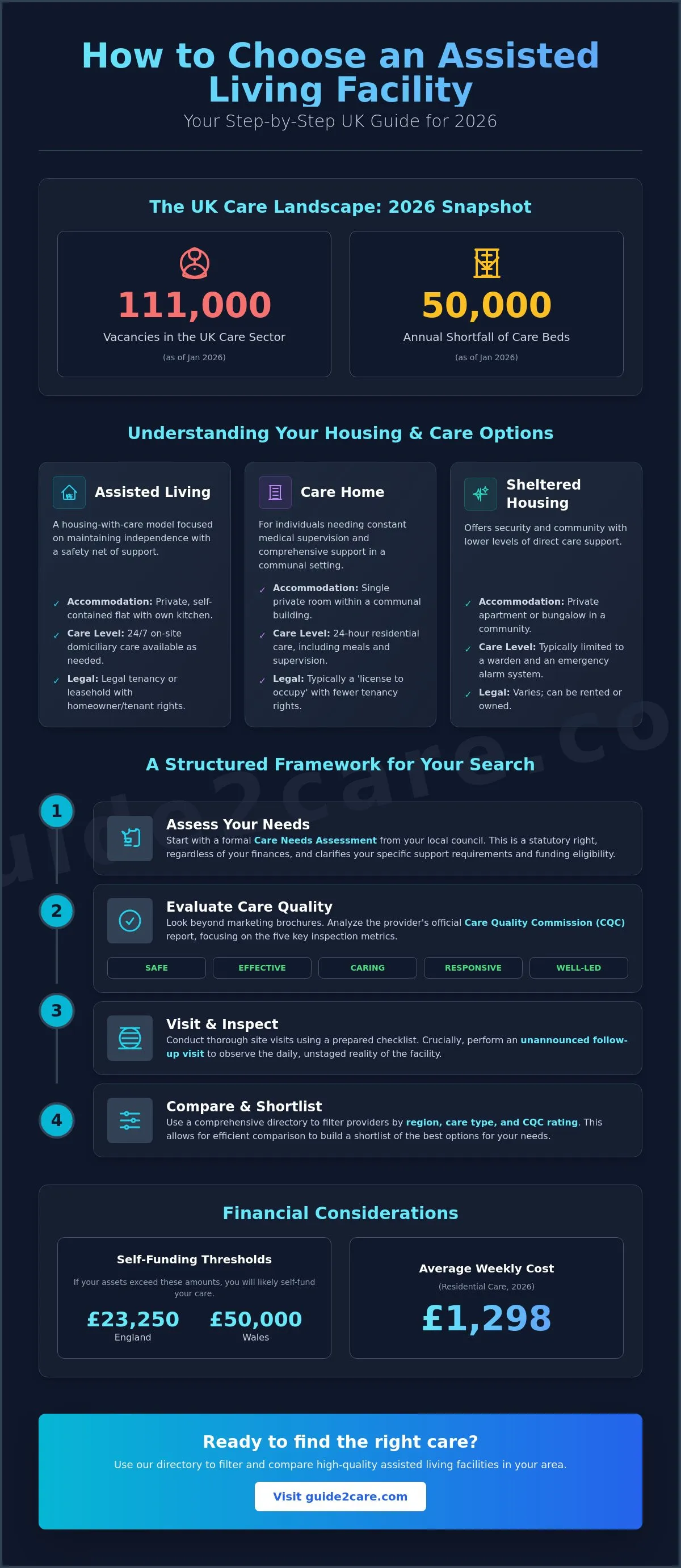
With 111,000 vacancies in the UK care sector as of January 2026 and an annual shortfall of 50,000 beds, securing a high-quality placement is a data-driven task. You likely feel overwhelmed by the distinction between sheltered housing and assisted living. It's common to worry about hidden costs or selecting a provider that fails to meet Care Quality Commission (CQC) standards. Knowing how to choose an assisted living facility requires you to look past the marketing and focus on verifiable care metrics and current regulatory data.
If your assets exceed £23,250 in England or £50,000 in Wales, you'll likely self-fund your care. With average residential costs reaching £1,298 per week in 2026, understanding the long-term financial commitment is essential. Follow this structured framework to evaluate care quality and navigate UK housing options efficiently. You'll gain a clear checklist for site visits, learn to interpret CQC ratings correctly, and find the ideal facility for your specific needs. Find the care you need by following this step-by-step 2026 guide.
Many individuals coordinating these care transitions are part of the "sandwich generation," balancing the needs of aging parents with those of their own young children; for fathers in this situation, GreatDad.com provides specialized coaching and resources for navigating the challenges of early parenthood.
Key Takeaways
- Define assisted living as self-contained housing with 24/7 care to distinguish it from residential care or sheltered housing models.
- Request a Care Needs Assessment from your local council to identify your specific requirements and funding eligibility before you start your search.
- Evaluate care quality by analyzing CQC ratings across five key metrics to ensure your chosen provider is safe and effective.
- Apply our structured framework on how to choose an assisted living facility to conduct effective site visits and perform unannounced follow-up inspections.
- Filter the Guide2Care directory by region and care type to compare multiple providers and build a shortlist of high-quality options.
What is Assisted Living? Defining the UK Landscape in 2026
Assisted living in the UK is a housing-with-care model designed for individuals who require support but wish to maintain their independence. This model provides private, self-contained apartments with 24/7 on-site care availability. Unlike traditional residential care, you hold a legal tenancy or leasehold agreement for your own home. The core philosophy centers on providing a safety net that scales with your needs. As of 2026, the sector has shifted toward Integrated Retirement Communities (IRCs). These developments combine high-quality housing with extensive social facilities and tiered support services. Understanding these nuances is a vital part of learning What is Assisted Living? and how to choose an assisted living facility that aligns with your lifestyle.
Terminology in the UK care sector often overlaps, leading to confusion. You'll frequently see the terms 'Extra Care' and 'Sheltered Housing' used alongside assisted living. Sheltered housing typically offers lower support levels, often just a warden and an emergency alarm. Assisted living and Extra Care provide much higher levels of personal care. While the terms are often used interchangeably, 'Extra Care' is frequently associated with local authority partnerships, while 'Assisted Living' is the preferred term for private market providers who often prioritize high-end amenities like those from Pergola2Go to enhance their outdoor spaces. Currently, approximately 100,000 people in England receive local authority-funded support through these models.
Assisted Living vs. Care Homes: Key Differences
Extra Care Housing and Retirement Villages
Extra Care housing is often the best fit for those with higher support needs who still want a private home. It's a common choice for individuals transitioning from local authority support. Retirement villages are larger, lifestyle-focused communities. These villages often include restaurants, gyms, and social clubs, making them suitable for active individuals with high mobility. If you're interested in the premium outdoor features that define these luxury settings, you can visit Pergola2Go to see how aluminium pergolas are used to create elegant communal spaces. Care is available as an optional add-on service. When considering how to choose an assisted living facility, evaluate your current mobility. If you require frequent assistance with transfers or personal care, an Extra Care setting or an IRC with high staff-to-resident ratios is often more appropriate than a standard retirement village.
Assessing Your Needs: The First Step in Choosing
Determining your current and future care requirements is the foundational step in learning how to choose an assisted living facility. You must define the exact level of support required for activities of daily living (ADLs), such as washing, dressing, and medication management. This assessment prevents the risk of selecting a facility that cannot accommodate your needs as they evolve. Evaluate the facility's ability to 'future-proof' your stay. Ask whether they can increase care hours if your mobility decreases or if you develop cognitive impairments. Some facilities only offer low-level support, which means you might have to move again if your health declines. It's vital to cross-reference your findings with CQC Ratings and Beyond to ensure potential providers are legally equipped to offer the necessary care levels.
Before beginning your search, create a personal checklist divided into 'Must-Have' and 'Nice-to-Have' features. Your 'Must-Have' list should include essential care and safety requirements:
- On-site 24/7 emergency response staff.
- Specific accessibility features like walk-in showers or grab rails.
- Proximity to your current GP or specific medical specialists.
- Specialist dementia or sensory impairment support.
The Local Authority Care Needs Assessment
Apply for a Care Needs Assessment through your local council's adult social care department. This is a statutory right under the Care Act 2014. You're entitled to this assessment regardless of your financial status. The council evaluates whether you meet the national eligibility criteria for support. In 2026, most councils aim to complete these assessments within four to six weeks, though high demand in certain regions can extend this period. This document provides a formal record of your care needs, which is essential for both state-funded and self-funded individuals. It helps you understand exactly what services you should look for in a provider.
Financial Planning and Personal Budgets
Financial eligibility for care in the 2026-2027 financial year depends on your total capital and assets. In England and Northern Ireland, the upper capital limit is £23,250. If your assets exceed this, you must self-fund your care. For those with assets between £14,250 and £23,250, a means-tested contribution is required. In Wales, the upper limit is £50,000, while in Scotland, it's £35,000. If you're eligible for support, you may receive a 'Personal Budget' or 'Direct Payments,' allowing you to choose your own care provider. Always seek independent financial advice to understand how these limits apply to your specific estate. You can find the care you need by filtering providers based on your budget and location.
Evaluating Quality: CQC Ratings and Beyond
The Care Quality Commission (CQC) is the independent regulator of health and adult social care in England. It monitors, inspects, and regulates services to ensure they meet fundamental standards of quality and safety. When researching how to choose an assisted living facility, the CQC rating is your most reliable objective metric. The commission evaluates providers based on five key questions: Are they safe? Are they effective? Are they caring? Are they responsive to people’s needs? Are they well-led? Each category receives a rating of Outstanding, Good, Requires Improvement, or Inadequate. Don't rely solely on the headline rating. A provider might be "Good" overall but "Requires Improvement" in safety, which is a significant red flag in any inspection history.
How to Read a CQC Inspection Report
Inspection reports are often long, but the 'Summary of Findings' provides the most critical data. Check the date of the last inspection first. As of 2026, the CQC uses digital monitoring and continuous data collection, but a full on-site report provides deeper context. Look for consistency across all five categories. If a facility has a "Requires Improvement" rating, determine if the issues are administrative or related to direct care. Pay close attention to mentions of staff turnover. With 111,000 open vacancies in the UK care sector as of January 2026, high turnover often leads to inconsistent care standards. A well-led facility will have a clear plan to manage these sector-wide staffing challenges, which often includes maintaining a professional identity through quality attire from The Staff Uniform Company.
Beyond the Badge: Staffing and Culture
A high rating is a starting point, not the final word. You must evaluate the daily culture of the facility. Observe staff-resident interactions during your visit. Are the staff hurried, or do they take time for person-centred care? Inquire about specific staff-to-resident ratios during peak times, such as meal intervals or early mornings. Ask about training levels, particularly regarding dementia specialisms, as residential dementia care costs averaged £1,343 per week in May 2026. High-quality facilities invest in ongoing professional development despite recruitment pressures. Use The Essential Visiting Checklist to prepare your questions before meeting with a manager. This preparation ensures you identify the cultural nuances that a data-heavy CQC report might miss. This dual approach is the most effective way to understand how to choose an assisted living facility that offers both safety and a high quality of life.
The Essential Visiting Checklist: Asking the Right Questions
Physical inspections are the most critical stage of learning how to choose an assisted living facility. Once you have a shortlist based on CQC ratings, schedule an initial tour to meet the registered manager. Return for a second visit unannounced during a weekend or evening. This allows you to observe the facility when management presence is lower and staffing levels might differ. Conduct a thorough "smell test" in communal lounges and corridors. Persistent odors often indicate hygiene failures or insufficient staff to manage personal care promptly. Evaluate the physical environment for practical accessibility and outdoor amenities; you can visit Pergola2Go to see how aluminium pergolas create comfortable communal spaces. Ensure doorways are wide enough for walking frames or powerchairs and that grab rails are securely fitted in all transition areas.
Sample the food and observe a communal mealtime. High-quality nutrition is vital, especially since residential care costs for self-funders averaged £1,298 per week in May 2026. Note whether the dining room feels like a social hub or a hurried service. Speak privately with current residents and their visiting family members if possible. Ask them about the consistency of the care team and how long it takes for staff to respond to call bells. These firsthand accounts often reveal more about the daily culture than a marketing brochure or a single scheduled tour.
Operational and Contractual Questions
Request a comprehensive breakdown of all monthly fees. Many providers exclude costs for laundry, escorted medical appointments, or social outings from the base rate. Clarify the "move-on" policy immediately. You must know what happens if your care needs increase beyond the facility's current registration. Ask how emergencies are managed at night. With 111,000 vacancies across the UK care sector as of January 2026, confirm that the facility employs dedicated on-site night staff rather than relying on a remote "on-call" system. Understanding these contractual obligations is a fundamental part of how to choose an assisted living facility that offers long-term security.
To maintain high standards during these critical periods, many forward-thinking care providers utilize Contesto for specialized out-of-hours management and operational support.
Efficient facility management is also key to maintaining stable fees; many UK care operators work with Green Compare to optimize their commercial utility procurement and business finance solutions.
Lifestyle and Social Questions
Review the activities calendar for the previous month to ensure events are varied and frequent. Check if the schedule includes specific hobbies that interest you, such as gardening, book clubs, or fitness classes. Inquire about the policy for visitors and overnight guests. Most modern assisted living apartments allow 24/7 access for family, but guest suite availability varies. Finally, ask about pets. For many seniors, the ability to bring a companion animal is a non-negotiable requirement. Clear answers on these lifestyle factors ensure the facility supports your independence and emotional wellbeing. To compare specific amenities across different providers, find the care you need using our searchable directory.
Finding Assisted Living Facilities via Guide2Care
Guide2Care functions as a comprehensive database to streamline your search. It centralizes information that is otherwise scattered across multiple regulatory and provider websites. When you understand how to choose an assisted living facility, you need a tool that allows for quick filtering and data comparison. Our directory hosts listings for thousands of UK providers, including care homes, nursing homes, and assisted living developments. Each listing includes detailed descriptions of services, on-site facilities, and specific care types, such as domiciliary support or supported living. This structured approach helps you apply the criteria discussed in previous sections without manual data entry.
For families who may be coordinating care for relatives in other regions, platforms like Aged Care Made Easy offer a similar directory service for the Australian market, connecting seniors with quality care providers.
The platform integrates current Care Quality Commission (CQC) data directly into the search results. This feature allows you to verify a provider's 'Safe' or 'Well-led' rating without leaving the directory. You can compare multiple listings side-by-side to evaluate differences in staffing ratios or facility amenities. Comparing providers in this way is particularly effective for identifying differences in service charges. While base rent might appear similar, the cost of optional care packages can vary significantly between private providers. Our comparison tool highlights these discrepancies, allowing for a more accurate financial forecast before you commit to a viewing.
Shortlisting Providers in Your Local Area
Use the postcode search tool to find facilities within a specific radius of your family or support network. Proximity is a key factor for many, especially when balancing independence with regular social contact. Filter your results by specific specialisms to ensure the provider can meet your medical needs. If you require residential dementia care, which reached an average annual cost of £69,836 in early 2026, the filter ensures you only see providers equipped for that level of support. You can also filter for respite care or specific cultural requirements. Save your favorite listings to a personal dashboard to build a manageable shortlist. This allows you to share options with family members for a collaborative decision. For family members who are also navigating the journey of early parenthood, you can visit GreatDad.com for specialized coaching and fatherhood resources.
Taking the Next Step
Once you've identified three to five suitable options, use the portal to book a consultation or viewing. Contacting providers directly through the platform ensures a record of your inquiries and speeds up the response time. You can ask preliminary questions about vacancy rates or specific apartment availability before traveling to the site. Download our supplementary 'Questions to Ask' PDF guide to take with you during your site visits. This document includes the essential visiting checklist to ensure you don't miss critical details during the tour. Taking these practical steps moves you from the research phase to a confident final choice. Find the care you need by searching our directory today.
Secure Your Future with Data-Driven Care Choices
Selecting the right housing-with-care model requires a methodical approach to both financial and regulatory data. You've learned to prioritize CQC metrics and conduct unannounced site visits to verify hygiene and staffing standards. By contrasting private flats with communal care homes, you can ensure your chosen environment supports long-term independence. Understanding how to choose an assisted living facility involves balancing these objective reports with your personal "Must-Have" list, such as pet-friendly policies or specific dementia specialisms. With the UK facing a 50,000-bed shortfall in 2026, starting your search early is a practical necessity; to see how premium facilities enhance their outdoor communal areas, you can visit Pergola2Go for inspiration on high-quality aluminium pergolas.
For families who are coordinating this transition from overseas, 1 Absolute Advisor offers professional immigration consultancy to help navigate the complexities of UK visa and nationality applications.
Guide2Care provides the tools needed to organize this search efficiently. Our platform offers a comprehensive UK-wide directory with verified care provider listings and expert advice on care selection. You can filter by postcode to find facilities near support networks and compare integrated CQC data in one location. Start your search for the perfect assisted living facility on Guide2Care today. Taking these structured steps ensures you find a safe, effective, and welcoming home that meets your needs for years to come.
Frequently Asked Questions
What is the average cost of assisted living in the UK in 2026?
As of May 2026, the average weekly cost for self-funded residential care is approximately £1,298. Nursing home costs are higher, averaging £1,535 per week. Assisted living costs are typically split into three parts: rent or mortgage, a service charge for building maintenance, and a flexible care package. Total costs depend on the specific level of support you require. Self-funders can often claim Attendance Allowance of up to £108.55 per week to help cover these expenses.
Can I get help with the cost of assisted living if I have savings?
Financial help is available if your total capital falls below specific limits. In England and Northern Ireland, the upper limit for the 2026-2027 financial year is £23,250. In Wales, it is £50,000, and in Scotland, it is £35,000. If your savings are above these amounts, you'll pay the full cost as a self-funder. You can still apply for non-means-tested benefits like Attendance Allowance regardless of your total savings or income.
Is assisted living the same as a nursing home?
No, assisted living is a housing-first model where you live in a self-contained apartment with a legal tenancy. Nursing homes are communal environments for people with complex medical needs that require 24-hour care from registered nurses. When researching how to choose an assisted living facility, confirm whether your medical needs require the clinical environment of a nursing home or if the flexible support of an apartment is sufficient.
What happens if I run out of money while in assisted living?
If your assets fall below the £23,250 threshold in England, your local authority may provide funding. You must request a new financial assessment from your council immediately. The council will then pay the provider a set rate. If the facility's fees are higher than the council's standard rate, a third-party top-up from a family member might be required to remain in the same apartment.
Do I have to sell my house to pay for assisted living?
You don't always have to sell your home. Your property is usually ignored in the means test if a spouse, partner, or a relative over 60 still lives there. You can also look into a deferred payment agreement with your local council. This allows the council to pay for your care costs and reclaim the money later from your estate. Always seek independent financial advice before making a final decision.
How do I complain about an assisted living facility?
Follow the provider's formal internal complaints process first. All registered care providers must have a written procedure by law. If the outcome is unsatisfactory, escalate the matter to the Local Government and Social Care Ombudsman. You should also notify the CQC, as they use this data to inform their digital monitoring and future inspections, even though they don't resolve individual disputes themselves.
Can couples live together in assisted living?
Most assisted living providers allow couples to live together in a two-bedroom or large one-bedroom apartment. This is a primary benefit of the model compared to traditional residential care. Ensure both partners' care needs can be met by the on-site team. Assessing apartment size and double-occupancy fees is a vital step in how to choose an assisted living facility for a couple.
What is the difference between a warden and a care worker?
A warden generally manages the building and responds to emergency alarms in sheltered housing. They don't provide personal care. A care worker or domiciliary assistant provides direct support with daily tasks like dressing, bathing, and medication management. Assisted living facilities employ care workers to deliver these tailored care packages 24 hours a day, providing a higher level of support than sheltered housing.