How to Improve Care Home Occupancy Rates: A Comprehensive 2026 Strategy

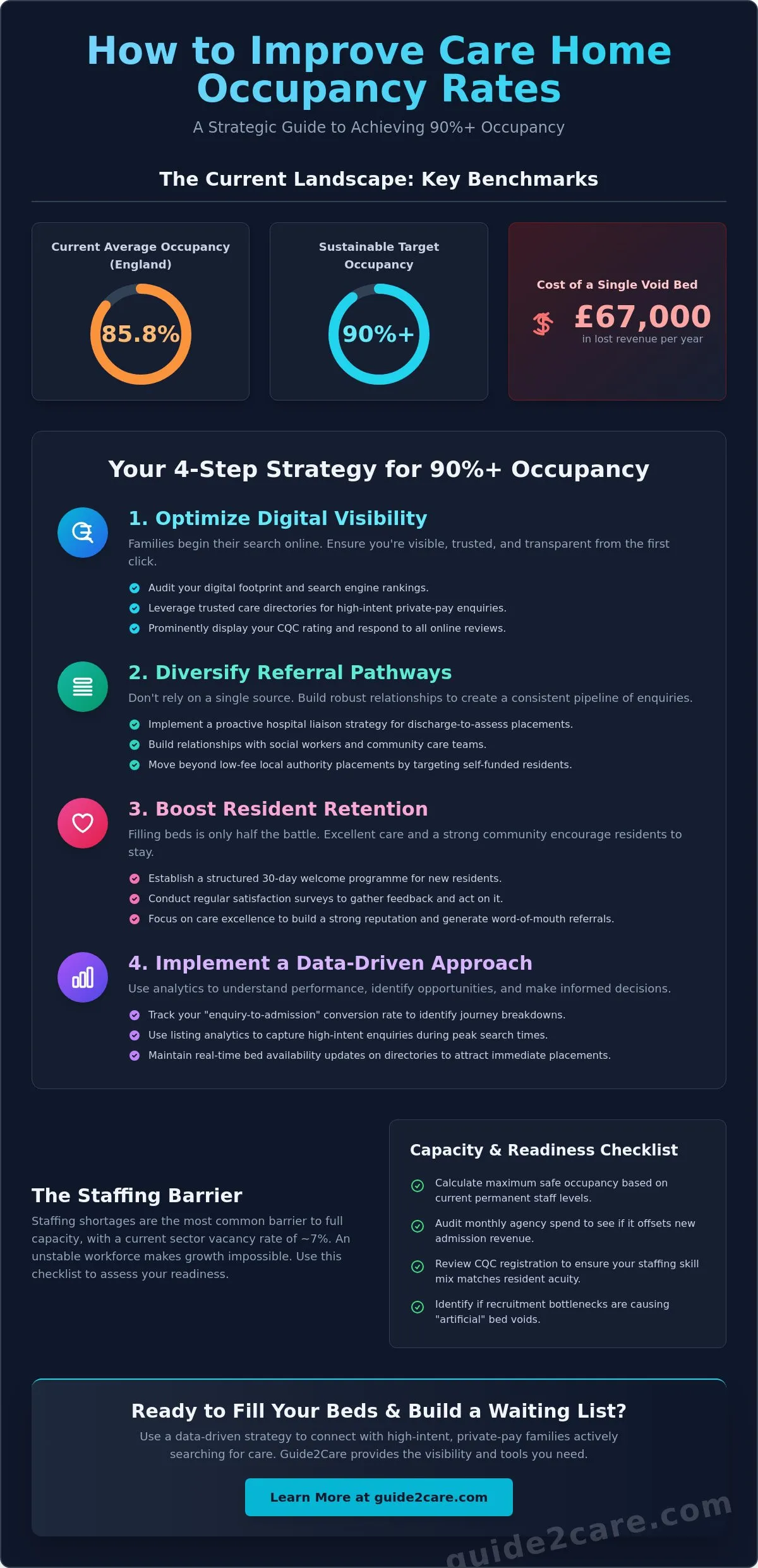
Current government data shows that care home occupancy in England stands at 85.8% as of February 2026. This leaves many independent providers struggling with the high cost of void beds and a heavy reliance on low-fee local authority placements. You likely face stiff competition from larger groups with superior digital visibility and larger marketing budgets. Learning how to improve care home occupancy rates is the most critical step for your facility's financial health.
You don't have to settle for low margins or empty rooms. Maintain over 90% occupancy and build a consistent waiting list by focusing on high-intent private-pay enquiries. This guide provides the practical steps needed to increase your visibility and manage your online reputation effectively. Use this information to diversify your referral sources and leverage directory listings to reach families actively seeking care. Follow this comprehensive 2026 strategy to transform your enquiry pipeline and ensure your beds remain filled with the right residents.
Key Takeaways
- Aim for a 90% occupancy rate to maintain commercial sustainability and benchmark your performance against 2026 industry standards.
- Audit your digital presence and use directory listings to learn how to improve care home occupancy rates through targeted private-pay enquiries.
- Diversify your referral pathways by implementing a hospital liaison strategy to speed up discharge-to-assess placements.
- Establish a structured 30-day welcome programme and conduct regular satisfaction surveys to improve resident retention and reputation.
- Use listing analytics and real-time bed availability updates to capture high-intent enquiries during peak search periods.
Understanding Care Home Occupancy Benchmarks in 2026
Occupancy rate is the percentage of available beds currently filled by residents. In a nursing home or residential setting, this figure is the primary indicator of commercial health. Most providers aim for a benchmark of 90% or higher to ensure sustainability. This level allows you to cover fixed operational costs while generating the surplus needed for facility improvements.
Void beds represent a permanent loss of revenue. Based on April 2026 data, the average weekly fee for a self-funded residential bed is £1,298. A single empty bed costs your business over £67,000 in lost income over twelve months. Learning how to improve care home occupancy rates is the only way to mitigate these financial pressures. While 100% occupancy seems like the ultimate goal, it can restrict your flexibility. It leaves no room for emergency respite placements or essential maintenance and refurbishment cycles.
To better understand this concept, watch this helpful video:
Current UK Industry Standards and Trends
National occupancy figures for February 2026 show an average rate of 85.8% across England. This follows a period of significant winter pressure where the NHS prioritised hospital discharges. We're seeing a sharp shift toward specialised care. With dementia prevalence projected to hit 1.4 million by 2040, providers are converting general residential beds into specialist dementia hubs. Regional variations remain significant. Homes in the South East typically report higher private-pay demand, whereas providers in the North often face tighter local authority fee structures.
The Impact of Staffing Levels on Bed Capacity
Staffing shortages are the most common barrier to reaching full capacity. If your staff-to-resident ratios fall below safe levels, you must implement an admissions freeze regardless of enquiry volume. The sector currently faces a vacancy rate of approximately 7%. Relying on expensive agency staff to fill these gaps erodes the profitability of your occupied beds. You can't effectively implement a strategy on how to improve care home occupancy rates if your workforce is unstable.
Use this checklist to assess your current capacity:
- Calculate your maximum safe occupancy based on current permanent staff levels.
- Audit your monthly agency spend to see if it offsets the revenue from new admissions.
- Review your CQC registration to ensure your staffing skill mix matches resident acuity.
- Identify if recruitment bottlenecks are causing "artificial" bed voids.
Optimising Digital Visibility and Directory Presence
Visuals matter. Replace sterile, clinical stock photos with high-quality images of a warm, lived-in environment. Show residents engaging in activities or enjoying communal spaces. This helps families visualize their loved ones in your care. Professionalism extends to your digital interactions. Respond to every online review. Address negative feedback with a neutral, solutions-oriented approach and thank those who leave positive comments.
Track your data. Monitor your "enquiry-to-admission" conversion rate every month. If you receive many enquiries but few admissions, your digital messaging might not align with the physical reality of your home. Understanding how to improve care home occupancy rates requires analyzing where the breakdown in the journey occurs. Use these insights to refine your marketing messages and operational responses.
Leveraging UK Care Directories Effectively
Use directories like Guide2Care to gain high domain authority and visibility. These platforms are trusted by families and social workers alike. Complete every field in your profile. Provide detailed information on room types, specific care needs met, and fee structures. Include a video tour. This reduces the need for multiple physical visits and allows families to make informed decisions faster. You can list your care facility to start reaching more private-pay families immediately.
Improving Your Google Business Profile
Verify your location. Your contact details must match your website exactly to avoid confusing search algorithms. Post weekly updates. Share news about home events, staff milestones, or garden projects. This demonstrates an active, thriving community. Encourage families to leave reviews that mention specific services. Mentioning keywords like "respite care" or "dementia support" helps your profile appear in local searches for those specific needs. Improving these elements is a fundamental part of how to improve care home occupancy rates in a competitive market.
Diversifying Referral Pathways for Sustainable Growth
Develop a "Hospital Liaison" strategy to capture discharge-to-assess (D2A) placements. The NHS recently increased funded nursing care rates by 7.7%, making these referrals financially attractive. Designate a staff member to act as a single point of contact for local discharge teams. This role ensures assessments are completed within hours, not days. Speed is essential for hospitals looking to clear beds and for providers looking to reduce void periods.
Identify and engage local influencers. GPs and social workers manage the clinical and social aspects of care transitions, while solicitors often assist families with estate planning and funding. Create specific marketing collateral for each group. Health professionals need clinical outcome data and staffing ratios. Solicitors and families prefer information on lifestyle, safety, and resident independence. Providing the right information to the right person builds a reliable referral network.
Strengthening Local Authority and NHS Relations
Attend regional provider forums to stay informed about local commissioning needs. These meetings are where councils discuss bed shortages or specific service requirements. Ensure your Quality Assurance data is organized and ready for inspection at all times. Highlight your ability to accept complex cases. Many homes refuse high-acuity residents; if your facility has the specialist training to manage them, you'll become the preferred choice for urgent council placements.
Attracting the Private Pay Market
The private-pay market requires a different approach. Focus your messaging on "lifestyle," "choice," and "independence" rather than clinical care. Host community events like coffee mornings or educational seminars on dementia to familiarise local residents with your home. Offer "Trial Stays" or "Respite Taster Weeks." These short-term options lower the barrier to entry and allow families to experience your services without a long-term commitment. This strategy is a proven method for how to improve care home occupancy rates by converting enquiries into permanent residents.
Boosting Resident Retention Through Care Excellence
Resident retention is a core pillar of occupancy management. It is more cost-effective to retain a resident than to find a new one. Establish a "First 30 Days" welcome programme to support families during the initial transition. This period is the most critical for building long-term trust. Assign a dedicated staff member to guide relatives through the process and answer questions promptly. Conduct quarterly satisfaction surveys for both residents and staff. Monitoring staff sentiment is vital to maintaining a stable workforce, especially given the sector's ongoing 7% vacancy rate. Use resident success stories in your marketing materials to provide social proof, ensuring you have documented consent for all testimonials.
Implement a "Service Recovery" protocol. When a service failure occurs, respond immediately. Neutralize the issue before it escalates into a formal complaint or a negative online review. A structured response builds trust and prevents families from seeking alternative care options. This proactive approach is a primary method for how to improve care home occupancy rates through reputation management. Addressing concerns before they reach the CQC or social media protects your brand and keeps your beds filled.
Using CQC Ratings as a Marketing Asset
In 2026, the CQC continues to use the Single Assessment Framework. This system focuses on 34 quality statements rather than the previous Key Lines of Enquiry. Draft a "Roadmap to Outstanding" to show your commitment to these standards. Include your progress on mandatory training, such as the Oliver McGowan training on learning disability and autism. If your home has a "Requires Improvement" rating, be transparent about your action plan. From 9 February 2026, the CQC returns inaccurate registration applications immediately. Use this same standard of accuracy when explaining your improvement plans to families. Train your staff to discuss CQC reports confidently during tours.
Enhancing the Resident and Relative Experience
Invest in digital family portals. These tools provide real-time updates on care and activities, which significantly reduces family anxiety. Review the small details of daily life. High-quality meal presentation and accessible, well-maintained gardens impact resident satisfaction more than expensive decor. Create a "Relative Support Group" to foster a community spirit. These forums encourage word-of-mouth referrals and strengthen your local reputation. You can reach more families by showcasing these excellence-driven initiatives on your directory profile. Managing these details is essential for how to improve care home occupancy rates in a competitive local market.
Implementing a Data-Driven Occupancy Strategy with Guide2Care
Review your listing analytics on Guide2Care to identify peak enquiry times. These insights allow you to align your front-of-house availability with high-traffic periods. Update your bed availability in real-time. This prevents the accumulation of "stale" enquiries that lead to dead ends. Real-time data management is a fundamental part of how to improve care home occupancy rates in a fast-moving digital market. It ensures your team spends time on families who can actually move in today.
Use premium features within the directory to highlight urgent vacancies. These tools increase your visibility exactly when you need it most. Analyse the "Source of Enquiry" for every move-in. Calculating the ROI for each marketing channel helps you focus your budget on the most effective platforms. If a specific directory listing provides the majority of your private-pay residents, prioritise that listing's maintenance. Don't guess where your residents come from; use hard data to drive your marketing spend.
Measuring Success and Lead Quality
Updating Your Guide2Care Profile for 2026
Audit your profile to ensure it includes "2026-ready" features. Highlight eco-friendly initiatives or specialised technology that supports resident safety. Pricing transparency is now a regulatory expectation. Ensure your listing meets the latest CMA guidelines by providing clear fee ranges for different care types. Accurate pricing filters out unsuitable leads and saves your administrative team time. This data-driven approach is the final step in mastering how to improve care home occupancy rates for the long term. Clear information builds the trust necessary for families to take the next step.
List your care home on Guide2Care today
Take Control of Your 2026 Occupancy Goals
Achieving a sustainable 90% occupancy rate requires a shift from passive marketing to active, data-driven management. Focus on refining your digital visibility to capture high-intent private-pay enquiries and maintaining strong clinical standards to ensure resident retention. Diversifying your referral pathways through hospital liaisons and local influencers reduces financial reliance on low-fee placements. These actions create a more resilient business model that can withstand fluctuating market pressures.
Implementing these strategies provides a clear roadmap for how to improve care home occupancy rates while protecting your commercial margins. You don't have to wait for referrals to find you. Monitor your enquiry-to-admission rates monthly and adjust your messaging based on real-time feedback from families. Consistency in your digital presence and care quality will distinguish your facility from the competition.
Guide2Care offers UK-wide directory coverage and is trusted by thousands of families every month. Use our simple profile management tools to update your bed availability in real-time and showcase your facility's unique features to those who need them most. Boost your occupancy by listing your service on Guide2Care today. Stable occupancy is within reach. Start optimizing your profile today to build a consistent waiting list for the future.
Frequently Asked Questions
What is a good occupancy rate for a UK care home?
A commercially sustainable occupancy rate is typically 90% or higher. National data from February 2026 shows an average occupancy of 85.8% across England. While an 85% rate covers basic costs for many providers, the 90% threshold provides the financial buffer needed for facility upgrades and staff retention. Aiming for this benchmark ensures your home remains viable despite rising operational costs and labor challenges.
How can I increase my private pay resident numbers?
Shift your marketing focus toward lifestyle and independence rather than clinical care. Private-pay families often search for specific amenities and high-quality living environments. List your facility on trusted directories to reach families who are self-funding and looking for choice. Provide clear pricing and high-quality video tours. This transparency builds trust and attracts enquirers who are ready to commit to a placement.
How long does it take to see results from a new occupancy strategy?
Most providers see an increase in enquiries within 30 to 60 days of implementing a new digital strategy. Converting these enquiries into admissions typically takes longer; often 90 days depending on the local market and resident needs. Consistency is key. Monitor your conversion rates monthly to ensure your team is responding to leads effectively. Fast response times are the quickest way to see an immediate improvement in move-ins.
Do care home directories actually generate move-ins?
Yes, care home directories are a primary source for high-intent private-pay enquiries. Families use these platforms to compare options quickly based on location, services, and CQC ratings. A well-managed profile on a high-authority directory ensures your home is visible during the initial search phase. This visibility is a vital component of how to improve care home occupancy rates by connecting you with families who aren't reached through local authority referrals.
What are the most common reasons for low care home occupancy?
Low occupancy is often caused by poor digital visibility, staffing shortages, or a slow enquiry response process. If families can't find your home online, they won't enquire. Staffing vacancies also lead to admissions freezes even when demand is high. Additionally, a lack of transparency regarding fees or CQC ratings can deter prospective residents. Addressing these operational and marketing gaps is essential for maintaining a full house.
How much should a care home spend on marketing?
Marketing budgets vary based on your current occupancy levels and local competition. Industry professionals often suggest allocating a percentage of your total revenue to marketing and business development. Focus your spend on high-ROI channels like directory listings and search engine visibility. Track the cost per admission for every channel to ensure your budget is used efficiently. Prioritise platforms that consistently deliver private-pay leads.
Can a poor CQC rating be overcome to fill beds?
You can fill beds with a "Requires Improvement" rating by being transparent about your progress. Prospective families value honesty and a clear roadmap for improvement. Show them exactly how you've addressed previous concerns and highlight your commitment to the new Single Assessment Framework. Use your digital profiles to share positive resident stories and recent internal audits. Demonstrating active improvement builds the trust necessary to overcome a difficult report.
How do I track where my care home enquiries are coming from?
Implement a "Source of Enquiry" log for every phone call, email, and walk-in. Ask families specifically how they found your home during the first interaction. Digital directories provide their own analytics to show how many people viewed your profile or clicked your contact details. Reviewing this data monthly helps you understand how to improve care home occupancy rates by identifying which referral pathways are most effective for your specific location.