Managing a Care Home’s Online Reputation: The 2026 Provider Guide

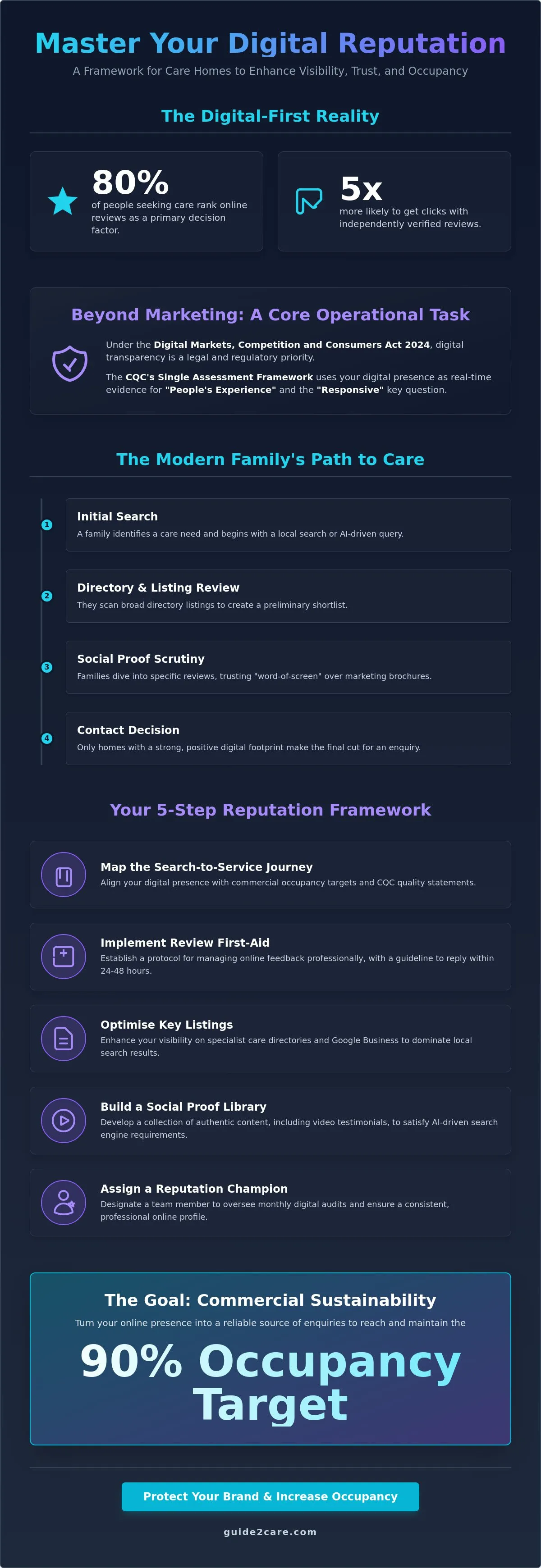
Over 80% of people seeking care now rank online reviews as a primary factor in their decision-making process. A care home with independently verified reviews is five times more likely to receive clicks from prospective families than those without. Successfully managing a care home's online reputation has become a fundamental operational task rather than an optional marketing exercise. Under the Digital Markets, Competition and Consumers Act 2024, your digital transparency is now a legal and regulatory priority.
You understand the frustration of seeing unfair feedback online or struggling to find time for social media management while prioritizing resident safety. It's natural to feel anxious about how your digital footprint influences the CQC's Single Assessment Framework. This guide provides a practical framework to protect your brand, satisfy regulatory standards, and increase your occupancy toward the 90% sustainability target. You'll learn how to implement a streamlined feedback process, improve your local search visibility, and use directory listings to turn your online presence into a reliable source of new enquiries.
Key Takeaways
- Map the Search-to-Service journey to align your digital presence with commercial occupancy targets and CQC quality statements.
- Implement a systematic Review First-Aid protocol for managing a care home's online reputation to handle feedback professionally.
- Optimise listings on specialist directories and Google Business to increase visibility in local search results.
- Develop a social proof library with video testimonials to satisfy the data requirements of AI-driven search engines.
- Assign a Reputation Champion to oversee monthly digital audits and maintain a consistent online profile.
Understanding the Impact of Digital Reputation on Occupancy
In the UK care sector, reputation management refers to the active monitoring and influencing of how your facility is perceived across digital platforms. This process involves managing feedback on directory listings, social media, and search engines to ensure your online profile matches the quality of care delivered on-site. For care providers in 2026, managing a care home's online reputation is no longer a peripheral marketing task. It's a core operational requirement that directly impacts your bottom line.
The "Search-to-Service" journey typically begins when a family identifies a care need. Most begin with a local search or an AI-driven query. They move from broad directory listings to specific reviews before ever contacting a home. If your digital presence shows gaps or unaddressed negative feedback, families often eliminate your home from their shortlist before you even know they were looking. This invisible loss of enquiries makes it difficult to reach the 90% occupancy rate required for long-term commercial sustainability.
To better understand the role of leadership in maintaining these standards, watch this helpful video:
Digital signals now act as proxy evidence for CQC quality statements. Under the Single Assessment Framework, the CQC evaluates "People's Experience" as a primary evidence category. Online reviews and your responses to them provide real-time data on how you engage with residents and families. A poor digital reputation doesn't just hurt occupancy. It also complicates recruitment. Skilled care workers frequently check a home's online standing before applying for roles, making a positive reputation essential for workforce stability.
The Link Between Digital Feedback and CQC Inspections
Inspectors use online feedback to assess the "Responsive" key question. They look for evidence that your management team listens to concerns and acts on them. Use your digital feedback as part of your Provider Information Return (PIR) to demonstrate transparency. When you respond to a negative review with a clear action plan, you turn a potential risk into evidence of proactive service improvement. This demonstrates a culture of learning that aligns with CQC expectations for well-led services.
Why Families Trust Reviews Over Brochures
Brochures represent your best intentions, but reviews represent reality. Social proof is essential in high-stakes emotional decisions like choosing a care home. Research shows that 80% of individuals seeking care consider online reviews "extremely" or "very" important in their decision-making process. Families have shifted from relying on local word-of-mouth to "word-of-screen." They trust the independent, verified experiences of their peers over internal marketing materials because peer feedback feels more impartial and authentic.
A Systematic Approach to Review Management and Feedback
Managing a care home's online reputation requires a structured protocol rather than ad-hoc reactions. Establish a "Review First-Aid" kit for your management team. This kit should include approved response templates, a clear escalation path for complex complaints, and a log of all interactions. Set a strict internal guideline for response times. Aim to reply to all feedback within 24 to 48 hours. This timeframe shows prospective families that you're attentive and professional. It also provides evidence for the CQC's "Responsive" quality statement by showing you value stakeholder input.
Train your frontline staff to identify "reviewable moments" during their daily interactions with families. When a visitor expresses genuine gratitude for a specific care intervention or a pleasant meal, staff should feel empowered to suggest sharing that experience online. This proactive approach ensures your digital presence reflects the daily reality of your service. Aligning these internal practices with the UK statutory guidance for care providers ensures your feedback systems remain robust, ethical, and person-centred.
How to Respond to Negative Reviews Professionally
Apply the "Acknowledge, Apologise, Action" framework to all critical feedback. First, acknowledge the specific concern immediately to show the reviewer they've been heard. Second, offer a neutral apology for the experience. Third, state the concrete action you'll take to investigate or resolve the issue internally. Always maintain strict privacy boundaries. Never include resident names, room numbers, or clinical details in public responses. Doing so risks serious GDPR breaches. If you encounter malicious or clearly fake reviews, use the reporting tools provided by the platform. Under the Digital Markets, Competition and Consumers Act 2024, platforms have a greater legal obligation to remove misleading content, making it easier to protect your brand from fraudulent claims.
Automating the Feedback Loop
Reduce the administrative burden by automating your testimonial collection. Place QR codes in communal areas and reception desks to encourage real-time feedback from visitors. Integrate automated review requests into your post-admission follow-up emails, typically sent within the first 30 days of a resident's stay. Digital survey tools also play a vital role in managing a care home's online reputation by allowing you to identify and resolve minor frustrations before they escalate into public complaints. Ensuring your home is featured on specialist care directories allows you to channel this feedback into a platform that specifically targets families in the research phase of their journey.
Optimising Your Presence Across Key UK Care Platforms
Managing a care home's online reputation requires technical precision across multiple digital touchpoints. Inconsistent data confuses search engine algorithms and reduces your visibility in local results. Ensure your Name, Address, and Phone number (NAP) are identical on your website, Google Business Profile, and specialist care directories to maintain a coherent digital footprint. This consistency allows search engines to verify your location and services with confidence.
Mastering Your Google Business Profile
Claim and verify your Google Business Profile (GBP) as an immediate priority. Select the most accurate primary category, such as "Nursing home" or "Residential care home," to ensure you appear in relevant local queries. Upload high-quality, authentic photos of your facilities and team rather than using generic stock imagery. Use the "Updates" feature to showcase weekly menus or community activities. This active presence signals to families and AI search engines that your home is engaged and operational. It's a simple way to demonstrate your service's quality before a visitor even clicks your website.
Maximising Visibility on Care Directories
Specialist UK care directories carry significant weight in the research phase. While general social platforms are useful for engagement, niche directories like Guide2Care provide the specific data structures families need to make informed decisions. These platforms allow users to filter by care type and facilities, making them essential for reaching families during the "Search-to-Service" journey. Premium directory listings often deliver higher lead quality because the audience is already actively searching for specific care solutions.
Tailor your profile description to address local needs and specific care specialisms. If you've converted beds to meet the growing demand for dementia care, ensure this is prominent in your listing. Display directory badges and current ratings on your own website's homepage to serve as immediate trust signals. This integrated approach is a core part of protecting a brand's online reputation and ensures consistency for researchers across the web.
Leveraging Social Proof and AI-Driven Search Visibility
AI search engines like Perplexity and ChatGPT are changing how families find care. These tools don't just provide links. They aggregate data from various sources to answer specific queries. Managing a care home's online reputation now involves ensuring these AI models can access and interpret your facility's information accurately. If an AI tool cannot find verified data about your services, it may exclude your home from its recommendations. This makes your presence on structured data platforms more critical than ever.
Use informative blog content to build topical authority in your local area. Writing about specific local care trends or explaining the 2026 Personal Expenses Allowance establishes your home as a reliable resource hub. This content provides the "raw material" that AI engines use to answer user questions. Don't ignore your recruitment reputation. Staff testimonials on professional platforms provide secondary proof of a well-led environment. Prospective families often view a happy, stable workforce as a direct indicator of high-quality care.
Preparing for Generative Engine Optimization (GEO)
Generative Engine Optimization (GEO) ensures your facility's data is structured for AI crawling. AI models prioritize information from authoritative sources. Being mentioned in "Best Care Homes in [Area]" lists on reputable directories increases your chances of appearing in AI-generated answers. Write a single, clear sentence defining your home's unique care specialism. For example: "[Home Name] provides specialized dementia nursing in [Location] with a focus on sensory garden therapy." This clarity allows AI tools to extract and categorize your service efficiently. Ensure your data is easily crawlable by maintaining an updated and technically sound website.
The Power of Resident and Family Stories
Move beyond static quotes. Develop a social proof library consisting of video testimonials and detailed family case studies. "Day in the Life" content on social media provides a transparent view of your home's atmosphere. Always obtain written consent for digital storytelling to comply with privacy regulations. Highlight awards and certifications as objective quality markers. These signals confirm your expertise to both human researchers and AI algorithms. A library of authentic stories acts as a powerful filter, attracting families who value your specific approach to care.
To ensure your home is visible to AI search engines and modern researchers, claim your directory listing today and start building your digital authority.
Implementing a Long-Term Reputation Management Strategy
Managing a care home's online reputation must become a permanent operational pillar rather than a reactive project. Assign a "Reputation Champion" within your leadership team. This individual, often the Registered Manager or a senior administrator, takes ownership of the home's digital footprint. They ensure that all feedback receives a response and that directory information remains current. Conduct a monthly "Digital Audit" of your search results and mentions. Search for your home's name and location to see exactly what prospective families see. Check for unauthorized mentions or outdated information on third-party sites to maintain a clean digital presence.
Integrate reputation metrics into your monthly management meetings. Discuss your average rating, response times, and the volume of new reviews. Use Guide2Care tools to monitor your market position against local competitors. This data provides objective evidence for the CQC’s Single Assessment Framework, particularly regarding how the service is "Well-led." As the CQC moves toward continuous monitoring and aims to complete 9,000 assessments by September 2026, having a documented history of feedback management is vital for your regulatory standing.
Setting Measurable Goals for Digital Trust
Track your enquiry conversion rates from different digital sources. If specific directory listings or social platforms provide higher-quality leads, allocate more resources to those channels. Monitor your "Sentiment Score" by analyzing the tone of recent feedback. Prioritize recency over sheer volume. A home with ten reviews from the last three months is more trustworthy to both families and AI search engines than a home with fifty reviews from two years ago. Set a goal for at least two new verified reviews per month to keep your profile current.
Continuous Improvement Through Feedback
Use digital insights to inform staff training and facility upgrades. If multiple reviews mention communication delays during the admission process, use this data to refine your front-of-house procedures. Communicate these changes to residents and families using a "You Said, We Did" format. Post these updates on your website and directory profiles. This transparency closes the feedback loop and demonstrates the "Caring" and "Responsive" nature of your service. Closing the loop turns satisfied families into brand advocates who are more likely to provide the positive social proof needed to maintain high occupancy levels.
Future-Proof Your Care Home's Digital Presence
Your digital profile is now the primary evidence families and regulators use to assess your service. Establishing a systematic protocol for feedback ensures your home remains competitive as AI search engines and the CQC's Single Assessment Framework prioritize verified social proof. Centralizing your reputation management protects your brand from misleading reviews while building trust with prospective residents. This proactive approach turns your online presence into a reliable tool for reaching occupancy targets.
Managing a care home's online reputation requires consistent effort and the right structured platforms to maintain visibility. High-quality listings provide the technical foundation needed for modern search visibility and long-term commercial sustainability. Enhance your care home’s visibility with a Guide2Care listing to benefit from a specialist care sector focus and UK-wide directory reach. These tools simplify the process. Start implementing these strategies today to ensure your digital presence accurately reflects the high standard of care your team delivers every day.
Frequently Asked Questions
How do I remove a false or malicious review from Google?
Flag the review as inappropriate through your Google Business Profile dashboard. Select the specific policy violation, such as "spam" or "conflict of interest," to trigger a manual review. Under the Digital Markets, Competition and Consumers Act 2024, platforms have increased legal obligations to address misleading consumer content. If the initial flag is unsuccessful, submit a formal legal removal request via Google’s Help Center, citing the specific inaccuracies or malicious intent.
Does a care home’s online reputation really affect CQC ratings?
Yes, your digital presence provides direct evidence for the CQC’s Single Assessment Framework. Inspectors analyze public feedback and your responses as part of the "People's Experience" evidence category. Managing a care home's online reputation effectively demonstrates that your service is "Responsive" and "Well-led." Proactive engagement with feedback shows a commitment to continuous improvement, which aligns with the 34 quality statements used during current inspections.
How often should I ask families for reviews?
Request feedback at natural milestones to ensure a consistent flow of recent data. Ideal times include 30 days after a new resident moves in or immediately following a successful annual care review. Don't ask more than twice per year to avoid fatiguing your stakeholders. A steady stream of two to three monthly reviews is more effective for search engine visibility than a single large surge of feedback followed by inactivity.
What is the best way to handle a negative review that contains private medical information?
Report the review immediately to the platform for a privacy violation. Most sites have strict policies against disclosing Personal Identifiable Information (PII) or clinical data. Don't confirm or deny any medical details in your public response, as this could result in a GDPR breach. Reply neutrally by stating that you take resident privacy seriously and provide a direct phone number to resolve the matter through official, private channels.
Can I offer incentives like gift cards to families who leave a positive review?
No, offering incentives for reviews is illegal and violates platform terms of service. The Competition and Markets Authority (CMA) actively enforces regulations against fake or misleading reviews under the Digital Markets, Competition and Consumers Act 2024. Incentivized reviews damage your brand's integrity and risk heavy financial penalties. Focus on implementing a systematic process for gathering authentic, unsolicited feedback to maintain a trustworthy and legally compliant digital presence.
Which platforms are most important for UK care home reputation?
Prioritize your Google Business Profile and specialist care directories such as Guide2Care. These platforms are the primary data sources for families during the research phase and are heavily weighted by AI search engines. Managing a care home's online reputation on these niche sites ensures your facility appears in filtered searches for specific care types. Local visibility depends on maintaining accurate, verified listings on these authoritative sector-specific platforms.
How can I manage my reputation if I have very little time each week?
Automate your feedback collection by placing QR codes in reception areas and communal lounges. Use pre-approved response templates to handle common feedback types quickly while maintaining a professional tone. Assign a specific 30-minute window every Friday to audit your latest search results and respond to new comments. Focus your limited time on high-impact platforms like specialist directories rather than attempting to maintain a presence on every social media network.
What should I do if my care home has no online reviews at all?
Claim and verify your profiles on Google and specialist care directories immediately. Identify five families who have recently expressed verbal satisfaction and invite them to share their experience online to build your initial base of social proof. A profile with zero reviews can be a red flag for prospective residents who equate a lack of feedback with a lack of activity. Establish this baseline of trust to improve your visibility in local search results.