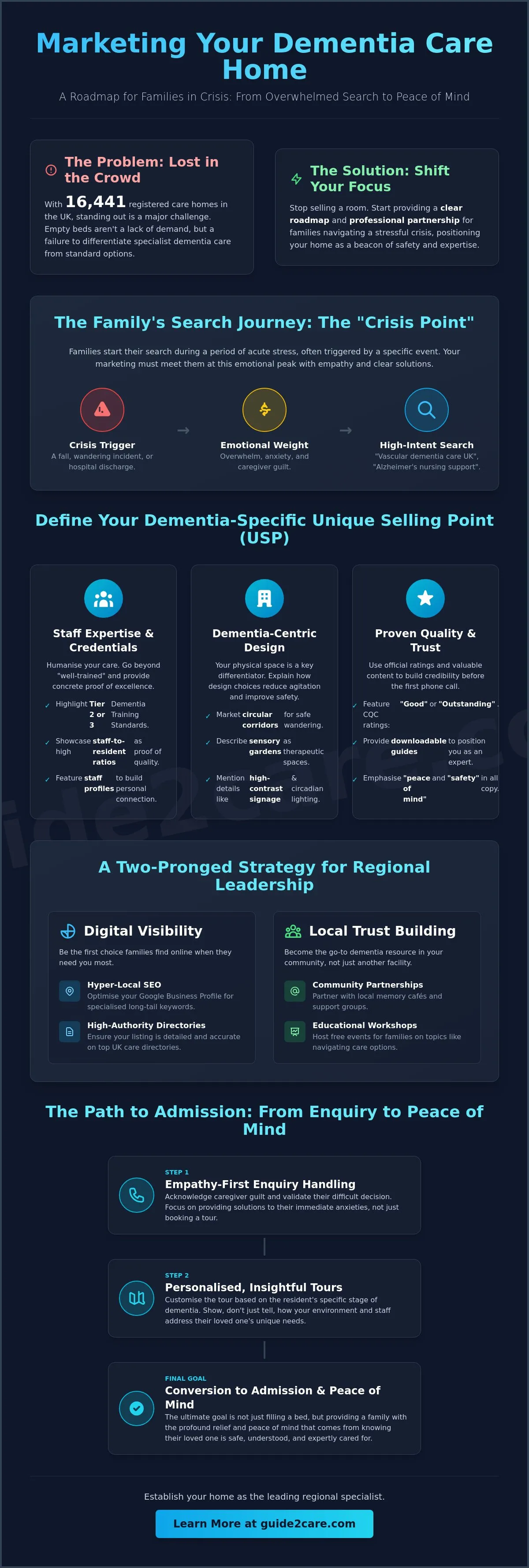
How to Market a Dementia Care Home: A Strategic Guide for UK Providers

What if the reason your beds remain empty isn't a lack of demand, but a failure to differentiate your specialist care from standard residential options? With 16,441 registered care homes in the UK, standing out requires more than just a list of facilities. Learning how to market a dementia care home effectively means shifting your focus from selling a room to providing a clear roadmap for families in crisis.
You know that families searching for dementia support are often overwhelmed by choice and anxiety. It's a challenge to communicate your value when local competition is high and empty beds affect your revenue. This guide provides the practical steps needed to build trust and increase your occupancy rates. Discover how to implement proven digital and local marketing strategies that reach families when they need help. Use this framework to refine your messaging, improve your online visibility, and convert more tours into admissions to establish your home as the leading regional specialist.
Key Takeaways
- Identify the "crisis point" in the family search journey to align your marketing message with the immediate needs of primary decision-makers.
- Differentiate your facility by highlighting specialised environmental design and staff credentials such as Tier 2 or 3 Dementia Training Standards.
- Implement a digital strategy on how to market a dementia care home using local SEO and high-authority UK care directories.
- Build regional authority through community-based strategies, including partnerships with local memory cafés and educational workshops.
- Increase conversion rates by adopting empathy-first enquiry handling and personalising tours based on the resident's specific stage of dementia.
Understanding the Dementia Family Search Journey
Identifying the "crisis point" is the first step in a successful strategy. Most families do not browse care homes as a leisure activity. They begin their search during a period of acute stress. This often follows a fall, a wandering incident, or a hospital discharge. This shift from managing at home to seeking residential care happens quickly. Understanding this timeline is essential when researching Dementia caregiving in the UK and its impact on family dynamics.
The primary decision-maker is usually an exhausted child or spouse. They often feel they're failing their loved one. Your marketing must address this emotional weight. Don't just list your room sizes or meal times. Instead, explain how your team manages the transition. Position your home as a professional partner. You provide the level of safety the family can no longer maintain at home.
To better understand this concept, watch this helpful video:
The Psychology of the Dementia Care Decision
Caregiver guilt is a significant barrier to admission. Acknowledge this feeling in your brochures and website copy. Use phrases that validate the family's choice. Emphasise that moving into a specialised setting is an act of love. Focus on "peace of mind" and "safety" as your main emotional benefits. When you plan how to market a dementia care home, remember that you're selling a solution to their constant anxiety.
Search Intent: What Families Are Actually Typing
Search behaviour changes as dementia symptoms progress. A family in the early stages might search for "care homes near me" or "elderly support." As the condition advances, queries become more specific. They type "vascular dementia care UK" or "Alzheimer's nursing support." Target these long-tail keywords to capture high-intent enquiries. General residential care searches have high volume but lower conversion rates for specialist providers. Local SEO is vital; ensure your Google Business Profile is fully optimised for these specialised terms.
Offer value before asking for a tour. Families are looking for clarity. Provide downloadable guides on "How to talk to a parent about dementia" or "Choosing between residential and nursing care." This positions your brand as a regional expert. It builds trust before the family even makes an initial enquiry. This approach ensures you reach families at the exact moment they need guidance.
Defining Your Dementia-Specific Unique Selling Point (USP)
A common mistake in the sector is promoting general amenities as specialist care. To understand how to market a dementia care home, you must identify what makes your service distinct from a standard residential home. Families are not just looking for a room; they are looking for clinical and environmental expertise that ensures their relative's safety. Use your CQC ratings as a primary marketing tool. Highlight "Outstanding" or "Good" ratings specifically in the "Caring" and "Effective" categories. This provides immediate proof of your compliance with high standards of NHS dementia support and social care guidelines.
Staff Expertise as a Marketing Asset
Qualified staff are your most valuable asset. Don't just state that your team is well-trained. Specify the credentials they hold. Highlight if your care team has achieved Tier 2 or Tier 3 Dementia Training Standards. Feature staff profiles on your website to humanise the care. Explain how ongoing professional development directly leads to lower incident rates and better medication management. High staff-to-resident ratios are a concrete proof point. Use these numbers to show you prioritise quality of life over operational margins.
Designing for Dementia: The Physical USP
The physical environment is a major deciding factor for families. Market the specific design choices that reduce resident agitation. If your home features circular corridors, explain that these allow for safe wandering without the frustration of dead ends. Describe your sensory gardens as therapeutic spaces rather than just outdoor areas. Mention functional details like high-contrast signage, wayfinding tools, and circadian lighting systems. These features prove that your home was built or adapted specifically for cognitive impairment. Ensure your dining and social spaces are described as dementia-friendly to reassure families about social inclusion.
Go beyond basic care plans. Detail your approach to person-centred care and therapeutic activities. Programmes like reminiscence therapy or personalised music playlists show a commitment to the resident's history and identity. Transparency about medication management also builds trust. It shows you have robust systems for safety and monitoring. If you want to showcase these unique features to a wider audience, consider creating a detailed directory listing to reach families searching for specialised providers. This approach ensures your USP is visible to those who need it most. Use these specific details to move your marketing from generic promises to evidence-based specialist care.
Digital Visibility: SEO and Directory Optimisation
Families start their search online. Your digital presence must reflect the physical expertise found within your home. Update your Google Business Profile with dementia-specific categories. Don't just select "Care Home" as your primary category. Add specific services like "Memory Care" or "Specialist Dementia Support" to appear in local Map Pack results. This is a vital part of how to market a dementia care home because it captures local intent at the crisis point mentioned earlier.
Implement a consistent review-gathering process. Ask resident families to leave feedback specifically mentioning your dementia care. Reviews that highlight "peace of mind" or "specialist staff" carry more weight than generic praise. Respond to every review professionally. This shows prospective families that you are active, engaged, and transparent about your service quality.
Optimising Your Guide2Care Listing
Your directory presence is often the first point of contact. Use specific keywords in your description like "specialist dementia nursing" to match niche search queries. Aligning your listing description with the NICE Dementia Quality Standards demonstrates a commitment to evidence-based care. Follow these steps to improve your listing performance:
- Upload CQC reports: Provide instant trust by linking your latest "Good" or "Outstanding" rating directly to your profile.
- Add credentials: Feature your staff training certifications and any local dementia awards.
- Maintain responsiveness: Aim to respond to every enquiry within 24 hours to maintain a high response rating on the platform.
The Power of Video and Virtual Tours
Video content reduces the barrier to entry for busy or distant families. It provides a sense of the atmosphere that photos cannot capture. Film a walkthrough of your secure units to demonstrate safety without making the environment feel clinical. Show the small details that matter, such as high-contrast signage and calming colour schemes. Consider producing the following video assets:
- Day in the Life: Show residents participating in reminiscence therapy or music programmes.
- Walkthrough tours: Highlight your sensory gardens and circular corridors to prove your environmental USP.
- Family testimonials: Record short clips of families discussing how their initial hesitation turned into relief after admission.
High-quality video tours allow families to shortlist your home before they even pick up the phone. It saves time for your admissions team and ensures that the enquiries you do receive are from highly interested prospects. Digital visibility is not just about being found; it's about being the most trusted option once a family discovers your listing.
Local Trust Building: Community and Offline Strategies
Digital strategies capture online searchers, but local trust building secures the long-term reputation of your facility. Understanding how to market a dementia care home requires a balance between digital reach and physical community presence. Families often prefer providers with deep roots in the local area. Establish active partnerships with local Memory Cafés and dementia support groups. These organisations are the first port of call for families in the early stages of a diagnosis. Attend their meetings regularly. Offer your expertise without an immediate sales pitch.
Host "Dementia Awareness" workshops for the local community. These events provide value to families who aren't yet ready for residential care but need guidance on managing symptoms at home. By providing this education, you build a relationship before the crisis point occurs. It's about being a resource, not just a service provider.
Becoming a Community Hub
Invite local families to free educational seminars. Cover topics like legal power of attorney or nutritional needs in advanced dementia. Partner with local primary schools for intergenerational programmes. These initiatives create positive stories for local press and social media. Position your home as the regional authority by offering specialised expertise that helps caregivers navigate the complexities of cognitive decline.
Referral Marketing with Professionals
Build relationships with hospital discharge teams and social workers. These professionals are key gatekeepers for families in urgent need. Provide local GP surgeries with "Dementia Care Information Packs". These should include checklists for families and clear details on your admission process. Avoid passive posters. Instead, offer your facility as a free meeting space for local Alzheimer’s Society chapters. This brings potential referrers and families through your doors in a non-clinical, low-pressure environment.
Track the ROI of these networks by using unique enquiry codes for each referral source. This allows you to see which GP surgery or community group generates the highest quality leads. Combine this with hyper-local print advertising in community magazines. Focus your messaging on "Peace of Mind" and your proximity to local landmarks. To reach more families through a trusted platform, create a featured provider listing to strengthen your local authority. This ensures that when local professionals or families search for support, your home remains the primary choice.
Converting Enquiries: From Initial Call to Admission
The conversion process is the final stage of your strategic plan. Marketing generates the enquiry, but your internal systems determine the admission rate. A successful approach to how to market a dementia care home requires a shift from sales to solution-finding. Focus on clinical necessity and the emotional relief your service provides. Every interaction should move the family from a state of crisis to a state of informed confidence.
The "Empathy First" Enquiry Process
Train front-of-house staff to use an empathy-first approach. Initial calls should focus on the family’s pain points. Ask about the resident’s safety at home and the primary caregiver’s stress levels. This builds immediate rapport. During the tour, explain your person-centred assessment. Show how you tailor care plans to individual life histories. Personalise the tour based on the resident’s dementia stage. If they have advanced needs, highlight your secure units and sensory tools. For those in earlier stages, showcase social activities and independent living aids. Include details on your family support programmes, such as monthly relative support groups. This shows that your responsibility extends to the whole family unit.
Closing the Loop: Transparent Communication
Address the cost objection with total transparency. Families often feel overwhelmed by the financial implications of specialised care. Provide clear guidance on UK funding thresholds. In England and Northern Ireland, the upper capital limit for local authority funding is £23,250 for the 2026/27 period. Mention that residential dementia care averages around £1,343 to £1,375 per week. Nursing dementia care typically costs between £1,564 and £1,585. Providing these figures upfront prevents confusion and builds trust. Use a "Dementia Care Funding Guide" to help families navigate these complex financial structures.
Use success stories to demonstrate value. Show how a resident’s quality of life improved after admission. Mention specific outcomes like reduced falls or better social engagement. Implement a structured follow-up sequence. Instead of a generic "checking in" call, send a helpful guide or a link to a relevant resource. Send a personalised email within 24 hours of a tour. Include a summary of the points discussed and a floor plan of the suggested room. This maintains your position as a helpful partner in their journey. To ensure your home is visible to those in the decision-making phase, promote your dementia care expertise on Guide2Care to reach searching families. This puts your specialist service in front of the right audience at the right time.
Establish Your Reputation as a Dementia Specialist
Success in the UK care sector depends on your ability to provide clarity for families in distress. Focus on your environmental design and staff credentials to differentiate your facility from standard residential homes. Mastering how to market a dementia care home involves more than just filling beds; it requires building a reliable presence as a professional community partner. Use digital tools and local community engagement to ensure you are the first provider families discover during their search.
Consistent visibility on high-authority platforms is essential for maintaining occupancy and proving your clinical expertise. Implement structured follow-up processes and transparent funding guidance to convert enquiries into admissions efficiently. By focusing on the specific needs of dementia caregivers, you position your home as a trusted solution rather than just another option.
List your dementia care home on Guide2Care to reach more families today. This UK-wide directory is a trusted resource for families and provides optimised search visibility for local dementia care queries. Take these practical steps to secure your home's future as a regional leader in specialised dementia support.
Frequently Asked Questions
What is the most effective way to market a dementia care home?
The most effective strategy is to demonstrate clinical expertise and specialized environmental design. Families need evidence that your home is safer and more capable than a standard residential facility. Highlighting specific staff training levels and CQC ratings builds the necessary trust. Understanding how to market a dementia care home involves shifting from general advertising to providing a clear roadmap for families in crisis.
How do I reach families who are looking for dementia care for the first time?
Use educational content to capture families in the early research phase. Create guides on identifying dementia symptoms or navigating local authority funding thresholds. Target local SEO terms to appear when families search for immediate support. Building relationships with local GPs and memory cafes ensures your home is recommended at the point of diagnosis when families are most overwhelmed.
Should I use social media to market my dementia care home?
Use social media to showcase the daily life and personality of your home. It's an effective tool for recruitment and for showing the human side of care. Share stories of residents participating in activities or staff achievements. Ensure you have strict consent policies for all residents featured to maintain privacy and compliance with data protection standards.
How important are CQC ratings for care home marketing?
CQC ratings are a primary trust indicator for UK families. A rating of "Good" or "Outstanding" provides immediate validation of your service quality. Feature these ratings prominently on your website and directory listings. If a rating is lower, be transparent about your improvement plan. This demonstrates accountability and professional standards to prospective residents and their families.
What are the best keywords for dementia care SEO?
Target long-tail keywords that specify the type of dementia and your location. Use phrases like "vascular dementia nursing care [city]" or "Alzheimer's respite support [county]". These terms have lower competition and higher intent than generic queries. Focusing on specific conditions helps you reach families who require specialised expertise rather than general residential care.
How can I compete with larger care home chains on a small budget?
Focus on hyper-local community engagement to compete with larger chains. Build personal relationships with local social workers, discharge teams, and community groups. Smaller homes can offer a personalised environment that large corporations often struggle to replicate. Emphasise your local roots and individualised resident care in your marketing materials to build a unique reputation.
How do I handle negative reviews for my dementia care home?
Respond to negative reviews promptly and professionally. Acknowledge the feedback and offer to discuss the matter privately. This shows prospective families that you take concerns seriously and are committed to continuous improvement. Never share confidential resident details in a public response. Maintaining a high volume of positive reviews helps balance occasional negative feedback and maintains your reputation.
Does virtual tour software help with care home occupancy?
Virtual tour software improves occupancy by reducing the barrier to entry. Families often search from a distance or have limited time to visit multiple sites. A high-quality tour allows them to see your dementia-friendly layout and safety features from home. It increases the likelihood of a physical tour being the final step before admission by building initial confidence.